
Desert Homes Interior: How the World’s Most Breathtaking Landscapes Are Redefining the Way We Live Indoors
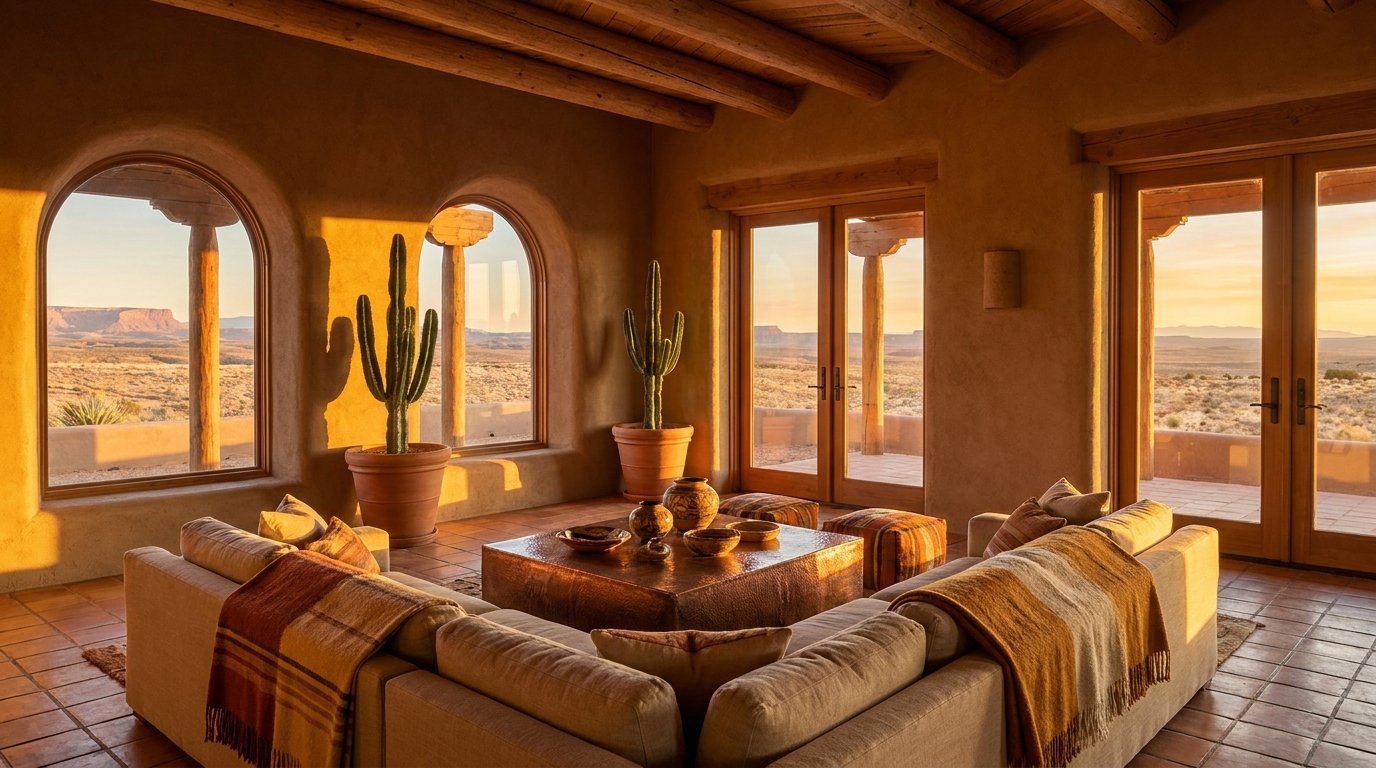
There’s something almost sacred about the desert — the way silence settles over the land like a warm blanket, the way golden light pours through wide windows at dusk and turns every surface into something luminous. Desert home interiors have captured something that modern design has been chasing for decades: the feeling of total, unhurried peace inside your own four walls.
—
1. Why Desert Interiors Feel Like a Deep Breath You Didn’t Know You Needed

Walk into a well-designed desert home and something shifts inside you. The noise of the world — the notifications, the deadlines, the mental clutter — seems to fall away almost instantly. That’s not an accident. Desert interior design is built on a philosophy of intentional restraint, where every object earns its place and every color was chosen to make you feel grounded rather than overwhelmed.
The palette is rooted in the earth itself: terracotta, sand, dusty sage, bleached linen, and the warm gray of sun-baked stone. These aren’t trendy colors pulled from a mood board — they’re the actual hues of the Sonoran Desert at noon, the Sahara at dusk, the Australian Outback at golden hour. When you bring them indoors, something primal in your nervous system recognizes them. You relax. You exhale.
“A desert home doesn’t decorate around nature — it invites nature in and lets her stay.”
Interior designers who specialize in Southwestern, Mediterranean, and modern desert styles often talk about this phenomenon. The goal isn’t to make a home look like the desert — it’s to make it feel like the desert feels: spacious, warm, unhurried, and deeply, quietly alive.
—
2. The Colors That Make a Desert Home Come Alive Without Screaming for Attention

Color in desert interior design is a conversation, not a monologue. The walls whisper rather than shout. A dusty terracotta wall doesn’t demand your attention — it simply holds the room together the way a canyon wall holds the sky. That’s the artistry of it.
The most popular desert color palettes work in tiers. The base layer is almost always a warm neutral — think raw linen, warm white, or pale sand. The mid-layer introduces earthy depth: deep rust, clay, muted olive, or smoked lavender, which appears naturally in desert wildflowers. The accent layer brings in the unexpected: a flash of turquoise from a ceramic pot, the almost-black of wrought iron hardware, or the rich burgundy of a hand-knotted rug.
What makes this approach so powerful is that it never looks overdone. There’s no moment where the eye snags on something that feels out of place. The whole room feels like a single, living exhale — cohesive without being cookie-cutter, layered without being busy.
—
3. The Textures That Turn a House Into Something You Can Almost Taste
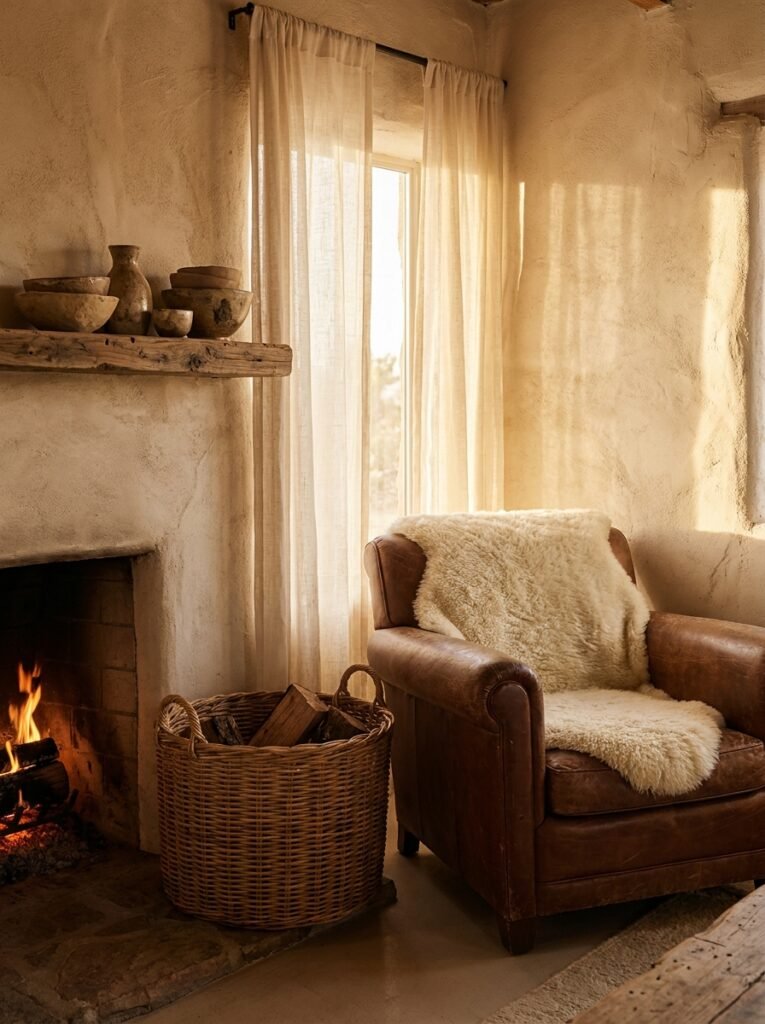
Imagine running your hand along a rough adobe wall — the slight give of the plaster, the warmth it holds from an afternoon in the sun. Now imagine that feeling captured inside your living room. That’s exactly what desert interior design does with texture, and it does it brilliantly.
Texture is the unsung hero of this design style. Because the palette is deliberately restrained, texture has to carry enormous visual and tactile weight. Rough-hewn wood beams crossing a ceiling. A sheepskin throw draped over a leather armchair. Woven rattan baskets stacked beside a fireplace. Hand-thrown ceramic vessels clustered on a shelf. Linen curtains that catch the light and hold it softly.
Each of these elements adds a layer of sensory richness that keeps a room from feeling flat or cold. The great paradox of desert design is that a room with so few colors feels so deeply full — because every surface has something interesting to say with its texture, grain, or weave.
—
4. Natural Materials: Why Desert Homes Choose Authenticity Over Perfection
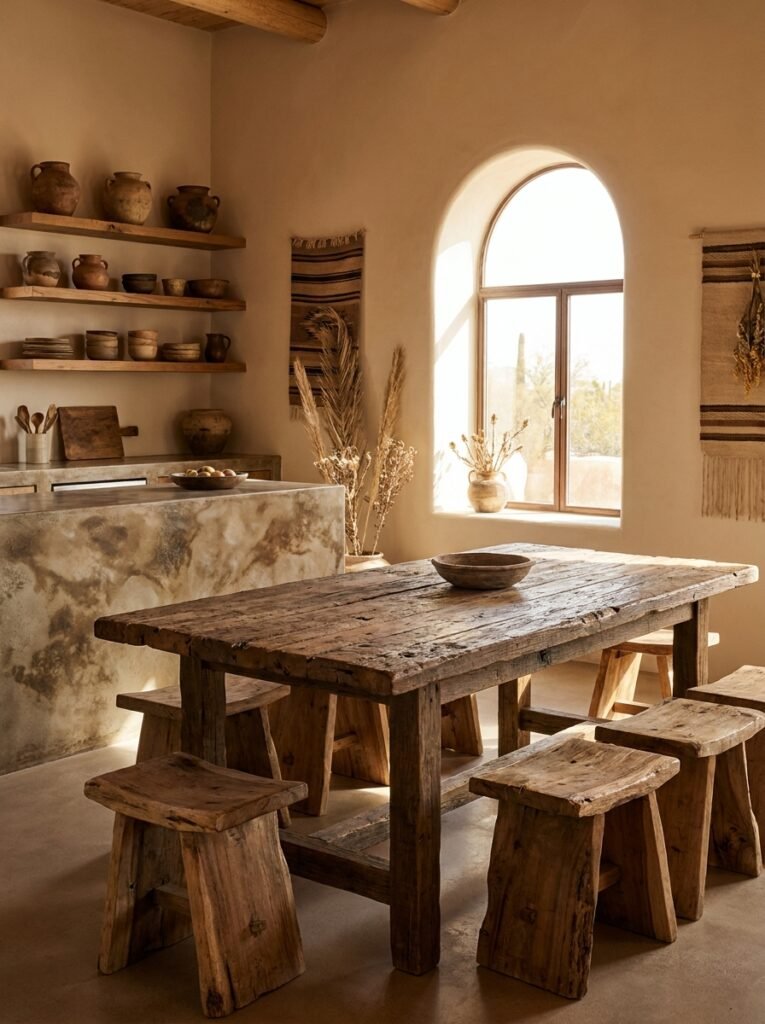
In a desert home, nothing is trying to look like something it isn’t. Wood looks like wood — weathered, grained, imperfect, beautiful. Stone looks like stone. Clay looks like clay. This commitment to authentic materials is one of the deepest design principles of the style, and it’s one of the reasons desert interiors age so gracefully.
Mass-produced, overly polished finishes tend to feel anonymous after a while — like a hotel room rather than a home. But a reclaimed wood dining table, a hand-carved wooden stool, a concrete countertop with natural variation in its tone — these pieces only get better with time. They develop patina. They hold stories. Every scratch or worn edge becomes part of the home’s character rather than a sign of neglect.
Sustainable design advocates love desert interiors for exactly this reason. When you build around natural, durable, locally sourced materials — adobe bricks, local stone, reclaimed timber — you’re creating a home that’s not just beautiful but also responsible. The desert has always demanded that kind of respect.
—
5. The Architecture That Makes Desert Interiors Possible
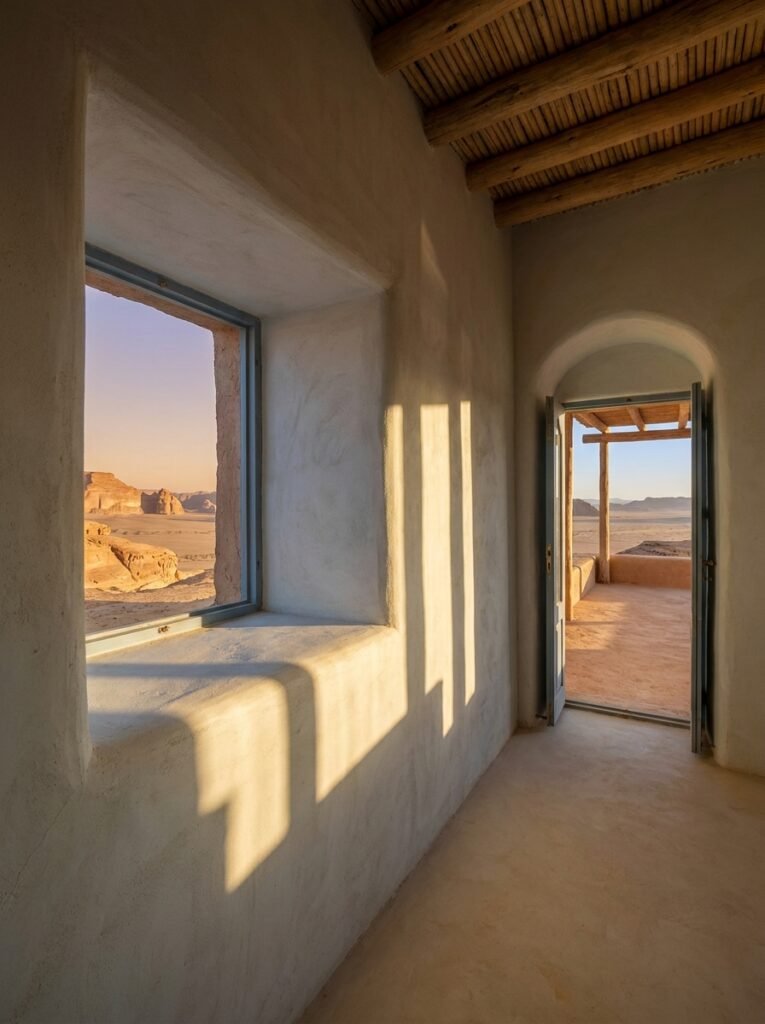
You can’t talk about desert home interiors without talking about the architecture that frames them. The two are inseparable — and understanding this relationship helps you bring desert design principles into almost any home, regardless of where you live.
Traditional desert architecture features thick walls designed to absorb heat during the day and release it slowly at night — a passive cooling system that’s been working for thousands of years. These walls create deep window recesses that frame views of the landscape like living paintings. They create a sense of shelter and solidity that modern construction often sacrifices for speed and cost.
“The thick walls of a desert home don’t keep the world out — they hold the good parts in.”
Flat or low-pitched roofs, covered outdoor patios called ramadas or portales, and interior courtyards open to the sky are all hallmarks of traditional desert architecture. When you design interiors to honor these features — letting the architecture breathe, keeping sightlines open, choosing furniture that doesn’t compete with the view — the result is something genuinely extraordinary.
—
6. Bringing the Outdoors In: Plants That Belong in a Desert Interior
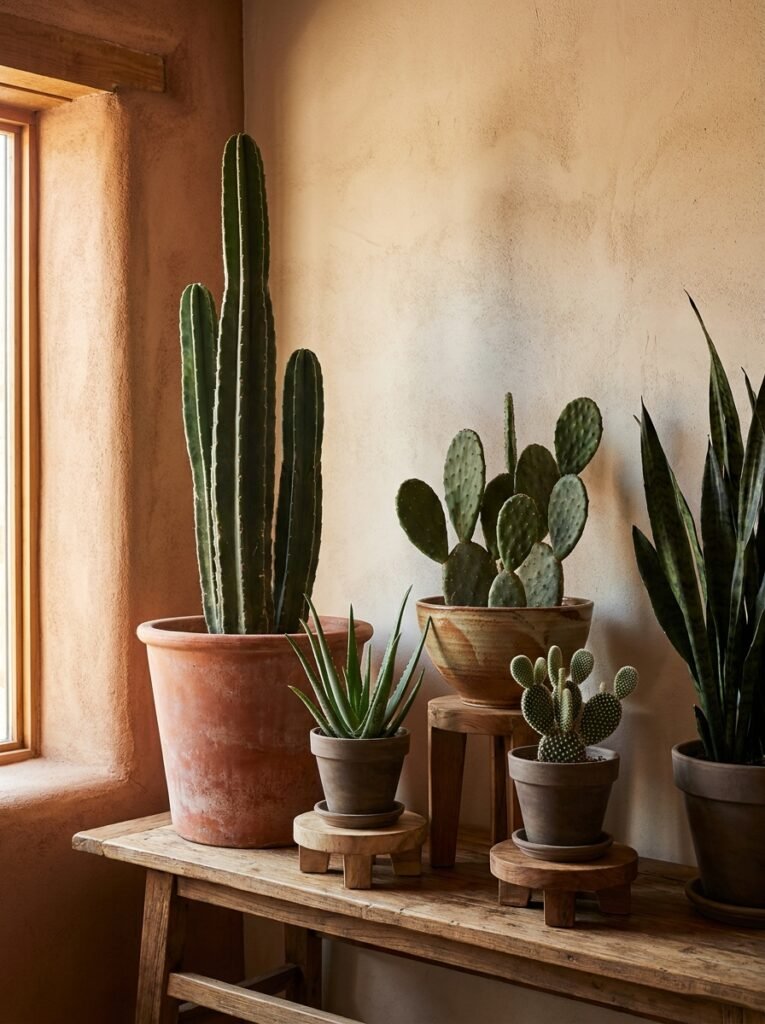
The idea of bringing plants into a desert-inspired interior might seem paradoxical — isn’t the desert supposed to be spare and minimal? But nature in the desert is anything but empty. It’s restrained, yes — but fiercely alive. And a desert home interior reflects that same quality.
The plants that work best in desert interiors are those that belong in the ecosystem: tall saguaro-style cacti in terracotta pots, sprawling paddle cactus, sculptural aloe vera, clustering bunny-ear cacti, or dramatic euphorbia. Succulents of every variety add organic color and shape without demanding much care. Snake plants — with their upright, architectural form — feel perfectly at home against an adobe-textured wall.
What makes these plants special in a desert interior context isn’t just their aesthetic fit — it’s the way they reinforce the home’s core values. They’re independent. They thrive with minimal intervention. They don’t need much to be beautiful. Sound like any other design philosophy you’ve heard?
—
7. Lighting in Desert Homes: How to Recreate That Golden Hour Glow Indoors
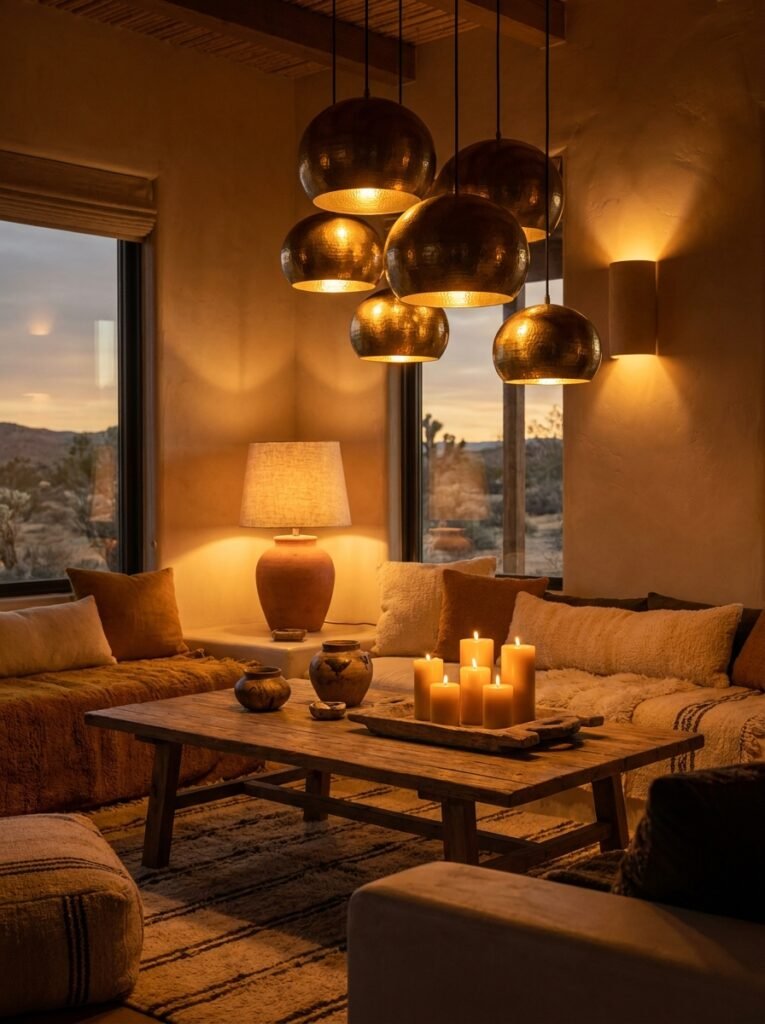
If you’ve ever stood in the desert at golden hour — that magical forty-five minutes before sunset when the whole world turns amber and the shadows go long and blue — you understand exactly what desert interior lighting is trying to achieve. Not the harsh white light of productivity. The warm, living glow of late afternoon.
Layered lighting is essential. Start with warm-toned LED bulbs (2700K or lower) as your base layer — cool lighting will undo every warm, earthy choice you’ve made everywhere else. Layer in ambient sources: a cluster of pendant lights in hammered brass or rattan, a terracotta table lamp with a linen shade, wall sconces that cast light upward and create soft shadows along textured walls.
Candles play a surprisingly important role in desert home interiors. Pillar candles in beeswax or unscented cream tones, grouped in varying heights on a wooden tray, recreate something of that campfire intimacy that has always been central to desert living. And at night, when warm candlelight flickers against textured walls, the room comes alive in a way no overhead fixture can manufacture.
—
8. The Desert Kitchen: Where Function Meets the Beauty of Honest Materials
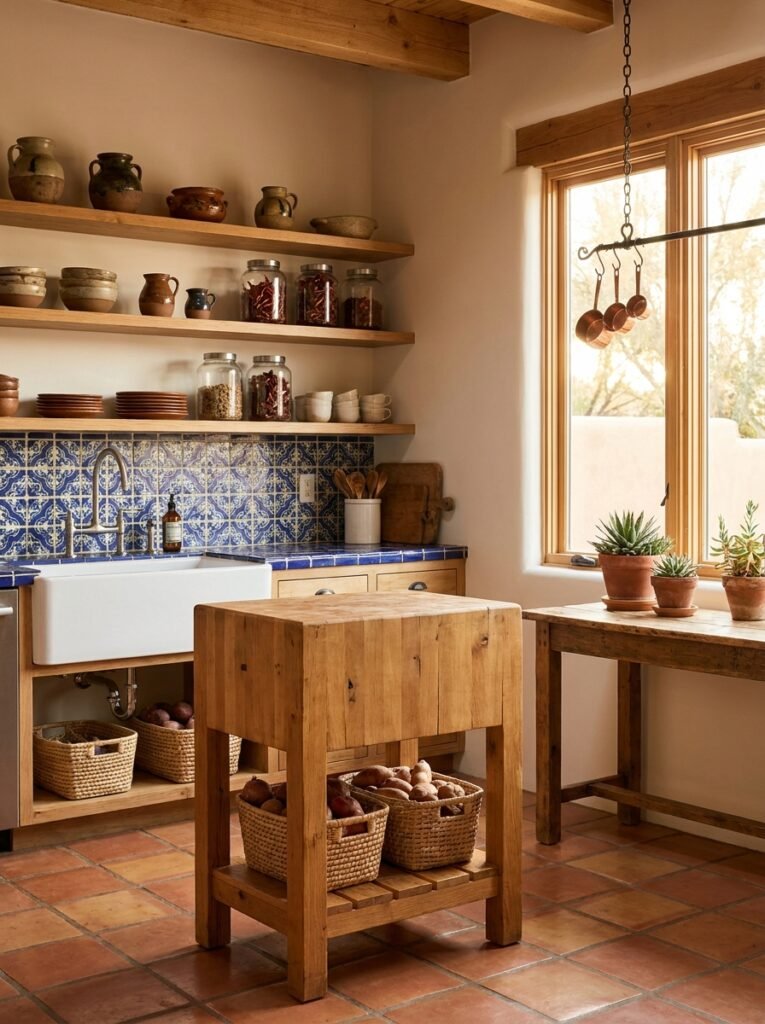
A desert home kitchen is one of the most satisfying rooms to design because it perfectly marries beauty and practicality. Nothing is frivolous here. Everything is chosen with care and used with intention — and yet the result feels deeply inviting rather than clinical.
Imagine terracotta tile floors worn smooth by years of foot traffic. Open wooden shelves displaying hand-thrown pottery, copper measuring cups, and glass jars filled with dried chiles or mesquite beans. A deep farmhouse sink in matte white against a Talavera tile backsplash — those hand-painted blue and white tiles that tell a story of Spanish colonial influence and centuries of craft. A butcher block island with a rough-sawn edge. Woven baskets storing root vegetables.
The desert kitchen isn’t obsessed with perfection. It’s obsessed with warmth. It’s the kind of kitchen where you want to make a pot of green chile stew from scratch, where the slow simmer of something good on the stove feels like the most natural thing in the world.
—
9. Small Desert Spaces: How to Design a Cozy, Inspired Interior Even Without Square Footage
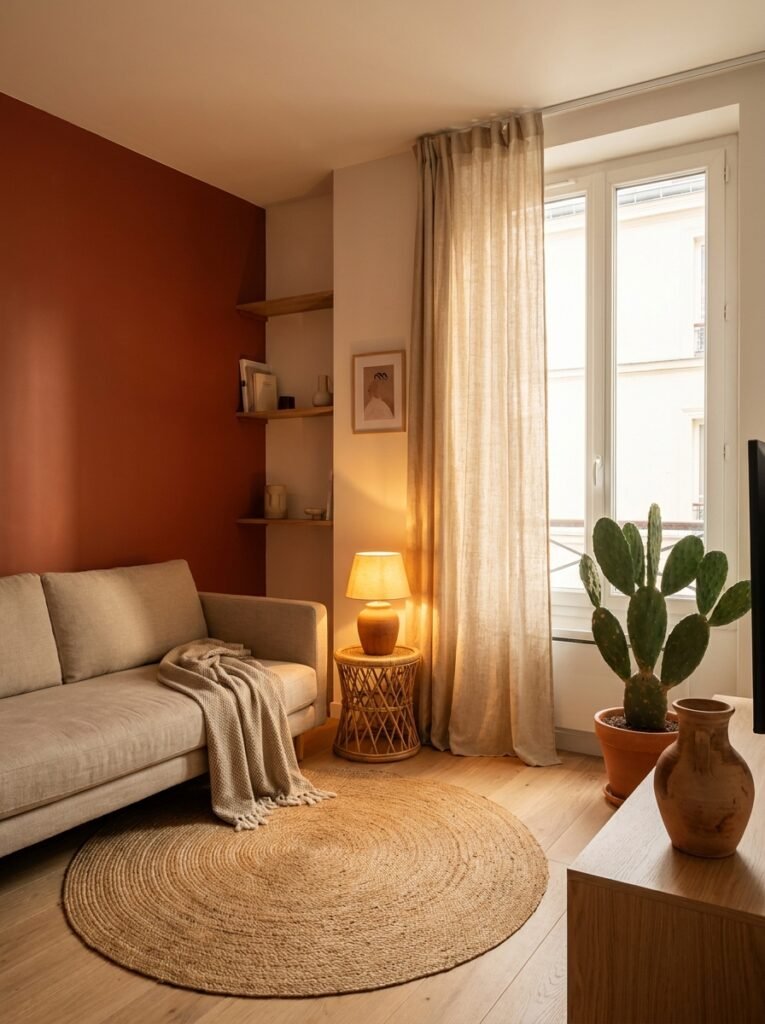
One of the most generous things about desert interior design principles is how beautifully they scale down. You don’t need a sprawling ranch house or a Scottsdale estate to bring this aesthetic into your home. A studio apartment in a city can feel like a desert sanctuary with the right choices.
Start with color — it costs nothing to paint a wall terracotta or sand. Then focus on one or two quality natural materials: a small jute rug, a rattan side table, a linen curtain. Choose furniture with clean lines and low profiles, which makes rooms feel more open. Declutter ruthlessly, because desert design is about what you choose to keep, not how much you can accumulate.
“In desert design, space itself is the luxury — and you can create it anywhere.”
Add one or two sculptural cacti, a hand-thrown ceramic vase, and a warm-toned lamp. Step back. You’ll be surprised how quickly a room transforms when the principles are right — even without the budget or the square footage you think you need.
—
10. The Desert Living Room: Designing a Space That Invites Long Conversations
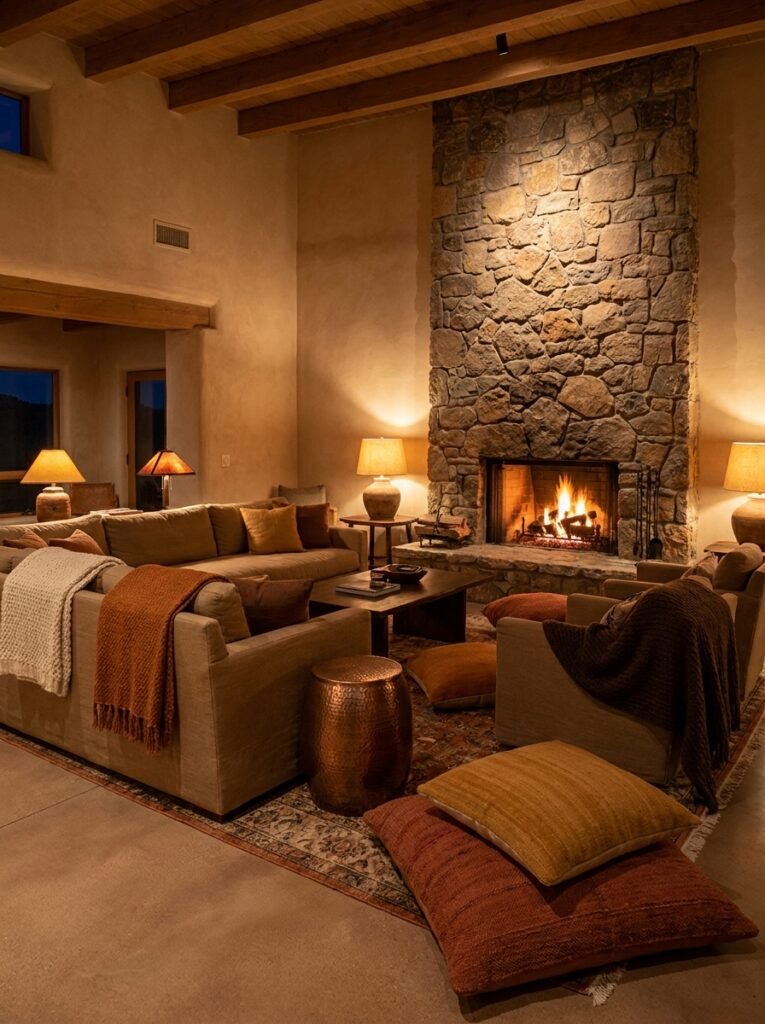
There is something about desert homes — and particularly their living rooms — that invites people to stay. To linger. To sink into a deeply cushioned sofa and let hours pass without guilt. This isn’t accidental. Desert living room design is built around the idea of gathering.
Furniture is arranged for conversation, not for television-viewing (though of course TVs exist here too). A deep sectional in warm linen or natural leather. A low coffee table in dark wood or hammered copper. Floor cushions in rust and ochre for overflow seating. A fireplace — real or ethanol — as the room’s emotional anchor. Woven wool blankets folded over the back of chairs because the desert, for all its warmth, gets genuinely cold at night.
The fireplace deserves special mention. In desert cultures across the world — from the pueblos of New Mexico to the riads of Morocco — the hearth has always been the heart of home life. Designing a living room around a beautiful fireplace isn’t nostalgic. It’s deeply, enduringly human.
—
11. Desert Bedrooms: Designing a Sleep Sanctuary That Feels Like a Private Retreat
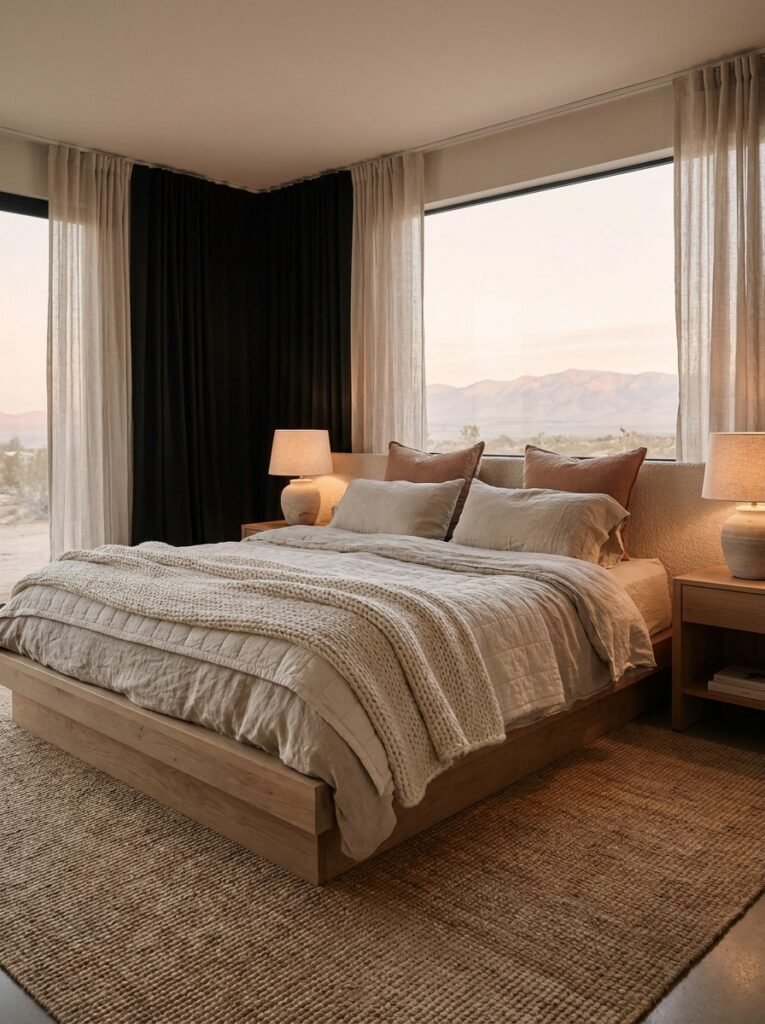
The desert teaches you something important about rest: that stillness is not the absence of life. It’s the fullness of it. A well-designed desert bedroom holds that truth in everything it contains.
Keep the palette intimate and muted: warm white walls, linen bedding in natural or dusty rose, a woven jute rug underfoot. Use layering to create depth — a quilted coverlet, a chunky knit throw, a stack of pillows in natural linen and faded terracotta. Furniture should be simple and solid: a platform bed in natural wood, a pair of ceramic table lamps, a low dresser with simple hardware.
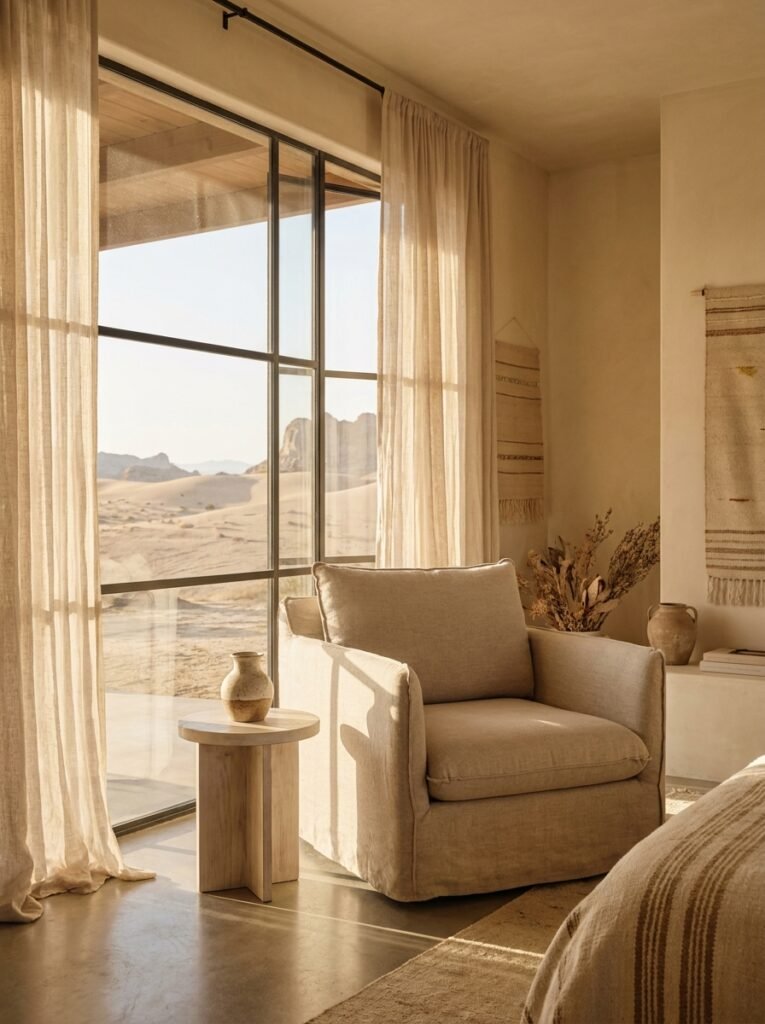
The window treatment matters enormously in a desert bedroom. Sheer linen panels allow morning light to filter in gently — and if you’re in an actual desert location, to frame a view of open sky or distant mountains. Blackout curtains layered beneath keep the room dark when you need real rest. This combination of translucency and control mirrors the desert’s own relationship with light: abundant, warm, and completely on its own schedule.
—
12. The Modern Desert Aesthetic: How Contemporary Design Is Reimagining an Ancient Style
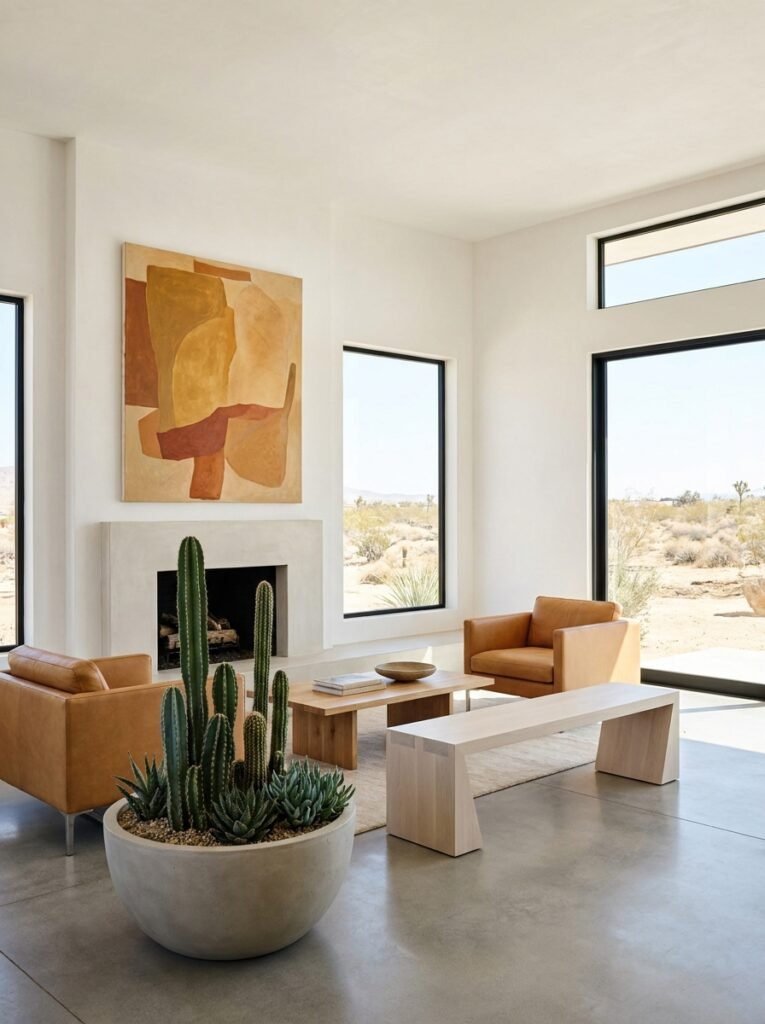
Desert interior design has always had a history — but today’s designers are doing something thrilling with it. They’re taking the ancient foundations of adobe, clay, and organic material and weaving them into the vocabulary of contemporary minimalism. The result is a style that feels simultaneously timeless and entirely of the moment.
Modern desert interiors often feature clean architectural lines — no ornate molding, no decorative excess. But they fill those clean lines with warmth: a single large abstract painting in desert tones, a sculptural cactus arrangement in a matte ceramic vessel, a fireplace surround in smooth concrete. The effect is one of sophisticated calm — a room that could belong to a contemporary art collector who also knows how to bake sourdough and tends a small herb garden.
This synthesis of old and new is perhaps the most exciting development in desert interior design today. It proves that this aesthetic isn’t a regional style trapped in a particular era. It’s a living, evolving design language — one that anyone, anywhere, can speak fluently in their own home.
—
🌿 How to Take Care of Your Desert-Inspired Interior
Maintaining the integrity of a desert home interior isn’t complicated — but it does require a certain kind of mindfulness. Here’s how to keep it feeling fresh, grounded, and genuinely alive over time.
First, protect your natural materials. Seal terracotta tile regularly to prevent staining, oil wood surfaces annually, and treat leather furniture with a natural conditioner every few months. These materials age beautifully when cared for — but they’ll look tired and neglected without minimal maintenance.
Second, edit regularly. Desert design lives and dies by restraint. Every few months, walk through your space and ask honestly: does this object earn its place? Does it add warmth, meaning, or function? If not, it’s worth letting it go. A curated space always feels more intentional than a crowded one.
Third, refresh with plants. Cacti and succulents are famously low-maintenance, but they do need occasional repotting, proper drainage, and bright indirect light. Rotate them occasionally to encourage even growth, and water only when the soil is completely dry. A healthy plant in a beautiful terracotta pot is one of the highest-return investments in desert interior design.
Finally, pay attention to scent. Desert homes often incorporate natural fragrance — a candle with notes of sage, cedar, or copal resin; dried herb bundles hung near windows; or a diffuser with frankincense and sandalwood. Scent is one of the most powerful design tools we almost never talk about, and in a desert interior, it completes the sensory picture in a way that’s genuinely unforgettable.
—
❓ FAQ
Q: Do I need to live in a desert climate to use this interior design style? A: Absolutely not. Desert interior design is a philosophy and an aesthetic — not a geographic requirement. The warm palettes, natural materials, and restrained approach to decoration translate beautifully into urban apartments, suburban homes, and cottages in cooler climates. If anything, bringing desert warmth into a cold or grey environment can feel even more transformative.
Q: What’s the best way to start transforming a room with a desert aesthetic on a limited budget? A: Start with paint — it’s the highest-impact, lowest-cost change you can make. Choose a warm terracotta, clay, or sandy tone for one accent wall. Then add a jute or wool rug, swap out cool-white light bulbs for warm-toned ones, and introduce one or two cacti in terracotta pots. These four changes alone can shift the entire feeling of a room dramatically.
Q: How do I avoid making a desert-inspired interior feel clichéd or like a costume? A: The key is authenticity over iconography. Rather than filling a space with overtly “Western” or “Southwestern” symbols, focus on the underlying principles: warmth, natural materials, restraint, and texture. Let the style emerge from thoughtful choices rather than themed decoration. When every piece feels personally meaningful and genuinely functional, the result feels curated — not costumed.
—
💭 Final Thought
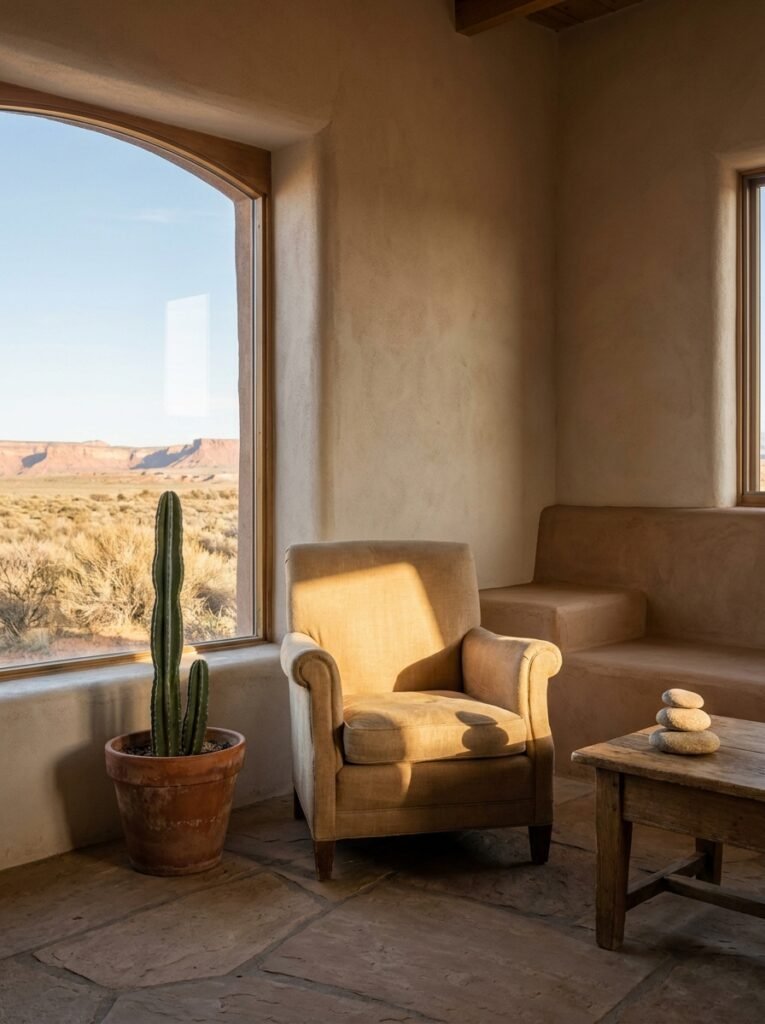
A desert home interior isn’t just a design choice — it’s a declaration about how you want to live. It says you value stillness over stimulation, authenticity over perfection, and depth over decoration. It says you’ve learned, somehow, that less truly can be more — that a warm, quiet, carefully chosen space can nourish you in ways that no amount of stuff ever will.
The desert has always known this. It’s been teaching it to anyone willing to stand still long enough to listen for centuries. The question is: are you ready to bring that wisdom home?