Why Sheer Curtains Are the Most Underrated Thing in Your Living Room Right Now
You hang thick drapes, light a candle, rearrange the cushions — and something still feels off. The room looks fine. But it doesn’t feel anything. Here’s what’s probably missing: the one layer that makes light itself part of your décor.
—
1. The Reason Every Gorgeous Living Room Photo Has Them (Even When You Don’t Notice)
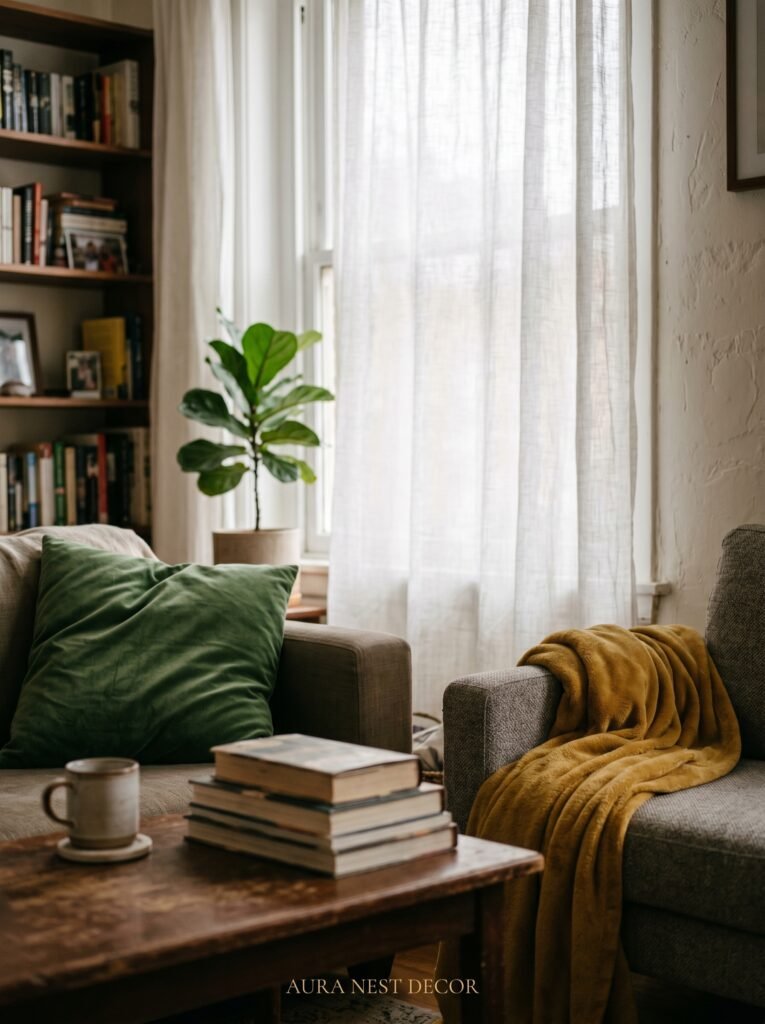
Scroll through any interior design account right now — Pinterest, Instagram, the glossy pages of House & Garden or Architectural Digest — and you’ll notice something. The rooms that stop you mid-scroll almost always have a softness to them. A kind of luminous, breathable quality. Light that doesn’t just come through the window but seems to arrive in the room, like it was invited.
That’s sheer curtains doing their quiet work.
They’re rarely the thing people talk about. You’ll hear about the velvet sofa, the antique coffee table, the perfect neutral paint color. But the sheers are there, in the background, doing something that no other design element can do: they’re translating the outside world into something beautiful and livable. They take harsh afternoon sun and turn it into something that looks like a Vermeer painting.
The reason we overlook them is the reason we overlook breathing. We don’t notice it until it’s gone. Pull the sheers down and suddenly the room feels harder. More exposed. Less like a home and more like a box with furniture in it.
This is the thing that took me embarrassingly long to understand. Sheers aren’t a finishing touch. They’re foundational.
“Sheer curtains don’t decorate a room — they change the quality of light inside it. That’s a different thing entirely.”
—
2. What “Sheer” Actually Means (Because Not All Light Fabrics Are Equal)
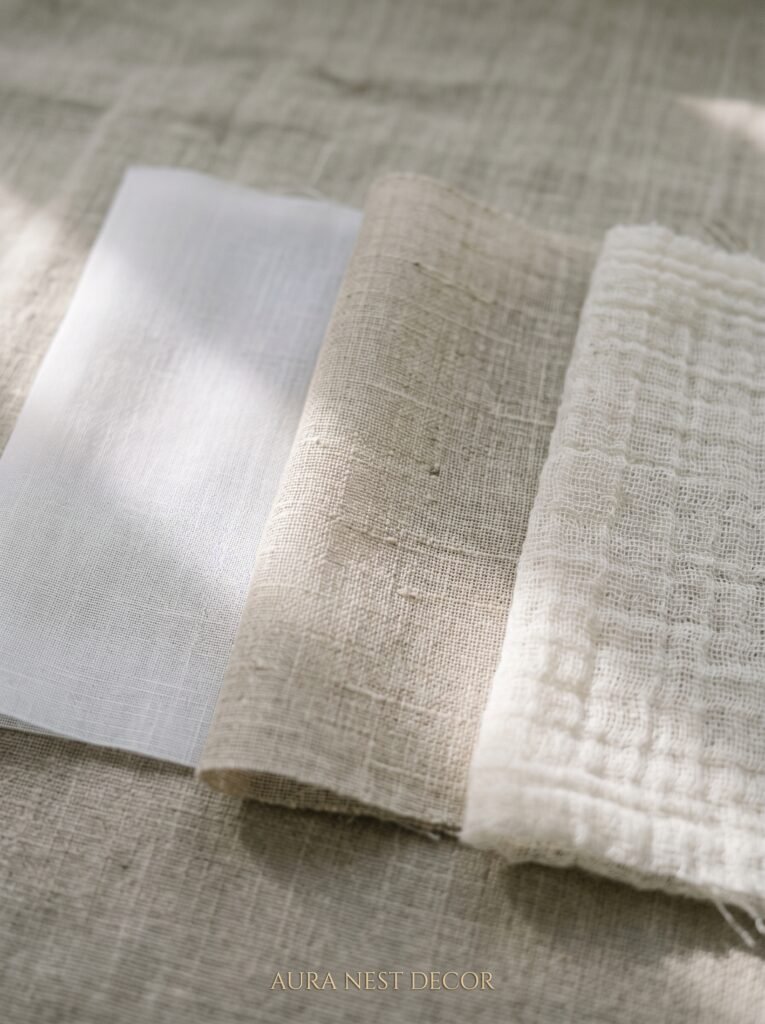
This might seem obvious, but it’s worth pausing on, because choosing the wrong sheer is a very real mistake people make constantly.
Sheer curtains are loosely woven, lightweight fabrics — voile, chiffon, organza, linen gauze, or cotton muslin — that allow light to pass through while still providing a layer of visual privacy. They are not the same as a thin lining. They are not the same as a white net curtain from your grandmother’s house in 1987. Modern sheers are an entirely different creature.
Voile is the most common and the most forgiving. It hangs with a beautiful natural drape and works in almost any room. Linen sheers are heavier, more textural, and feel more expensive even when they aren’t. They work particularly well in rooms with organic, natural aesthetics — think rattan furniture, terracotta pots, unfinished wood. Chiffon gives you the most ethereal look, almost bridal, and it photographs beautifully in morning light, though it can feel too delicate for busy family rooms.
Organza is crisper and has a slight shimmer. It’s more formal and works brilliantly in a room that leans traditional or maximalist.
The material you choose changes everything about how the light behaves. Linen sheers filter light into something slightly warm and golden. Voile makes it clean and airy. Chiffon makes it dreamy. This isn’t styling — it’s physics. Pick accordingly.
—
3. The Color Rule That Most People Get Wrong on the First Try
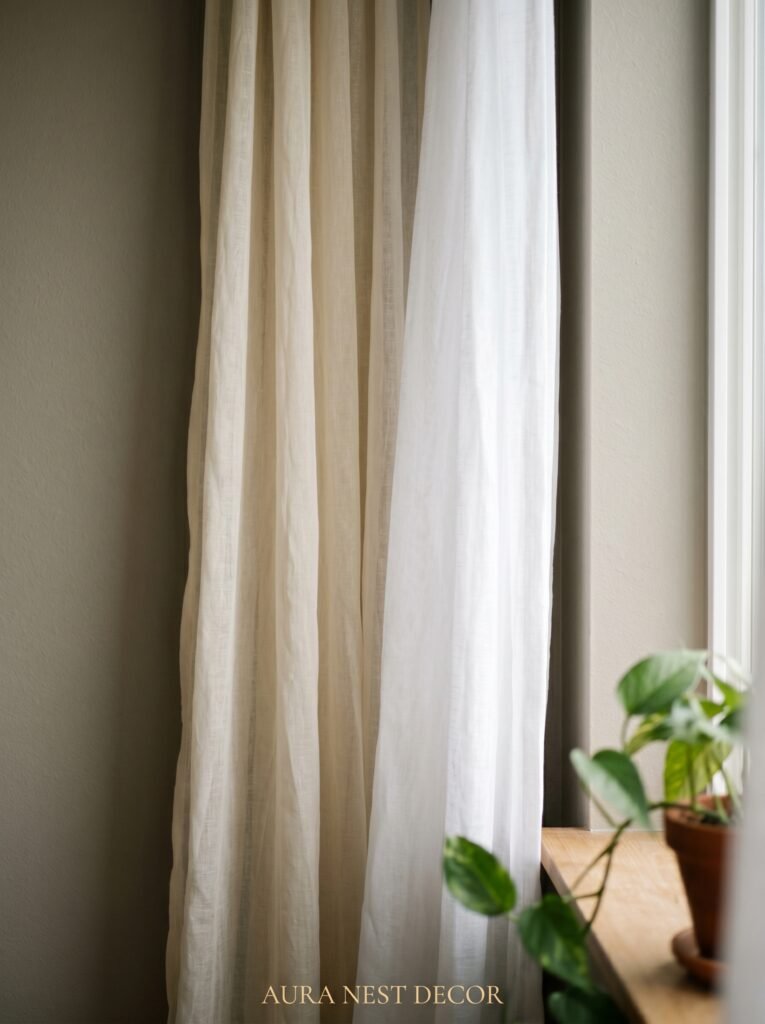
White seems like the obvious answer. White is safe. White goes with everything.
Here’s the problem: white sheers can read as clinical, stark, or — in older homes with aged woodwork and warm-toned furniture — slightly jarring. You hang your white sheers and everything looks fine until 4pm, when the light shifts and suddenly your beautiful warm living room is being divided by something that feels a bit like a hospital curtain.
The secret that most experienced decorators know is this: warm white. Not pure white. Not cream exactly, but something in between. An ivory voile, an off-white linen — something with just a whisper of warmth woven into the fabric itself. These catch afternoon light differently. They don’t compete with your walls. They breathe with the room instead of against it.
For rooms with cooler palettes — greys, blues, clean whites — a true bright white sheer is actually correct. It keeps the crispness intact and adds brightness without muddiness.
And here’s the bold option that more people should try: blush. A very pale blush sheer in a neutral living room creates the most extraordinary quality of light in the late afternoon. It casts the faintest warmth over the whole room, like you’ve turned on a filter that doesn’t exist. It sounds alarming. In practice, it is absolutely stunning.
—
4. The Length Question That Divides Interior Designers Right Down the Middle
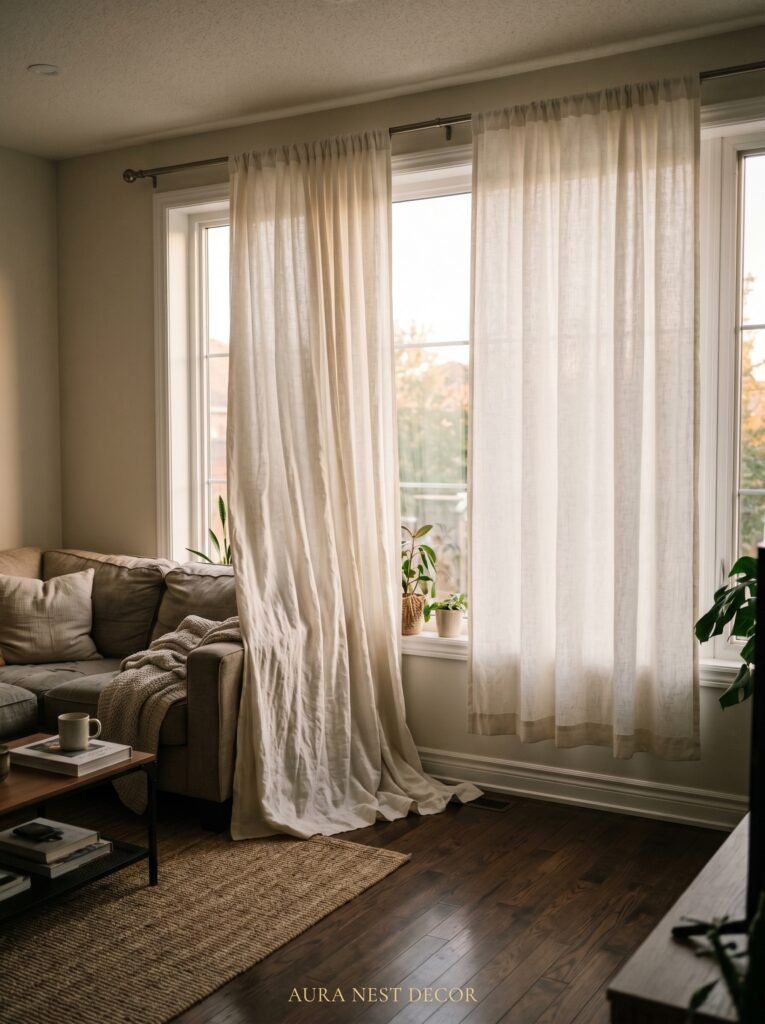
Do the curtains pool on the floor? Kiss it? Float just above it?
Honestly, I’ve changed my mind on this more times than I care to admit. Here’s where I’ve landed.
For sheers in a living room, floor length is non-negotiable if you want the room to feel finished and intentional. Curtains that stop at the windowsill or fall to just below it on a floor-length window look pinched. Truncated. Like they ran out of fabric halfway through the job.
The real debate is what happens at the bottom. A slight break — where the curtain just touches the floor and folds perhaps an inch — looks clean, modern, and works in most contemporary homes. A proper pool, where the fabric puddles three to five inches on the floor, is romantic, dramatic, and works in more traditional or maximalist spaces. It does require more fabric, more washing, and the willingness to shake the curtain out every time someone vacuums. Worth it in the right room. Impractical in others.
What almost nobody talks about is the top. Where you hang the rod matters as much as how long the curtain falls. Hang it close to the window frame and the window looks like a window. Hang it two to four inches below the ceiling — even if the window doesn’t reach anywhere near there — and the whole wall reads taller. The ceiling feels higher. The room feels larger. This is one of those tricks that sounds too simple to work.
It works every single time.
“Hang the rod closer to the ceiling than feels logical. Do it. The room will thank you immediately.”
—
5. Why Layering Changes Everything (And the Formula That Actually Works)
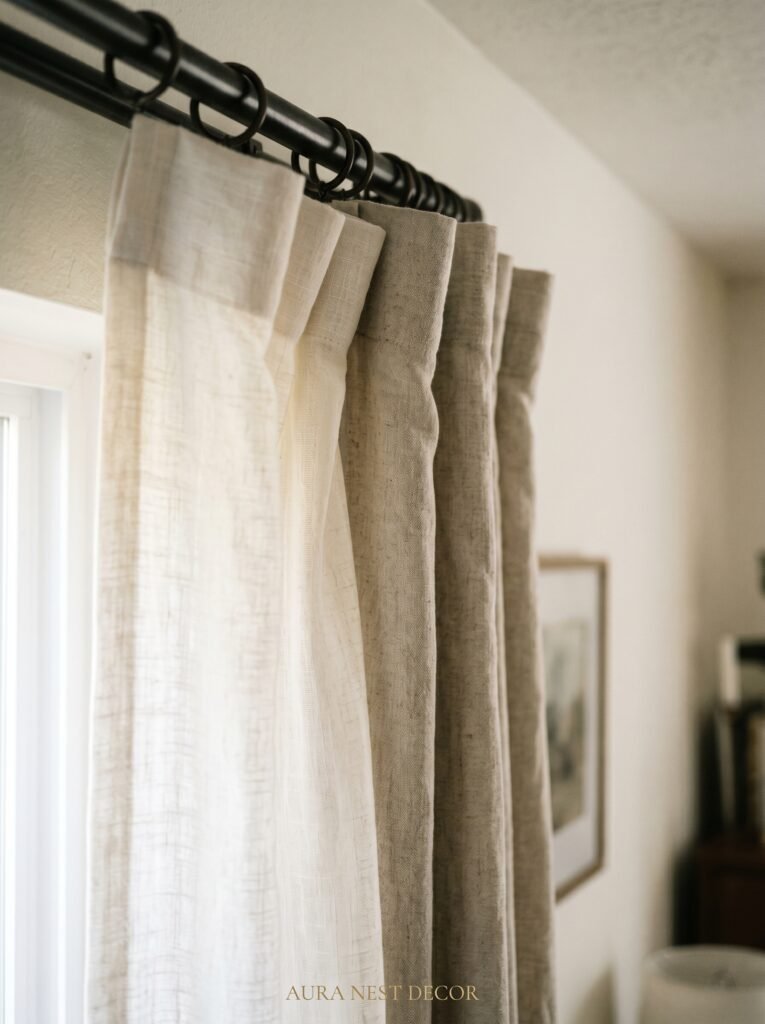
Sheers on their own have a certain look. It’s a good look. Light, breezy, almost Scandinavian in its simplicity. But if you want a living room that feels genuinely luxurious — the kind of room that makes guests stop and go oh when they walk in — you layer.
The formula is simple: sheer underneath, heavier panel over the top. The sheer does the work with the light. The heavier panel adds drama, privacy when needed, and grounds the whole arrangement.
The key is contrast. If your sheer is ivory voile, your outer panel should be something with real weight and presence. A deep linen in stone, olive, or charcoal. A velvet in rust or forest green. Something that earns its place in the room. These two layers, drawn apart during the day, frame the window like a picture frame frames a painting.
In American homes, this layered look tends to go wider and fuller — generous swags, real drama. In British homes, it tends to be more restrained, the sheers doing most of the visual work while the outer curtains sit pulled back as a structural element more than an active one. Both are right. It depends entirely on the scale of your room and what you’re drawn to.
One thing that doesn’t work: two fabrics that are too similar in weight. A semi-sheer over a regular voile. It just looks like you couldn’t make a decision.
—
6. The Rooms in America and Britain Where Sheers Work Hardest
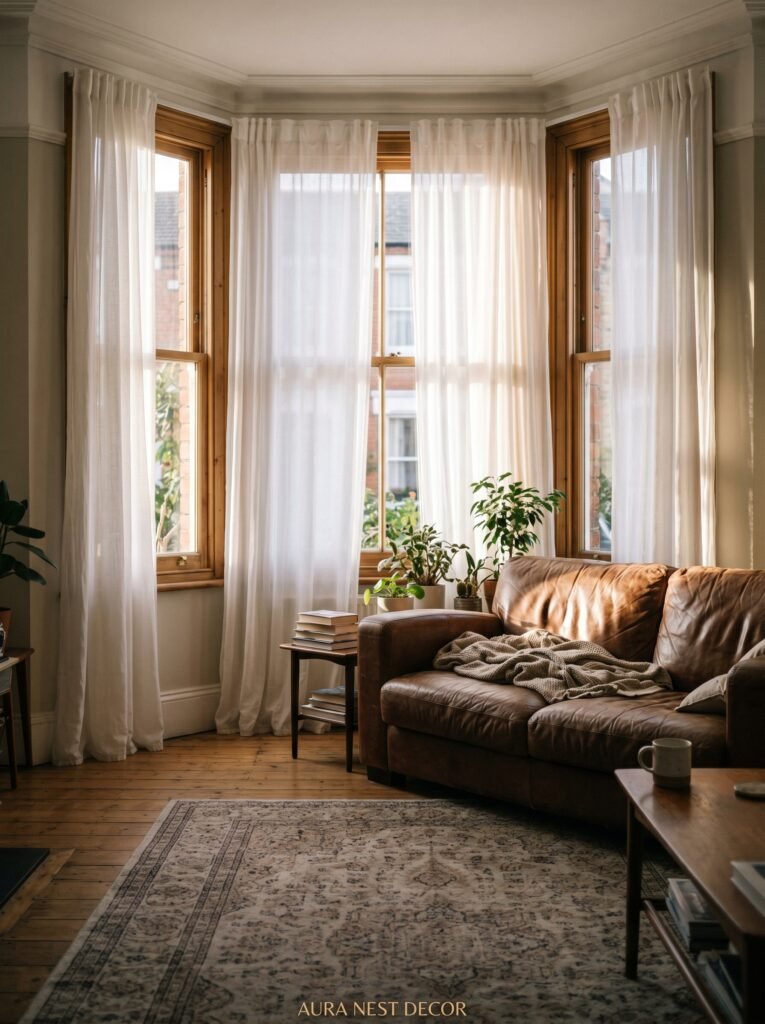
A Victorian terrace in South London and a craftsman bungalow in Portland, Oregon have almost nothing in common architecturally. But in both of them, sheer curtains are doing the same job.
In older British homes — the kind with sash windows, slightly uneven walls, and rooms that can feel a bit dim — sheers are essential for managing the quality of the limited light that comes in. They don’t block it. They amplify it, spread it around the room, make it feel like more than it is. A north-facing sitting room in a period terrace without sheers is a different room from one with them. The sheers make it feel inhabited by light even when the sun isn’t cooperative.
In newer American homes with bigger windows and more direct sun exposure, sheers solve a different problem. They diffuse glare. They stop the 2pm sun from washing out your artwork, bleaching your furniture, and making the sofa too hot to sit on — while still keeping the room feeling bright and open.
Both uses are genuinely valuable. Both are the kind of thing you notice the first week you hang them and then, because they work so well, promptly forget to appreciate.
—
7. The Hanging Mistakes That Make Even Expensive Sheers Look Cheap
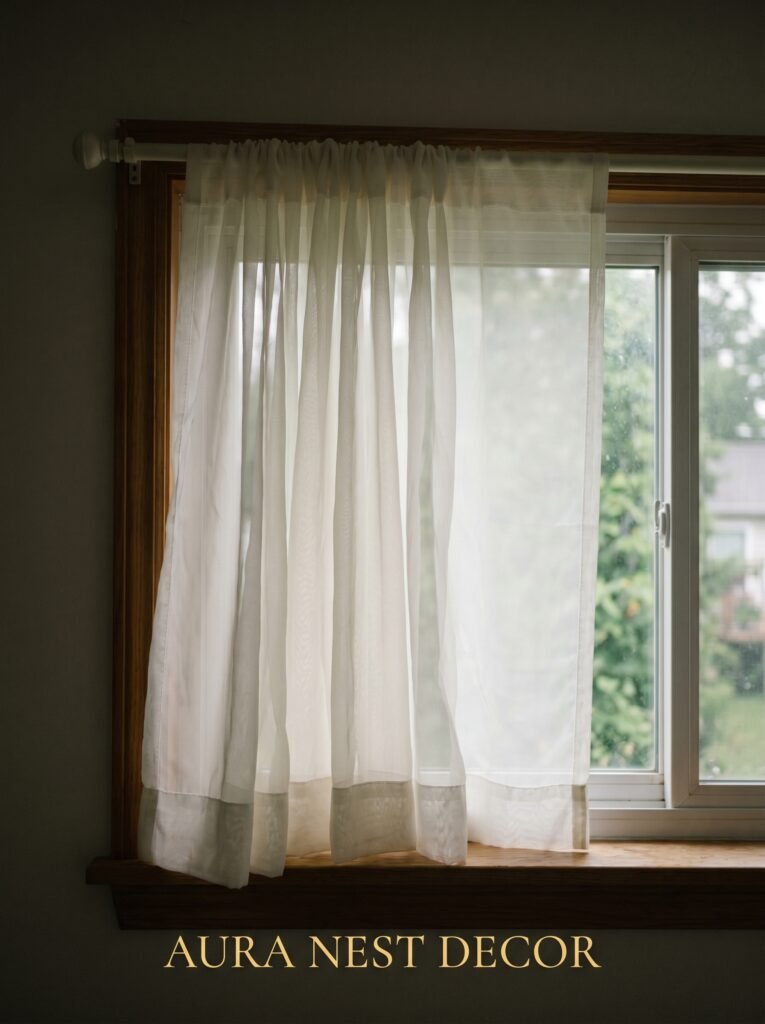
You can spend three hundred dollars on hand-embroidered voile panels and make them look like a budget dorm room. The hanging is everything.
First mistake: too few panels. Sheers look right when they’re generous. Full. When you pull them across, they should have enough fabric to gather softly, not stretch taut. The standard rule is two to two-and-a-half times the width of your window in fabric. Most people buy one panel per window half and wonder why it looks meager.
Second mistake: the wrong curtain rings or track. Fabric this light needs a rod or track that lets it move freely. Cheap plastic rings that catch and pull create uneven bunching that never looks intentional.
Third mistake: leaving them unsteamed. Sheers come out of packaging looking terrible. Creased, sad, slightly chaotic. Steam them. Or hang them in a steamy bathroom for twenty minutes. The difference is extraordinary — it’s the difference between fabric that looks deliberate and fabric that looks like you gave up.
Fourth mistake: hanging them centered on the window instead of wide. Extend the rod well past the window frame on both sides. When the sheers are open during the day, they frame the glass without blocking any of it. More light. Better proportions.
“Most bad curtain jobs aren’t about the curtain. They’re about the rod placement.”
—
8. The Specific Light Moments That Make You Fall in Love with Your Own Living Room

This is the reason we’re really here.
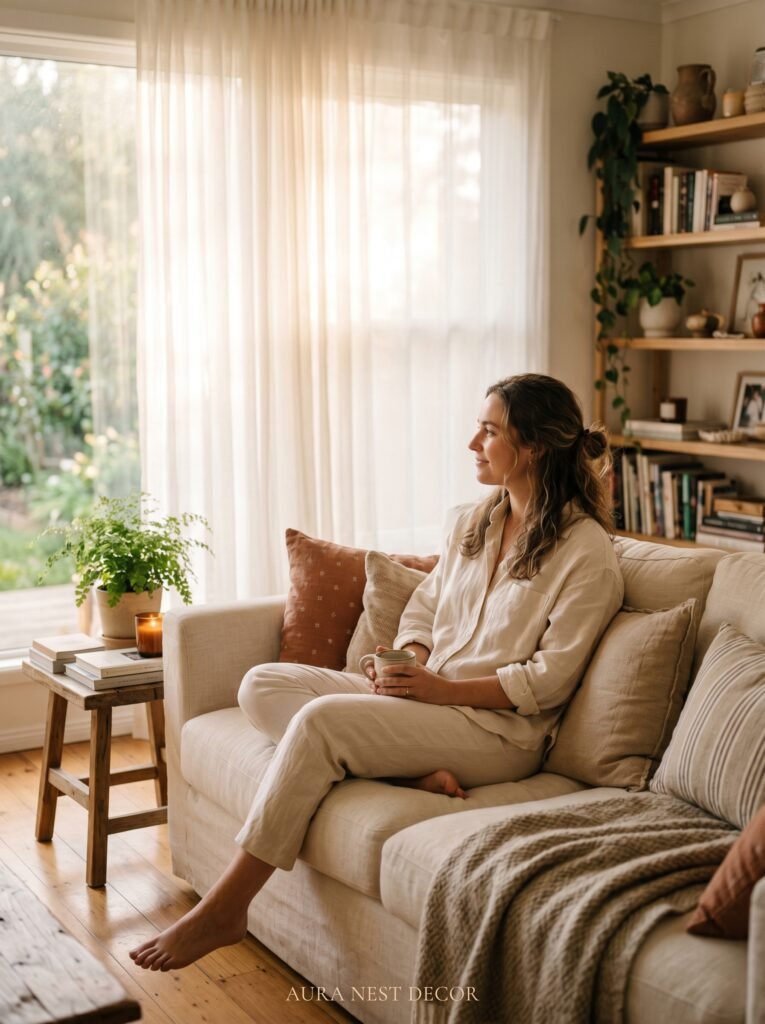
There’s a moment that happens in a well-curtained room with good sheers. It’s around 7am in summer, when the first proper light is coming through and the sheers are moving very slightly in a breeze from a cracked window. The light they’re casting onto the far wall is almost liquid. Rippling, slightly amber, impossibly soft. The room smells like morning. The coffee is ready. You stand there for a second before anyone else wakes up and you feel, genuinely, that you live somewhere beautiful.
That’s not staging. That’s not a photo. That’s an experience that costs you a curtain rod and forty dollars of voile, if you shop carefully.
The afternoon version is different. When sun hits sheer linen at around 3pm, it creates a warm diffusion that fills the whole room like something golden has been released into it. Reading in that light feels like a specific kind of luxury.
These are the moments interior design is actually for.
—
9. How to Choose Sheers When You Already Have a Strong Color Palette
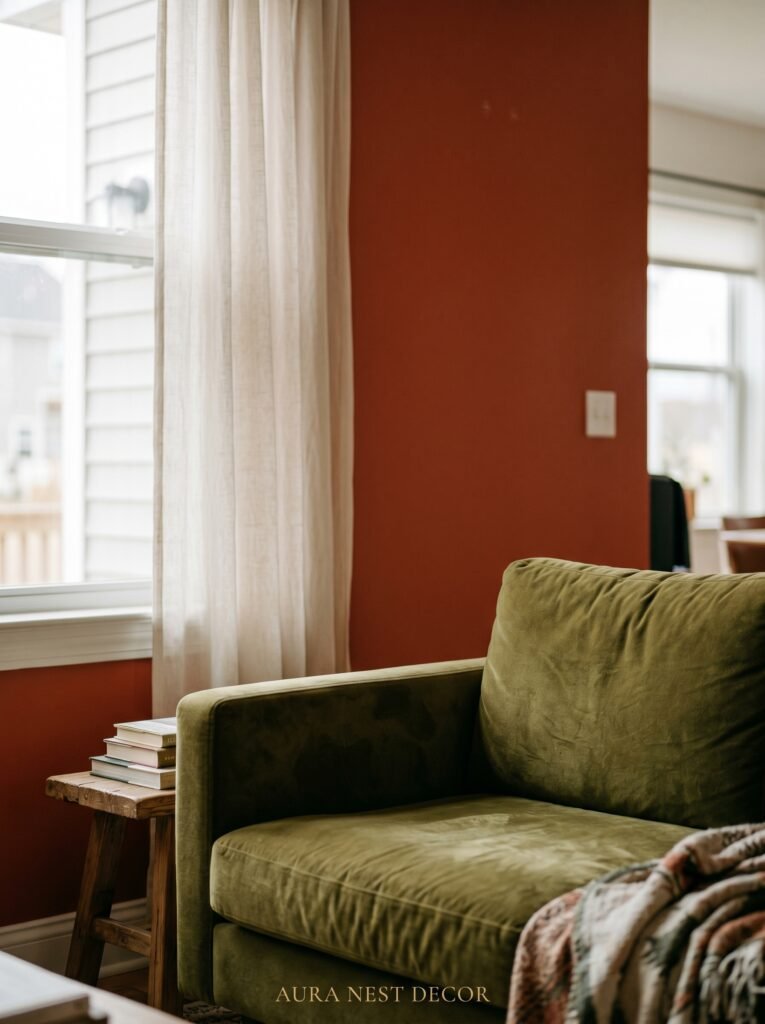
If your living room already has a clear identity — a dominant color, a strong piece of furniture, a wallpaper that announces itself — your sheers should not add another voice to that conversation. They should provide the quiet.
In a room with jewel tones, dark walls, or bold pattern, white or ivory sheers are the right answer. They’re the breath between sentences. They stop the room from becoming overwhelming and give the eye somewhere to rest.
In a neutral room — the warm whites and taupes and soft greiges that dominate so many American and British homes right now — you have more freedom. This is where your blush, your pale sage, your barely-there blue can work. These whisper-colored sheers add interest without competition. They make the neutrals feel intentional rather than cautious.
The one combination that almost always fails: a strongly patterned room with patterned sheers. Pattern on pattern on pattern, even in different scales, tends to create visual chaos that nobody asked for. The sheers lose the one quality that makes them valuable: simplicity.
—
10. The Budget Reality (Where to Spend and Where to Save)

Here is an honest breakdown, because the range on sheer curtains is genuinely enormous and not all of it is worth it.
The rod and hardware: spend here. A good quality rod — matte black, brushed brass, aged bronze, depending on your room — elevates every single thing you hang from it. It reads as quality before you even look at the fabric. Cheap chrome rods are noticeable in a way that’s hard to explain and very easy to feel.
The fabric: this is where you can be strategic. Ready-made voile panels from Target, Dunelm, IKEA’s LILL range, or Amazon can be genuinely excellent when hung properly. The key is quantity — buy more panels than you think you need. Six panels hung generously on a good rod looks more expensive than two panels of costly fabric hung stingily.
Where real investment pays off: linen sheers. Not all linen sheers are equal and the better ones hang in a way that cheaper options simply don’t. If you have a feature window, a bay, or a room that you spend most of your time in, linen sheers are worth budgeting for properly.
—
11. The Styling Details That Take Sheers from Nice to Remarkable
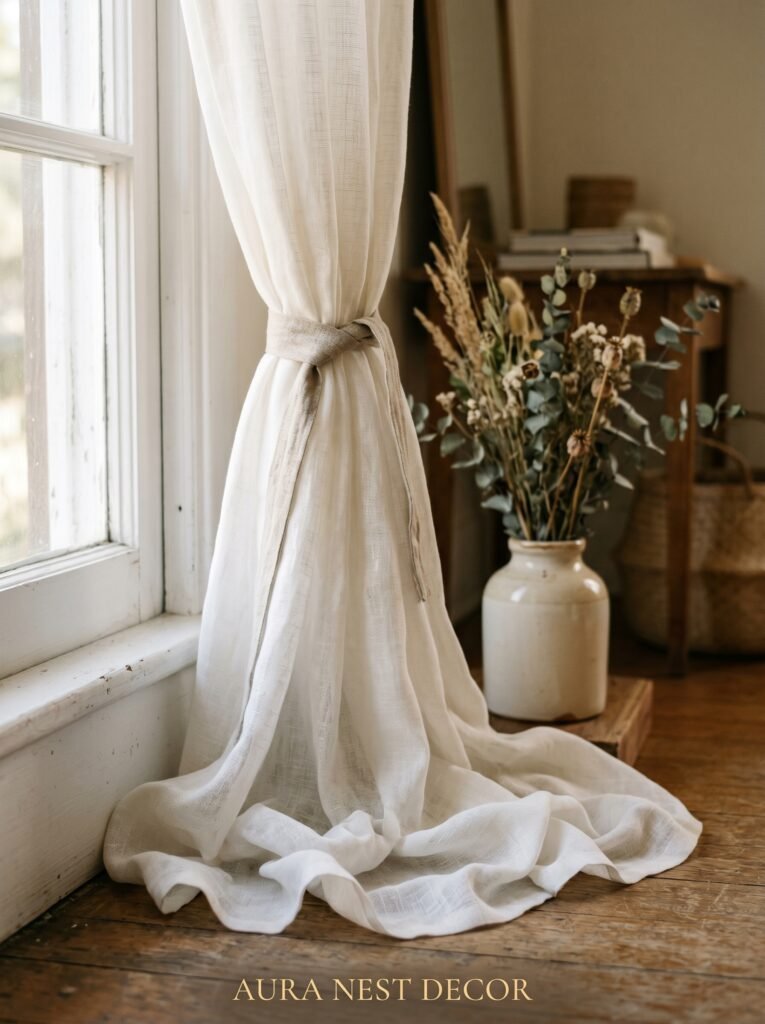
The sheers are hung. They’re pressed. They’re the right length. Now the room still needs to earn the light they’re creating.
Furniture placement matters more with sheers than without them, because now the quality of light in the room is visible. A reading chair positioned to catch the afternoon diffusion through the sheer becomes a destination. A side table with a simple vase and a book, positioned where the morning light hits it — suddenly you have a vignette that looks effortless and is anything but accidental.
Consider what the sheers frame. From inside, they turn the window into something close to a living painting. What’s outside your window? If there’s a tree, a garden, even a row of neighbors’ rooftops, the sheers do something remarkable: they soften it all into something that reads as atmosphere rather than distraction.
From outside, sheers glow at night. When your interior lights are on and the sheers are drawn, the room casts a warm amber rectangle onto the street. It looks like a painting. It looks like the kind of home people want to live in.
—
12. The One Thing Nobody Talks About When It Comes to Sheers and Mental Health

This feels slightly left-field for a curtain article. Stay with me.
There is a growing body of research on the relationship between natural light quality and mood, focus, and general wellbeing. Not just the amount of light — the quality of it. Harsh, direct sunlight in an interior space increases glare fatigue. It creates contrast that makes screens difficult to use and eyes tired by mid-afternoon.
Diffused light — the kind created by sheer fabric — has a measurably different effect. It fills the room more evenly. It’s easier on the eyes. It’s the quality of light that’s been associated, in multiple studies, with reduced eye strain, improved concentration, and — this is the part worth sitting with — a subtle but real improvement in mood during extended periods at home.
This matters more than it used to. Many of us are working from home, spending extended stretches in our living rooms in ways that weren’t true a decade ago. The quality of light in the room you inhabit most of your day is not a trivial concern. It’s not vanity. It’s the kind of thing that affects how you feel without you ever quite pinpointing why.
Sheers are, among other things, a very low-cost investment in the livability of your home. That’s not a decorator’s argument. That’s just physics and light and the way being human works.
—
❓ FAQ
Q: Can I use sheer curtains in a living room without any other window treatment? A: Absolutely — and it’s a look that works really well in modern, Scandinavian, or minimalist interiors. The key is getting the length right (floor-length) and using enough fabric so the panels look full rather than sparse. Just know that sheers alone provide very little privacy at night when your interior lights are on.
Q: How do I stop sheer curtains from looking cheap? A: The biggest factors are rod quality, hanging height, and fullness. A matte black or brushed brass rod, hung two to three inches below the ceiling rather than at the window frame, with panels that are two to two-and-a-half times the width of your window — these three things will make even budget fabric look intentional and considered.
Q: How often do sheer curtains need washing? A: In most living rooms, a wash every three to four months is sufficient. Always check the label — most voile and cotton sheers are machine washable on a gentle cool cycle. Wash them separately, remove promptly, and hang straight back on the rod while still damp. They dry in position and usually need minimal steaming.
—
💭 Final Thoughts
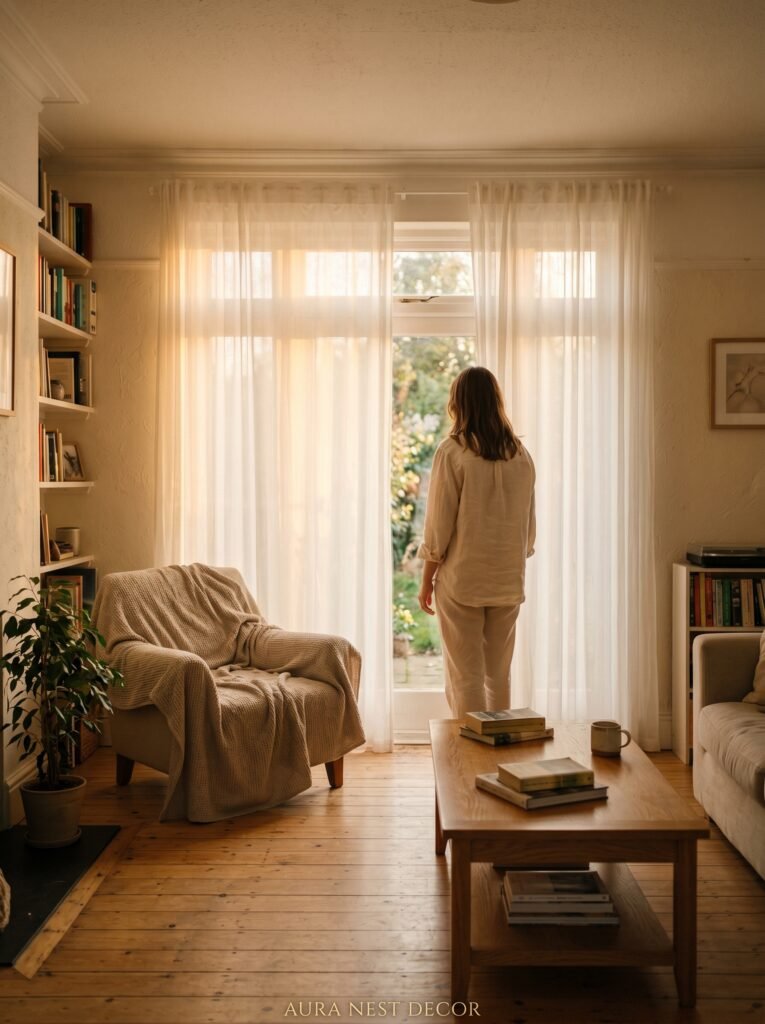
The thing about sheer curtains is that they’re one of those design decisions you make once and then simply live inside for years. They don’t demand attention. They don’t go out of fashion. They just quietly change the way light moves through the room you love most, every single day, in ways that shift with every season and every hour. There’s something almost generous about that. Are you giving your living room the light it deserves?