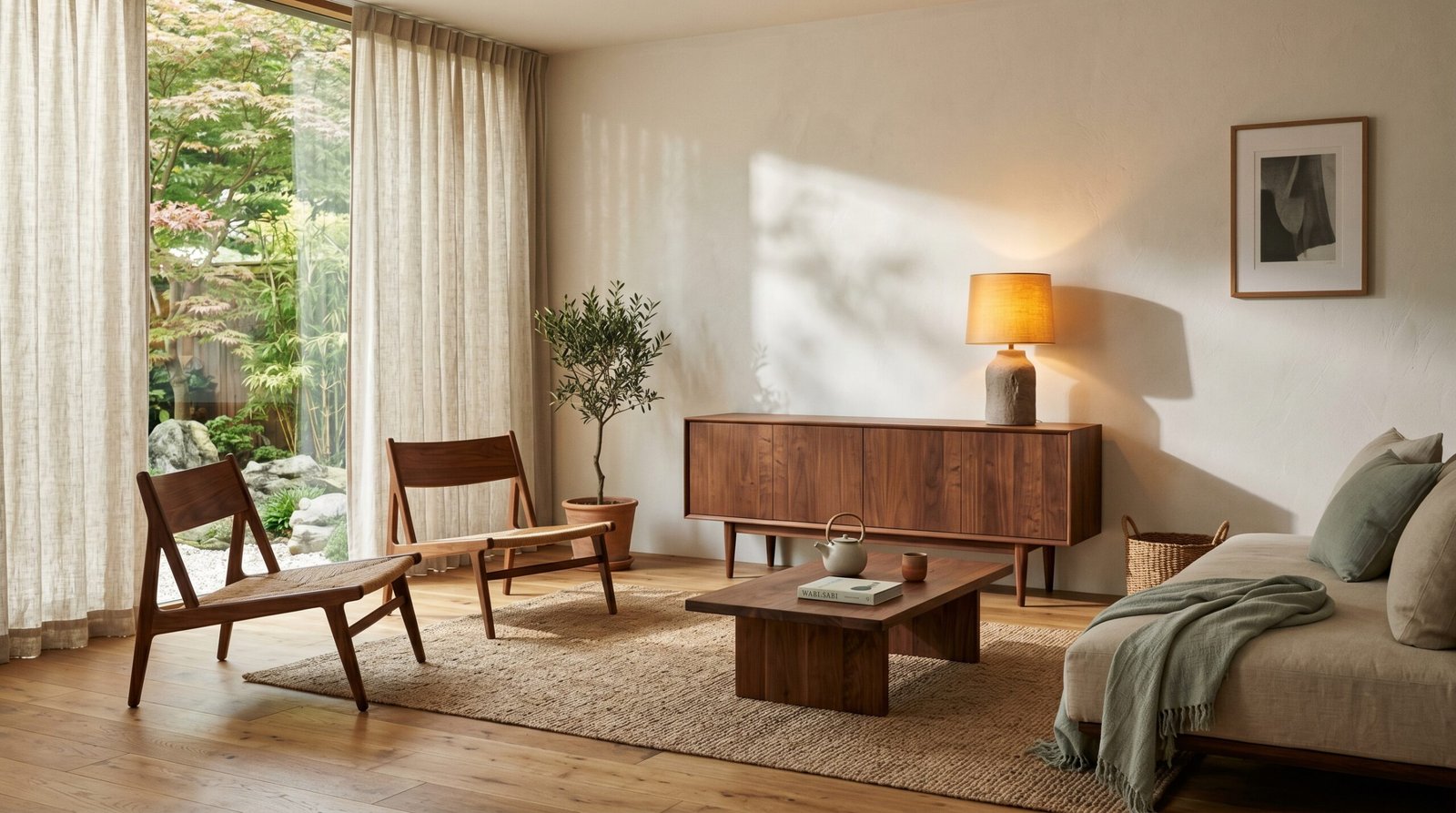
When Two Worlds Meet: The Quiet Magic of Mid-Century Japandi Interior Design
There’s a particular kind of room that makes you exhale the moment you walk into it — not because it’s grand or impressive, but because it feels right. That’s the feeling mid-century Japandi interiors are built on, and once you experience it, ordinary rooms start to feel like they’re trying too hard.
—
Table Of Content
1. What Exactly Is This Style, and Why Is Everyone Whispering About It?
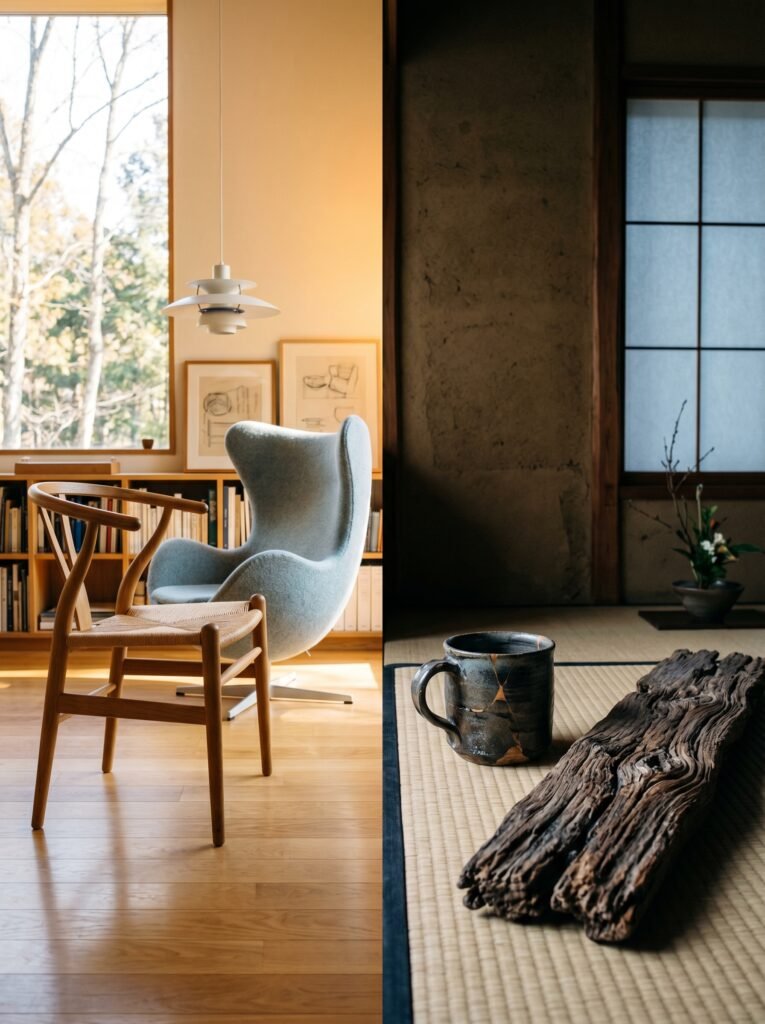
Mid-century Japandi is the design world’s most thoughtful love story — a marriage between mid-century modern aesthetics born in postwar America and Scandinavia, and the centuries-old Japanese philosophy of wabi-sabi and ma (the beauty of empty space). Neither style swallows the other whole. Instead, they meet somewhere quiet in the middle, agreeing that a room should feel lived-in but never cluttered, beautiful but never boastful.
What makes this fusion feel so relevant right now is that both parent styles share a DNA rooted in the same values: respect for natural materials, a preference for honest craftsmanship, and a deep suspicion of decoration for decoration’s sake. When you blend them, you don’t get a contradictory mashup — you get something that feels inevitable, like two sentences that complete each other.
“Mid-century Japandi doesn’t ask you to fill the room. It asks you to trust the space.”
2. The Roots That Make This Style Feel So Grounded
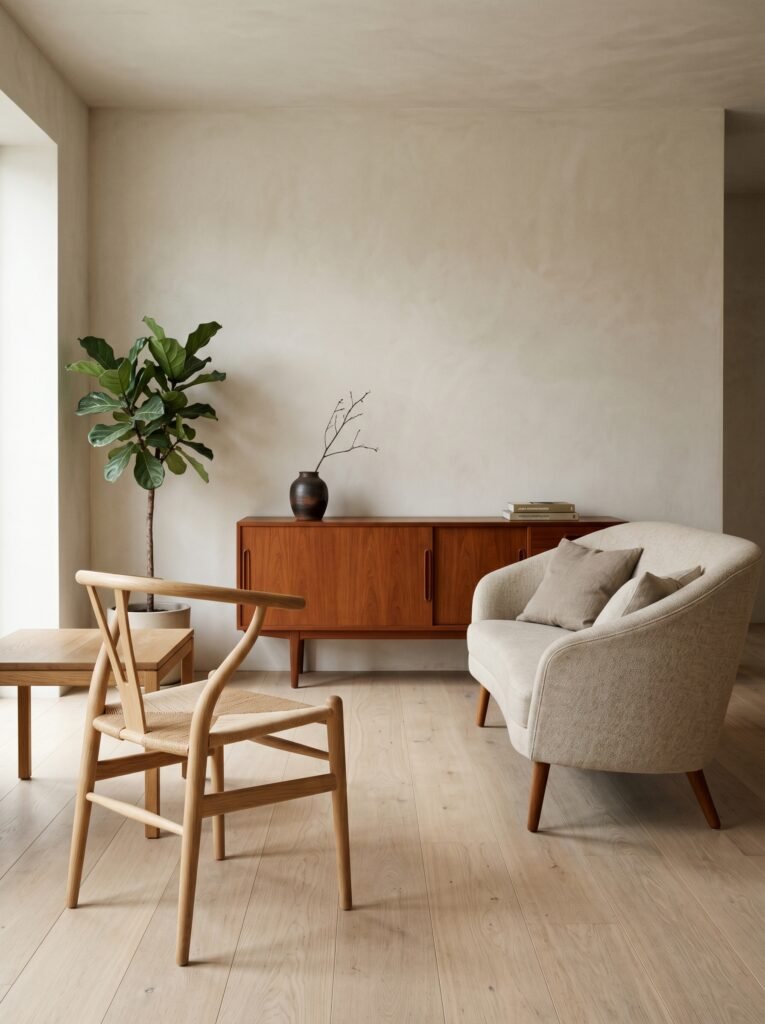
To truly appreciate mid-century Japandi, it helps to know where each half came from. Mid-century modern design flourished roughly between the 1940s and 1960s, born from a postwar optimism that said furniture should be accessible, functional, and forward-looking. Designers like Hans Wegner, Charles and Ray Eames, and Arne Jacobsen gave the world chairs and tables that felt both sculptural and democratic — made for real people living real lives.
Japandi’s other half draws from Japanese aesthetic philosophy stretching back centuries. Wabi-sabi embraces imperfection and transience — the crack in a ceramic mug, the knot in a wooden plank, the way a linen curtain shifts unevenly in the breeze. These aren’t flaws to be hidden. They’re the signatures of an authentic, living object. When you layer this philosophy over mid-century modern’s clean geometry, something extraordinary happens: the furniture gains soul, and the space gains wisdom.
3. The Color Palette That Feels Like a Deep Breath

Imagine standing barefoot on cool sand at dawn, the sky just shifting from grey-blue to the softest blush of pale gold. That sensory experience is essentially the mid-century Japandi color story.
The palette lives in the space between warm and cool — earthy terracottas paired with misty sage greens, deep charcoal walls anchored by warm oak floors, creamy off-whites sitting alongside muted mushroom browns. You won’t find a single color here that demands attention. Each one asks to be noticed slowly, quietly, the way you might notice a bird sitting perfectly still on a fence post. The effect is a room that feels simultaneously grounding and calming, a visual exhale built into every surface.
4. Wood: The Material That Both Cultures Refuse to Give Up
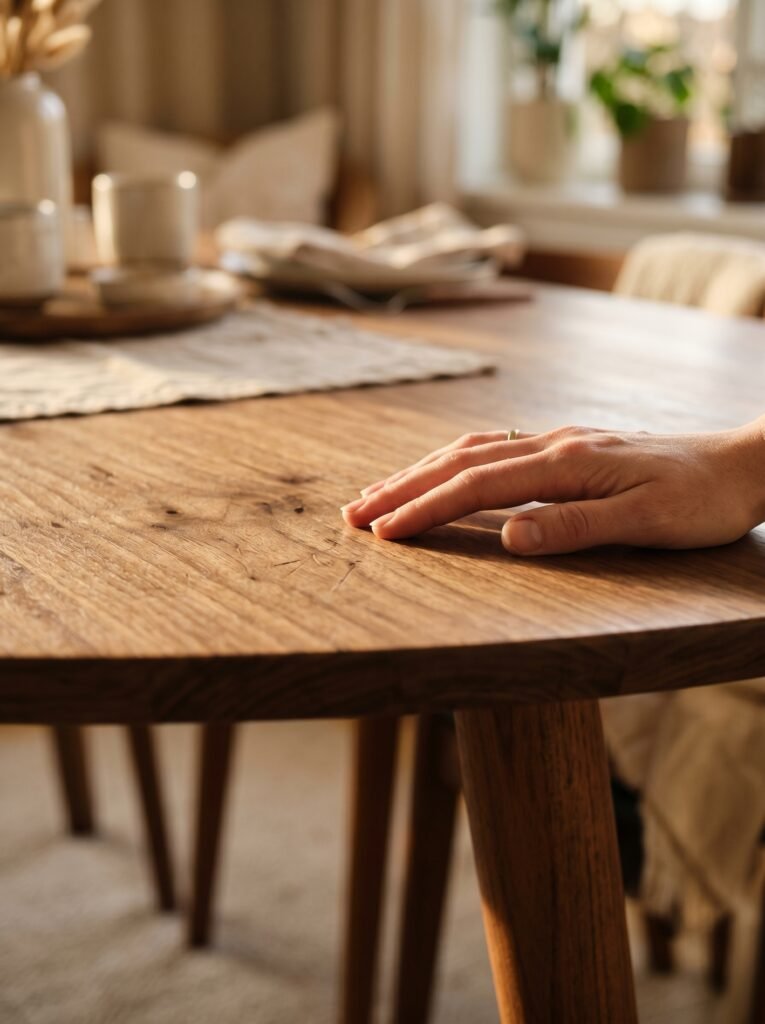
Walk into a mid-century Japandi room and the first thing your eyes will almost certainly land on is wood. Not the glossy, too-perfect laminate kind — but the warm, grained, character-full wood that you want to run your hands along.
Mid-century modern brought us the low-slung walnut credenza and the tapered teak leg. Japanese design gave us the reverence for wood’s natural imperfections, the subtle variations in grain that make each piece unique. Together, they produce interiors where wooden furniture isn’t just functional — it’s emotional. A mid-century Japandi dining table feels like something worth gathering around. It has presence without weight, warmth without excess.
5. The Rule of Negative Space (Or: Why Empty Isn’t Empty)
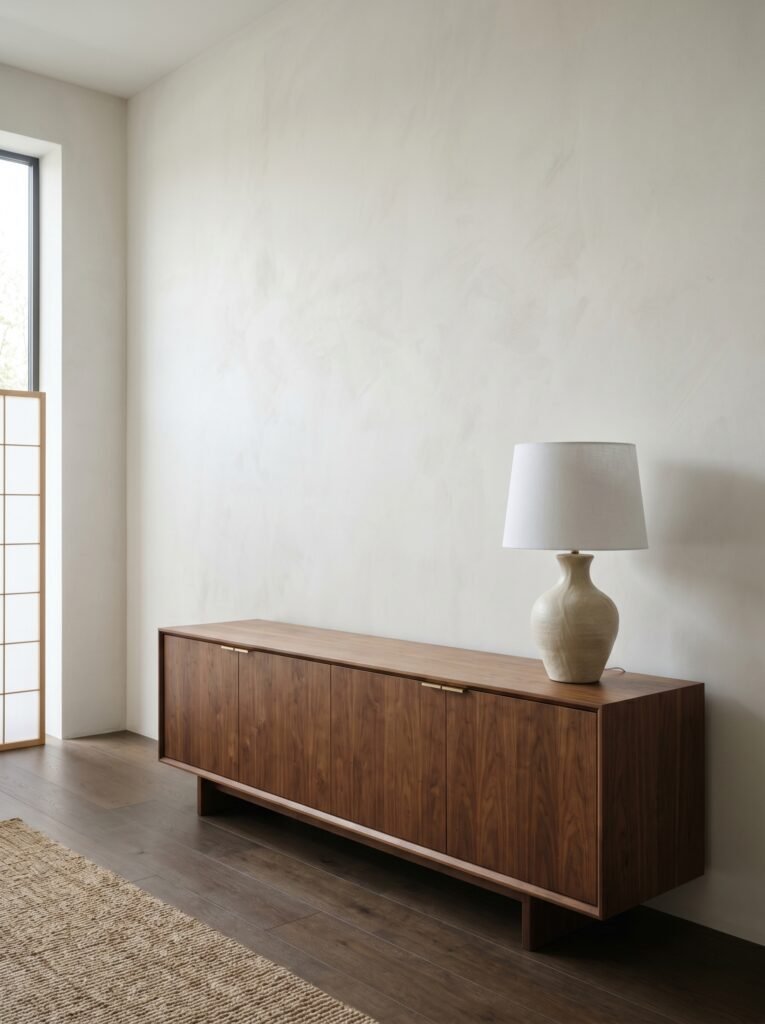
This is where mid-century Japandi quietly challenges almost everything Western interior design has historically told us to do. We’ve been taught to fill rooms — to hang artwork on every wall, to find a use for every corner, to layer accessory on top of accessory until the room feels “done.”
Mid-century Japandi asks you to stop.
The Japanese concept of ma — often translated as negative space or interval — teaches that the space between objects is not wasted space. It’s breathing room. It’s where the eye rests. It’s where the room finds its rhythm. When you pair this philosophy with mid-century modern’s already-restrained aesthetic, you get rooms where a single beautifully shaped lamp on an otherwise bare sideboard becomes a complete sentence. The emptiness is not absence. It’s intention.
“In a world that never stops adding, the bravest design choice is knowing when to stop.”
6. Furniture Shapes That Feel Familiar but Never Boring
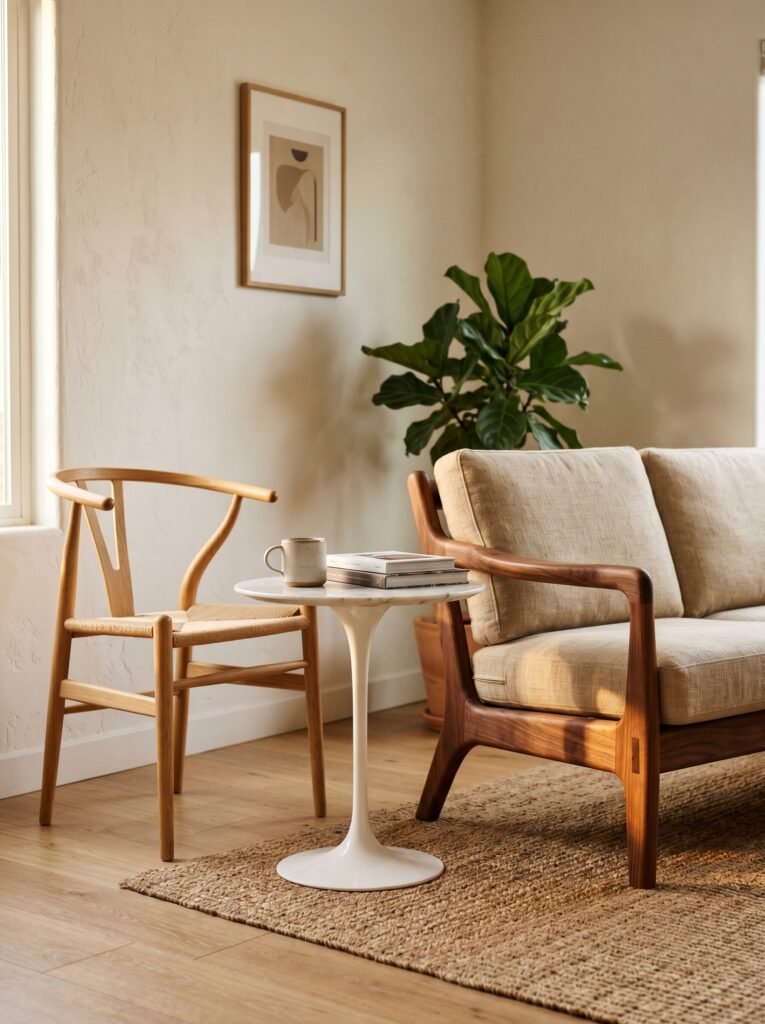
The furniture silhouettes in mid-century Japandi are where the design language gets most fluent. Mid-century modern gave us icons — the wishbone chair, the tulip table, the gentle arc of a Danish sofa on delicate legs. These forms are clean but never cold, geometric but never rigid.
Japanese design adds a layer of organic softness — slightly imperfect curves, handcrafted joinery details that are visible and meant to be seen, proportions that feel humble rather than imposing. The result is furniture that rewards close attention. The more time you spend in a mid-century Japandi room, the more details reveal themselves: a hand-rubbed oil finish, a deliberately exposed tenon joint, the way a cushion sits with the quiet confidence of something made to last.
7. Textiles That Speak in Textures, Not Patterns
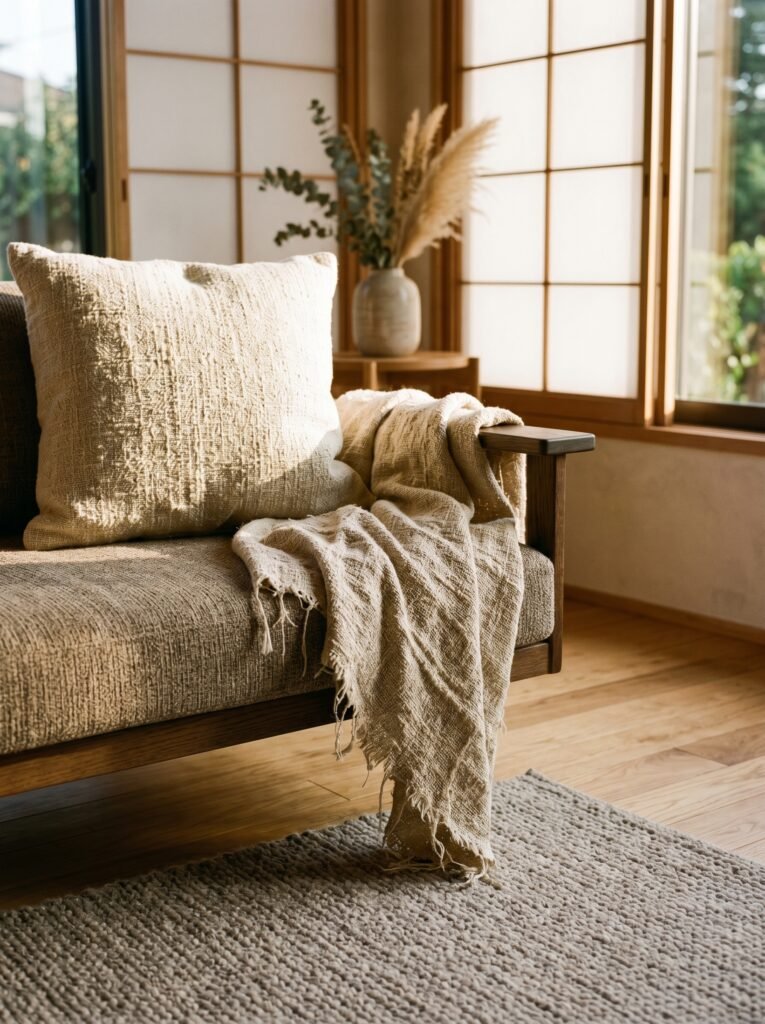
In a mid-century Japandi interior, textiles do their work quietly. You won’t find bold geometric prints or aggressively patterned throw pillows fighting for attention. Instead, texture becomes the language — a chunky linen weave on a cushion cover, a rough-hewn cotton throw in natural undyed ecru, a low-pile wool rug in warm greige that anchors a seating area without dominating it.
This restraint in pattern doesn’t mean the room lacks personality. It means the personality runs deeper. When you remove visual noise, you become aware of how a raw linen curtain catches afternoon light differently than a morning shadow. The room becomes responsive, alive to the time of day in a way that pattern-heavy rooms never quite manage.
8. Greenery That Earns Its Place
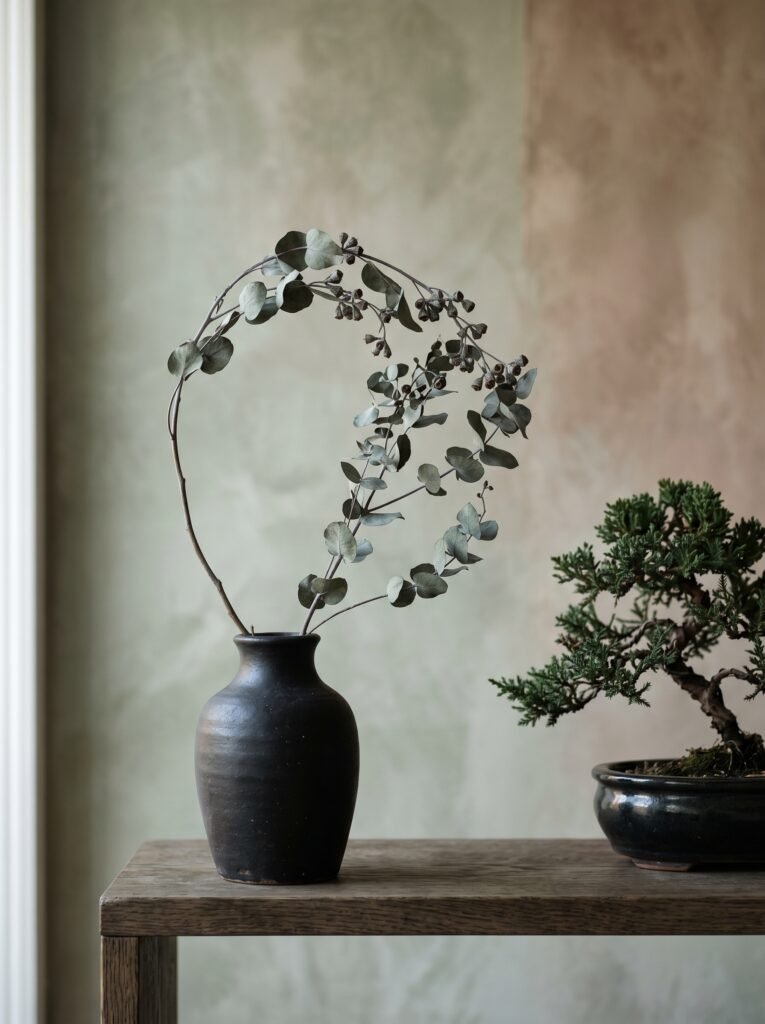
Both mid-century modern and Japanese design have always had a meaningful relationship with the natural world, but they express it differently. Mid-century modern interiors often featured plants as punctuation — a statement rubber tree in a woven basket, a cactus on a windowsill that doubled as sculpture.
Japanese design deepens this relationship. The practice of ikebana — the art of mindful flower arrangement — treats a single stem with the same care and consideration a sculptor gives to marble. In a mid-century Japandi room, plants and botanicals are never afterthoughts. A single branch of dried eucalyptus in a matte ceramic vase can carry more visual weight than a whole bouquet. A bonsai on a low shelf becomes a focal point. Every living thing earns its place.
9. Lighting: The Architect of Atmosphere
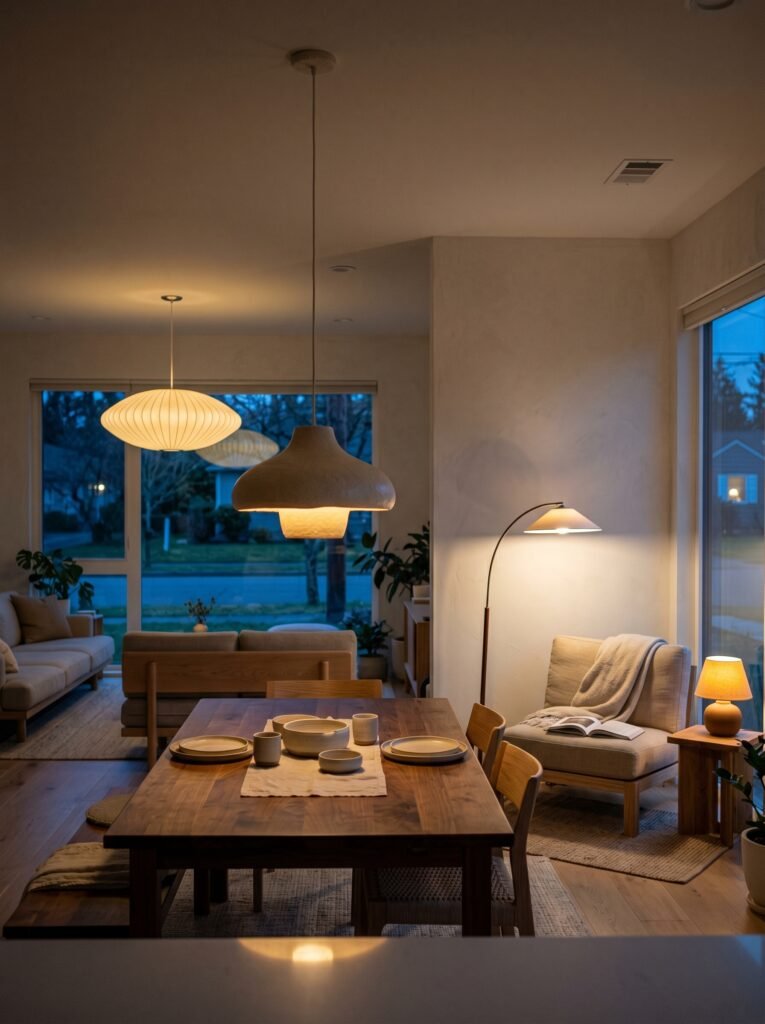
Harsh overhead lighting is, for all practical purposes, banned from the mid-century Japandi vocabulary. This style understands something that takes most of us years to learn about our own homes: lighting isn’t just about illumination. It’s about mood, temperature, and the feeling of safety that warm, low light quietly creates.
Mid-century modern brought us extraordinary pendant lamps — the organic mushroom shapes, the sculptural Sputnik clusters, the soft glow of a George Nelson bubble lamp. Japanese design contributed paper lantern forms, the diffused warmth of washi shades, and the philosophy that light should whisper, not shout. In a mid-century Japandi interior, you layer these influences — an iconic pendant above a dining table, a low-wattage arc floor lamp beside a reading chair, a small ceramic table lamp that glows amber on a side table at dusk.
“The right light doesn’t just illuminate a room. It makes a room feel like home.”
10. Ceramics and Objects That Tell Honest Stories
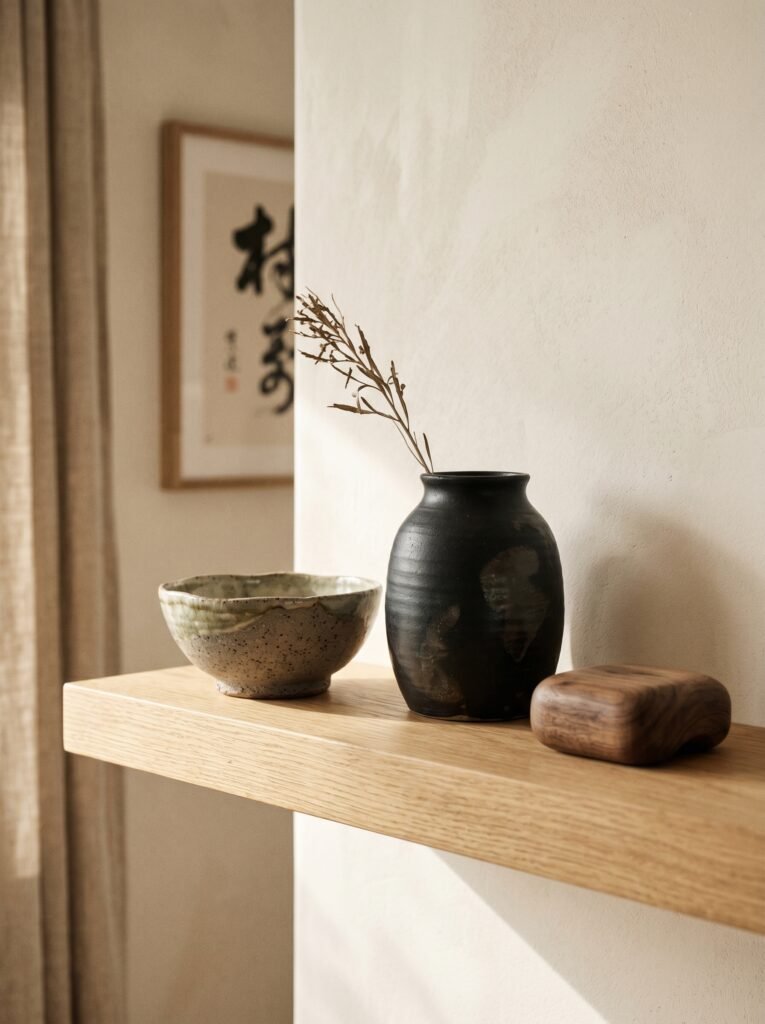
Every object in a mid-century Japandi interior is there because it matters. This isn’t a style that accommodates decorative clutter — those little trinkets accumulated over years because they were gifts, or because they were on sale, or simply because the shelf looked bare without something.
Instead, the objects that populate these rooms tend to be handmade, imperfect, and quietly beautiful. A stoneware bowl with a slightly uneven rim. A hand-thrown vase in matte black with a subtle glaze variation. A small wooden object whose function isn’t immediately obvious but whose form is deeply satisfying. The Japanese concept of mingei — folk crafts made by unknown artisans — resonates powerfully here. These are objects that honor the hands that made them.
11. The Role of Natural Light and Shadow
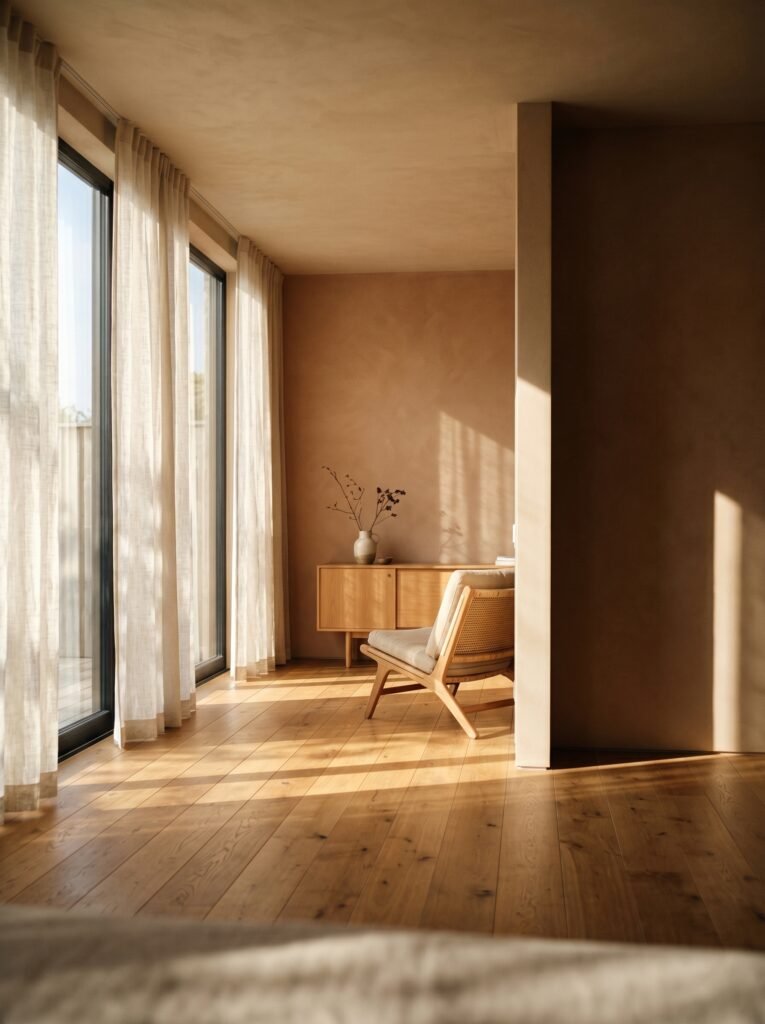
In most interior design conversations, natural light gets treated as a bonus — a nice-to-have. In mid-century Japandi design, it’s a foundational material, as important as any piece of furniture. The way light moves through a room across the day is something these interiors are deliberately designed to let you notice.
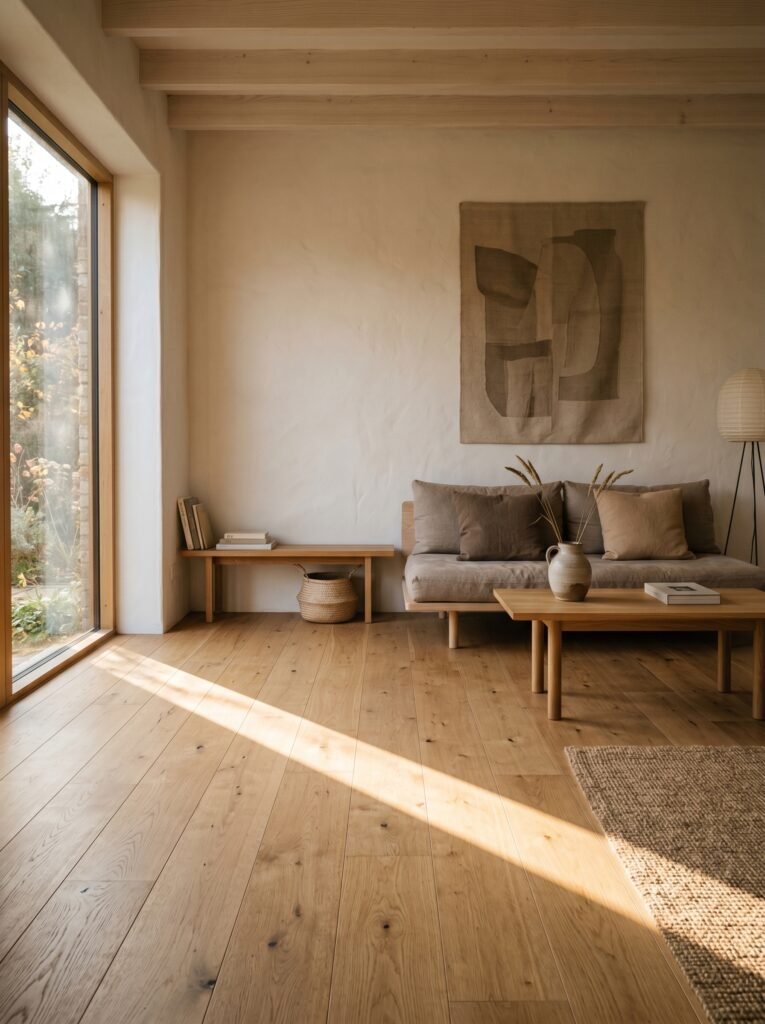
Window treatments tend to be minimal — simple linen panels that filter rather than block, or clean roller shades that disappear when not needed. Floors in warm oak or light bamboo catch the shifting afternoon sun. Walls in warm white or soft clay tones hold the light gently, releasing it slowly as the day turns towards evening. Shadow is not something to be eliminated — it adds depth, it defines form, it makes even a simple empty corner feel complete.
12. Why This Style Feels So Right for the Life We’re Living Now
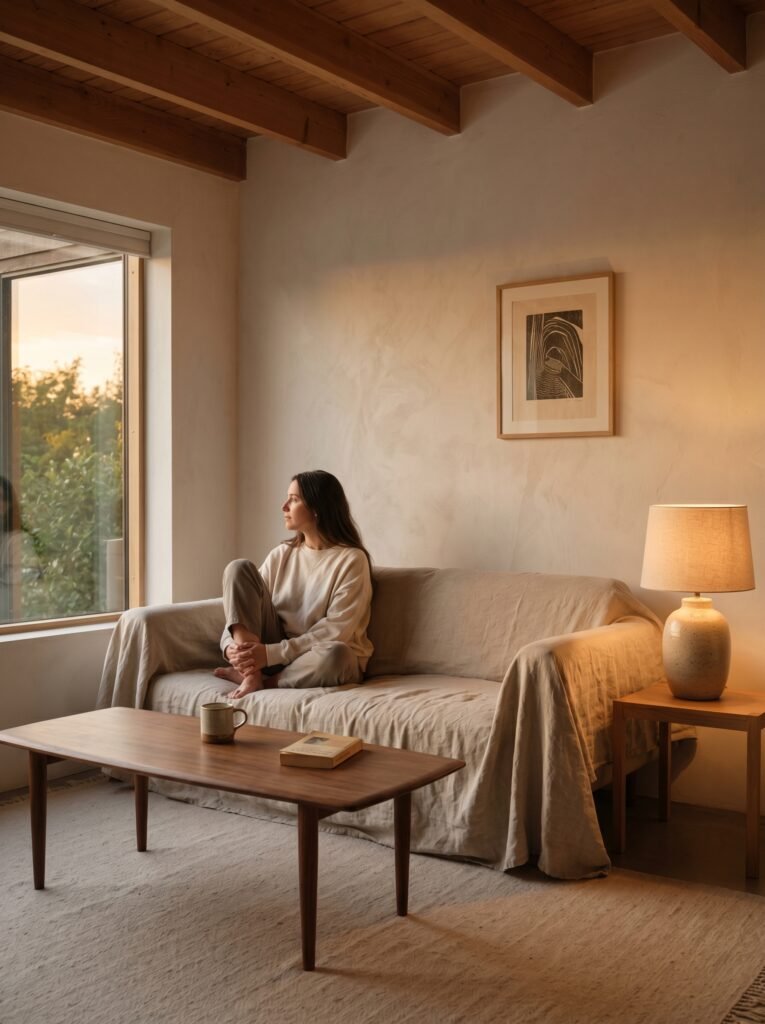
There’s something almost prescient about the way mid-century Japandi speaks to our current moment. We live in a time of relentless stimulation — notifications, noise, visual complexity everywhere we look. The idea of coming home to a room that is intentionally quiet, deliberately simple, and deeply considered feels less like a design preference and more like an act of self-preservation.
This style doesn’t require wealth. It requires editing. It asks you to buy less, choose better, and trust that a room with fewer things, each one meaningful, is richer than a room full of things that say nothing about who you are. That’s not an aesthetic philosophy. That’s a way of living.
—
🌿 How to Bring Mid-Century Japandi Into Your Own Home
The good news is that you don’t need to start from scratch or spend a fortune. Here’s how to begin shifting the energy of your space in a thoughtful, manageable way.
Start by editing, not adding. Walk through your room and ask of each object: does this earn its place? Is it beautiful, functional, or meaningful — ideally more than one? Remove anything that answers no to all three, and notice how the room begins to breathe.
Invest in one or two anchor pieces with good bones. A walnut-finish coffee table with tapered legs, a wishbone-style dining chair in natural wood, or a simple ceramic pendant light can shift a room’s entire character. Choose quality over quantity — one honest piece beats five forgettable ones.
Bring in natural materials deliberately. Swap synthetic textiles for linen, cotton, or wool in undyed or naturally toned variations. Add a single plant in a handmade ceramic pot. Place a small piece of driftwood or a smooth stone on a shelf. Let nature speak quietly in your space.
Reconsider your lighting. Replace a harsh overhead fixture with a warm-toned pendant or invest in a floor lamp that creates a pool of soft light in your reading corner. The single change of switching to warm-toned bulbs around 2700K can transform the feeling of a room at no real cost.
Slow down your relationship with the room. Sit in it at different times of day. Notice where the light falls. Notice what draws your eye. A mid-century Japandi room is meant to be lived in attentively, not just occupied.
—
❓ FAQ
Q: Is mid-century Japandi expensive to achieve? A: It doesn’t have to be. The philosophy of this style actually works in favor of your budget — you’re aiming for fewer, better-chosen pieces rather than volume. Thrift stores and vintage markets are genuinely excellent sources for mid-century modern furniture shapes at accessible prices, and simple ceramic vessels or linen textiles can be found at most price points.
Q: Can mid-century Japandi work in a small apartment? A: It may actually work better in a small space than in a large one. The emphasis on negative space, low-profile furniture, and a restrained palette means that small rooms feel calmer and more intentional rather than cramped. The low-slung furniture typical of both styles also keeps sightlines open, which makes rooms read as larger than they are.
Q: What’s the difference between Japandi and mid-century Japandi? A: Standard Japandi blends Scandinavian and Japanese design principles with a contemporary sensibility, tending toward a cooler, more minimal palette and very clean lines. Mid-century Japandi specifically incorporates the warmth, optimism, and iconic furniture forms of the mid-century modern era — tapered legs, organic sculptural shapes, slightly richer wood tones — giving the space a bit more warmth and a distinctly vintage-informed character.
—
💭 Final Thought
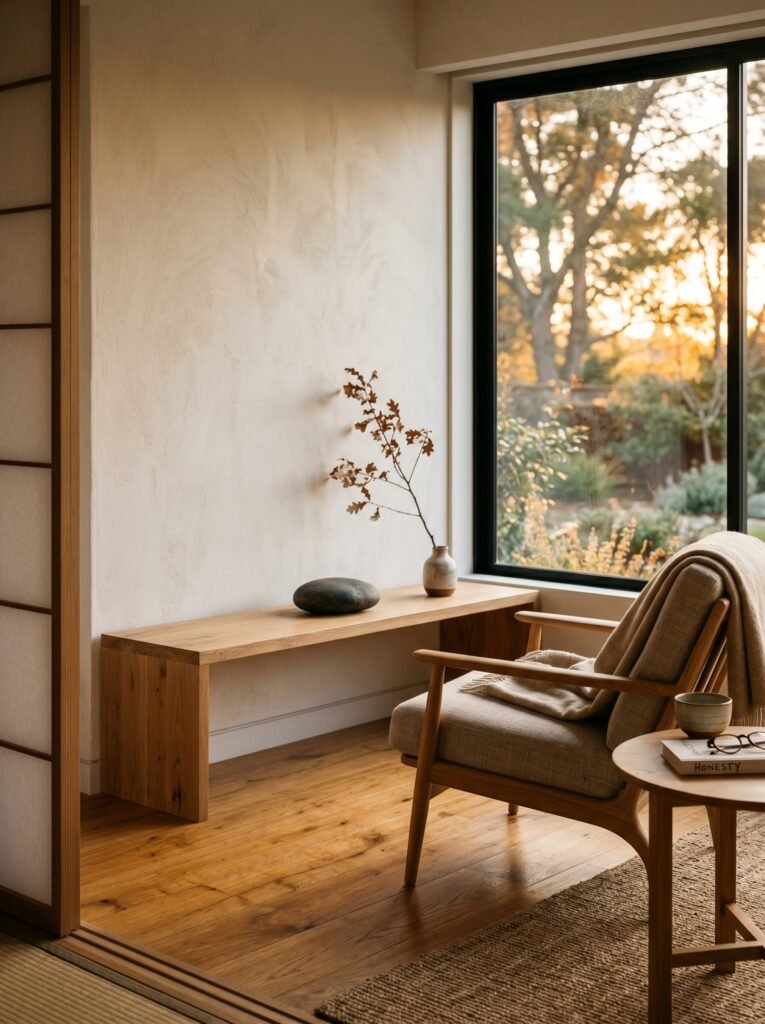
There’s a kind of room that doesn’t try to impress you — it just quietly makes you feel more like yourself. Mid-century Japandi interiors have that rare quality. They’re built not on trends, but on values: honesty, impermanence, craftsmanship, and the radical idea that enough is genuinely enough. In a world that keeps telling you to want more, a room that whispers this is sufficient might be the most subversive — and the most beautiful — space you’ll ever inhabit.
So the question worth sitting with is this: what would your home feel like if you designed it not to impress visitors, but to restore yourself?