Living Room Table Ideas That Actually Work in Real Homes (Not Just on Pinterest)
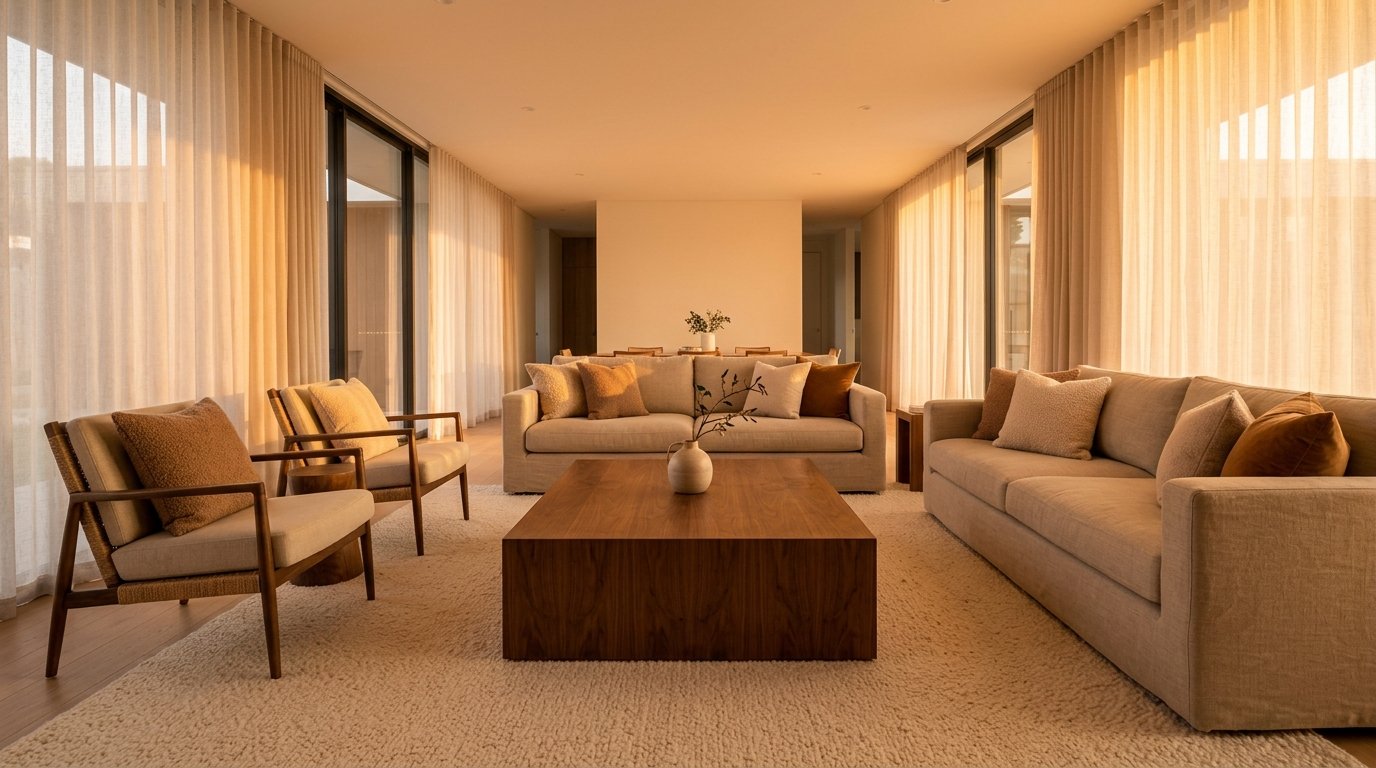
Let me tell you something about the living room table that nobody says out loud: it’s the piece of furniture that makes or breaks the whole room, and yet most people treat it like an afterthought. They buy the sofa first, paint the walls, hang the art, and then they’re standing in a half-finished room thinking okay but what goes in the middle of all this?
The coffee table, the side table, the console behind the sofa — these are the workhorses. They hold your wine glass at 10pm. They catch the keys you threw without looking. They’re where you stack the books you intend to read and the candles you light on a Friday when you’re trying to feel like a person again.
Getting them right changes everything. I mean that.
Here’s what I’ve learned, styled, obsessed over, and occasionally got completely wrong.
—
1. The Coffee Table Mistake Almost Everyone Makes on the First Try
It’s too small. Every single time.
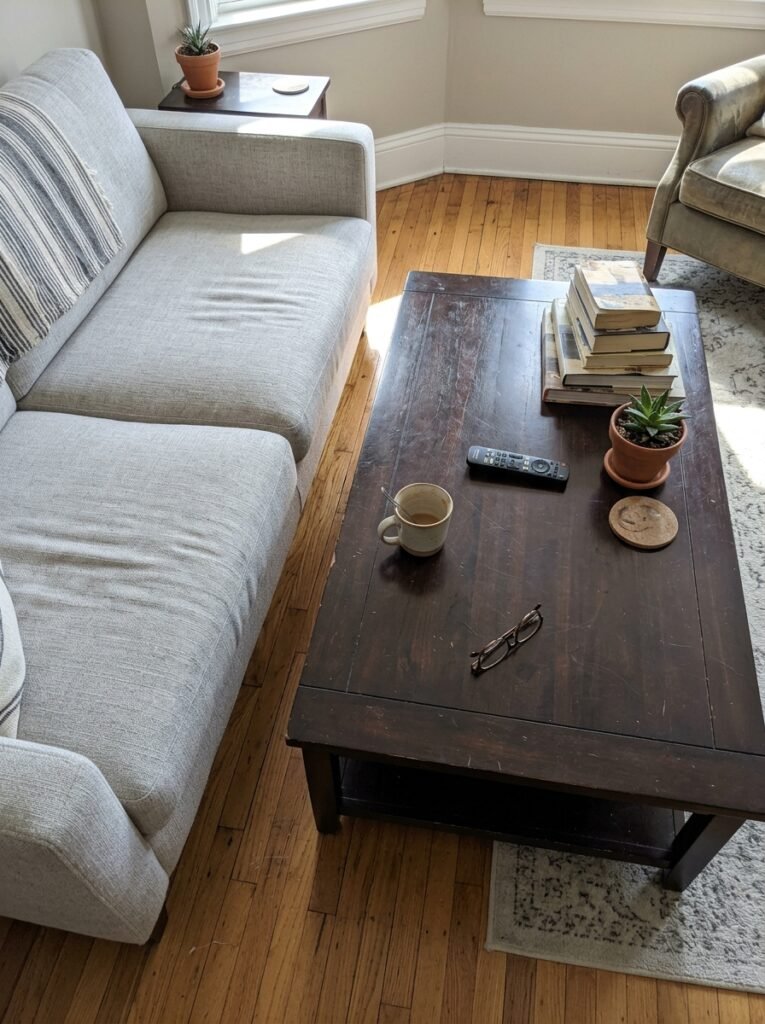
You buy something that looks perfect in the store, bring it home, center it in front of your sofa, and suddenly your living room looks like it’s missing a piece. The table floats. It doesn’t anchor anything. The proportions feel off in a way you can’t immediately name but can absolutely feel every time you walk in.
The rule that actually works: your coffee table should be roughly two-thirds the length of your sofa. Not half. Not equal. Two-thirds. If you have a 90-inch sofa, you’re looking for a table around 60 inches long.
And the height? It should sit within two inches of your sofa cushion height. Not flush, not dramatically lower — just close. So your arm can rest naturally on the sofa arm and your hand drops to the table without effort.
These aren’t aesthetic preferences. They’re functional geometry that happens to look beautiful when you get it right.
—
2. What a Round Coffee Table Does to a Room That a Rectangle Simply Cannot
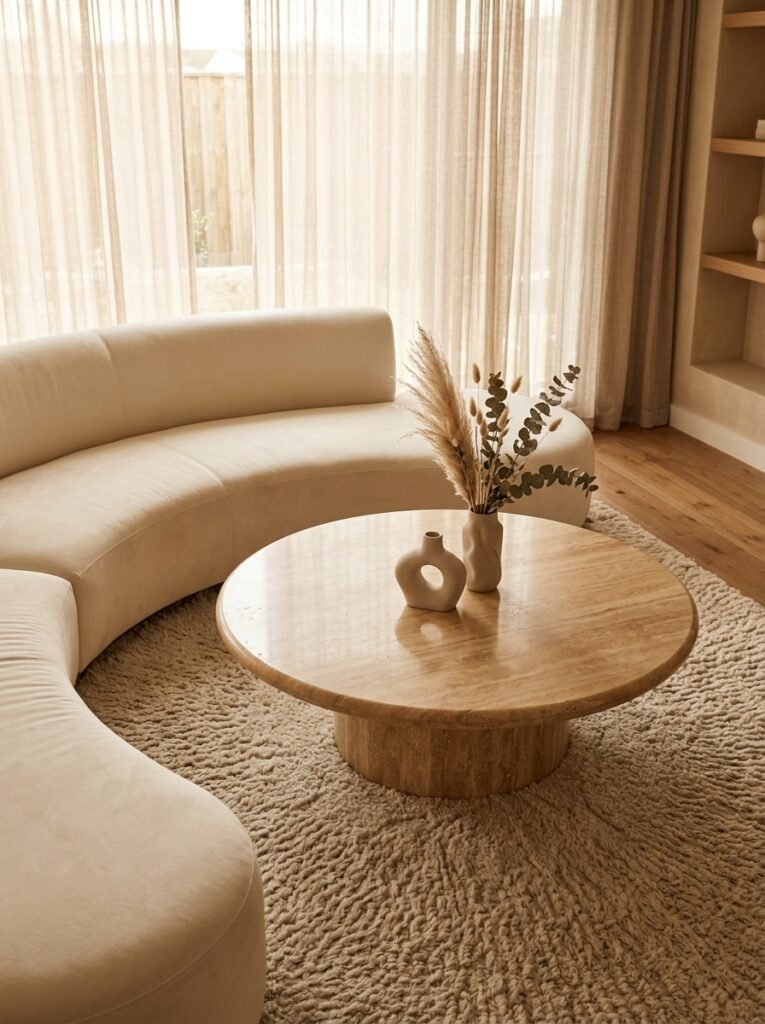
There’s something softer about a round table. Not softer in a weak way — softer the way a conversation gets easier when nobody’s sitting at the head of the table.
In a living room with sharp architectural lines, hard corners, built-in shelving, boxy furniture — a round coffee table interrupts all of that in the most satisfying way. It becomes the organic moment in an otherwise structured space.
A round table in a square room is one of the oldest design tricks in the book, and it still works every single time.
It’s also genuinely practical if you have kids, or if your living room doubles as a space where people walk through often. No sharp corners catching hips in the dark. No bruised shins on a Sunday morning.
Round tables in marble, oak, and painted rattan are everywhere on Pinterest right now, and they deserve the attention.
—
3. The Nesting Table Situation — Why Two Is Sometimes Better Than One
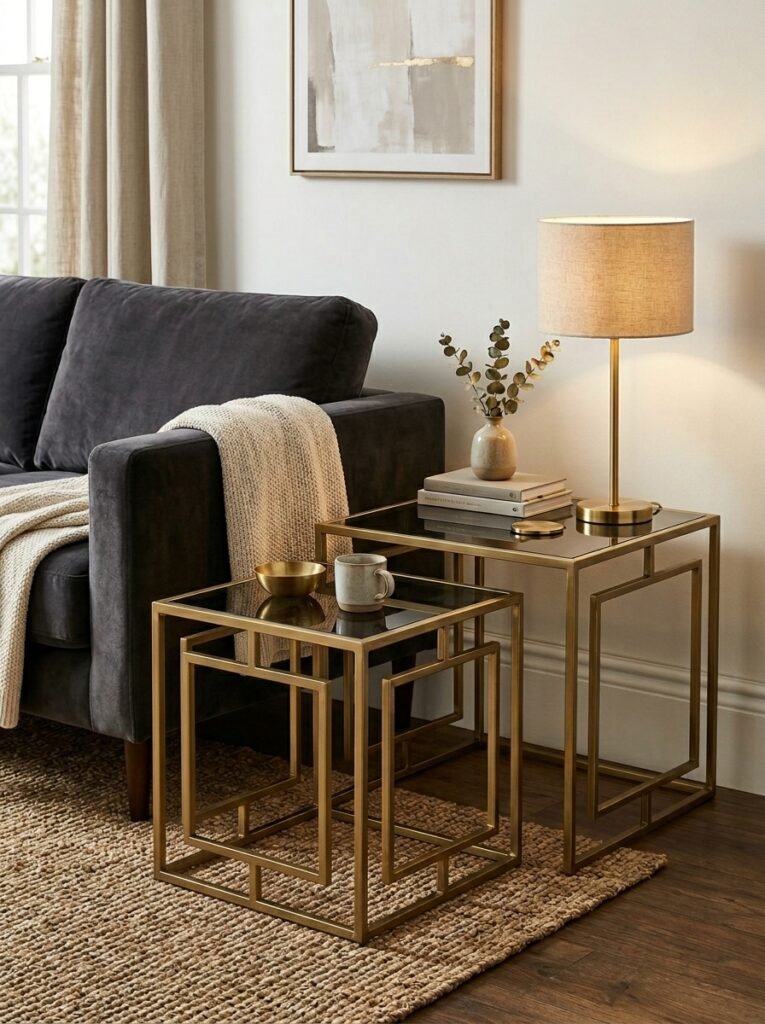
My grandmother had nesting tables. Three of them, pale yellow with gold trim, perpetually tucked into each other beside her reading chair. She pulled them out for tea. She pulled out the biggest one when she needed space. She never once bought a coffee table.
I used to think nesting tables were old-fashioned. Now I think they’re one of the most intelligent pieces of furniture ever made.
For small living rooms, they’re transformative — except I’m not supposed to say that word, so let’s say: they solve problems. When you need surface space, you have it. When you don’t, you tuck them away and the room breathes. In a flat in London or a smaller house in the American midwest, that flexibility matters more than aesthetics.
Brass and smoked glass nesting tables are having a serious moment right now, and they photograph beautifully, which explains the Pinterest saves.
—
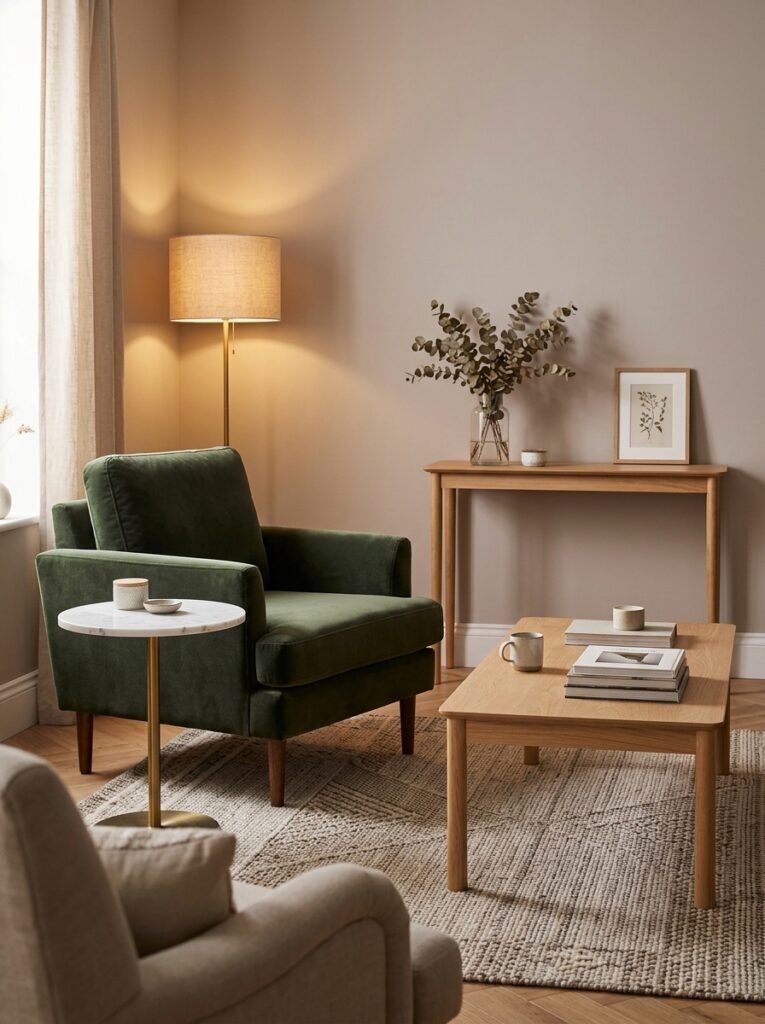
4. The One Thing a Console Table Does That a Coffee Table Never Can
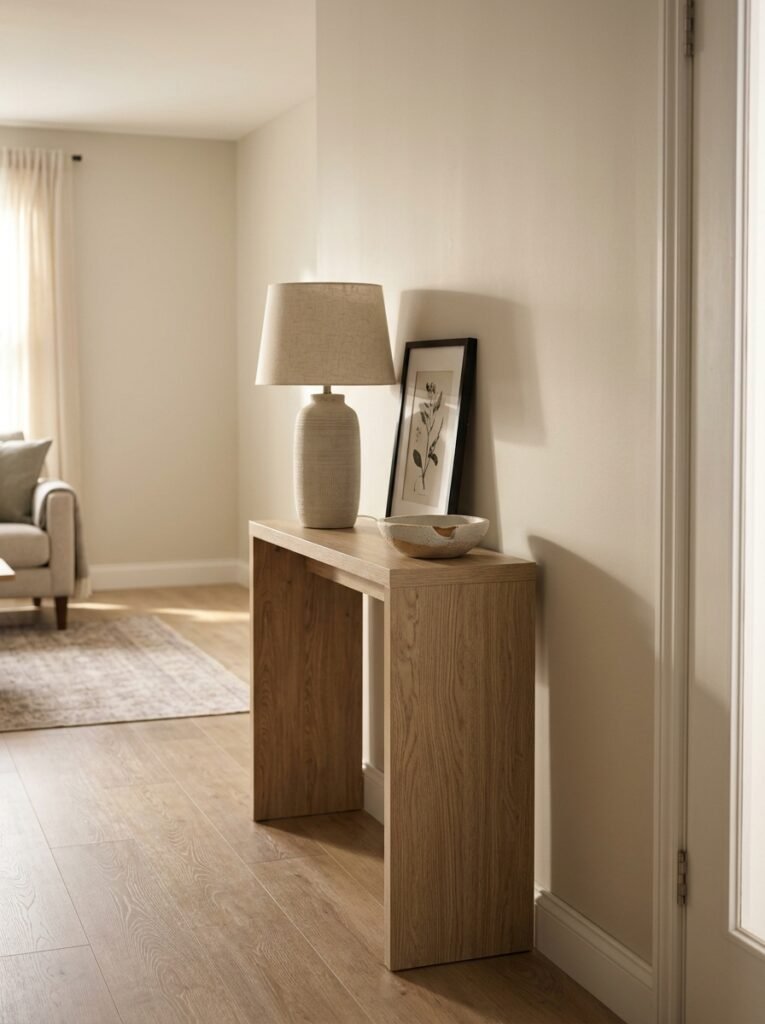
It defines the back of a room.
Most people think about furniture from the front — what you see when you walk in, what faces the sofa, what anchors the center. But a console table placed against the far wall, or behind a sofa in an open-plan space, gives the room a back. An end point. A visual period at the end of a long sentence.
A thin console table with a lamp, a few objects, something tall — a branch, a vase, a stack of art books — creates a destination in your room. It makes the eye travel and then arrive somewhere.
In open-plan American and British homes where the living room bleeds into the dining area or kitchen, a console table behind the sofa also acts as a room divider without any walls. That’s elegant problem-solving.
—
5. Styling Your Coffee Table So It Doesn’t Look Like a Store Display
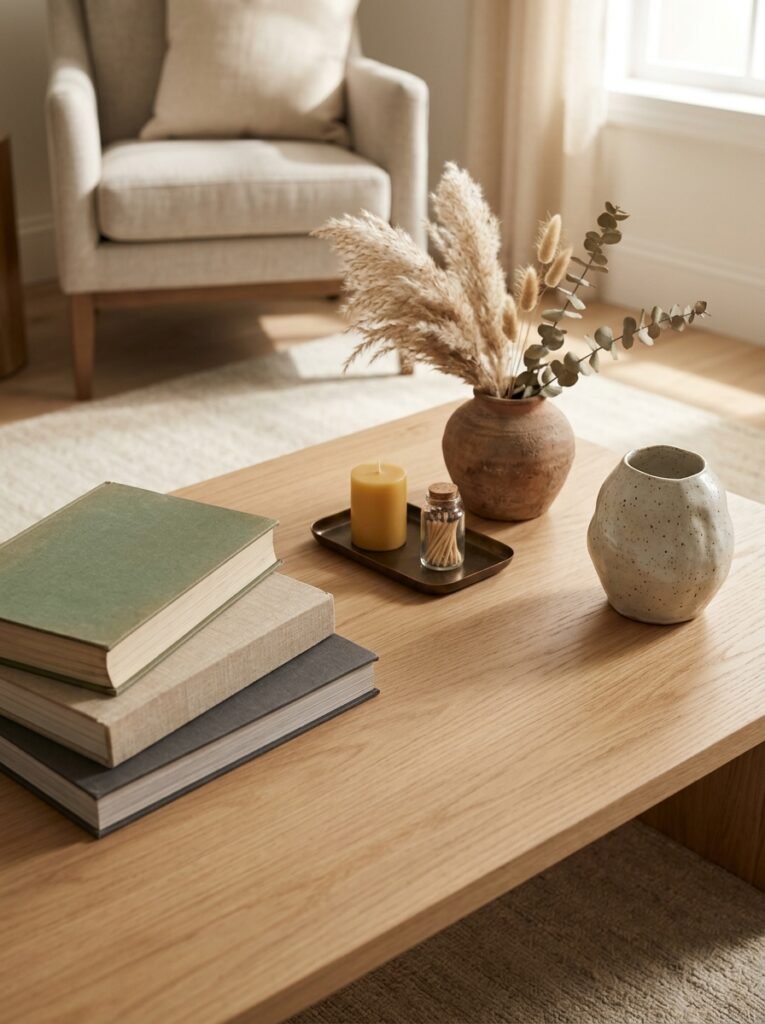
There’s a specific kind of coffee table styling that looks incredible in photos and deeply uncomfortable in real life. You know the one. Three coffee table books stacked at a perfect angle, a single sculptural object, a tray, a candle that’s never been lit.
It’s beautiful. It’s also a lie.
Real coffee table styling accounts for living. That means: yes, the tray (it corrals everything and makes the table look intentional even when life happens around it). Yes, one or two books you’ve actually read or genuinely want to read. One candle — one — in a holder that has some weight to it.
The thing that makes it feel human is one object that doesn’t quite belong. A smooth stone from a beach. A small ceramic your friend made. A weird little sculpture from a thrift shop. Something with a story, even if you never tell anyone the story.
That’s the difference between a styled surface and a lived surface.
—
6. The Side Table Height Rule Nobody Told You About
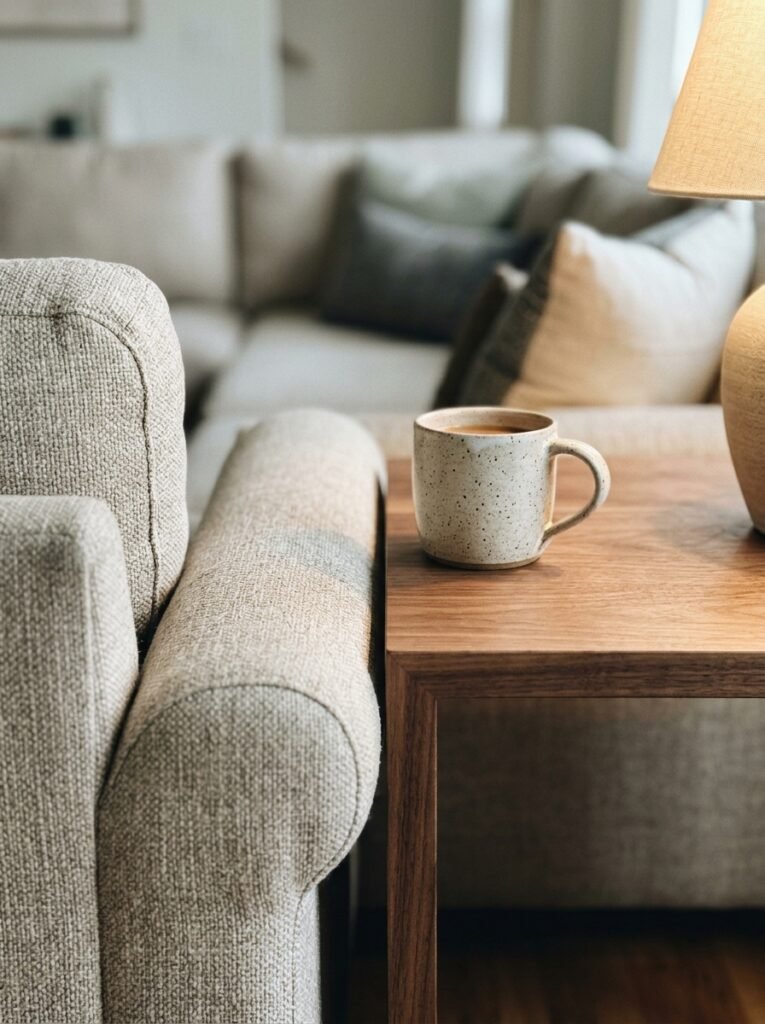
Your side table should be even with or within two inches of the arm of your sofa or armchair.
That’s it. That’s the whole rule.
But nobody tells you this, so people buy side tables that are too tall (your elbow rests awkwardly elevated, like you’re perpetually signaling a waiter) or too short (you have to lean and lunge for your drink, which is undignified and slightly exhausting).
The right height side table means you set your glass down without looking. You reach for your phone and it’s just there. It integrates into how you actually use your body in the space. That’s good design.
—
7. Drum Tables, Pedestal Tables, and the Round Side Table Renaissance
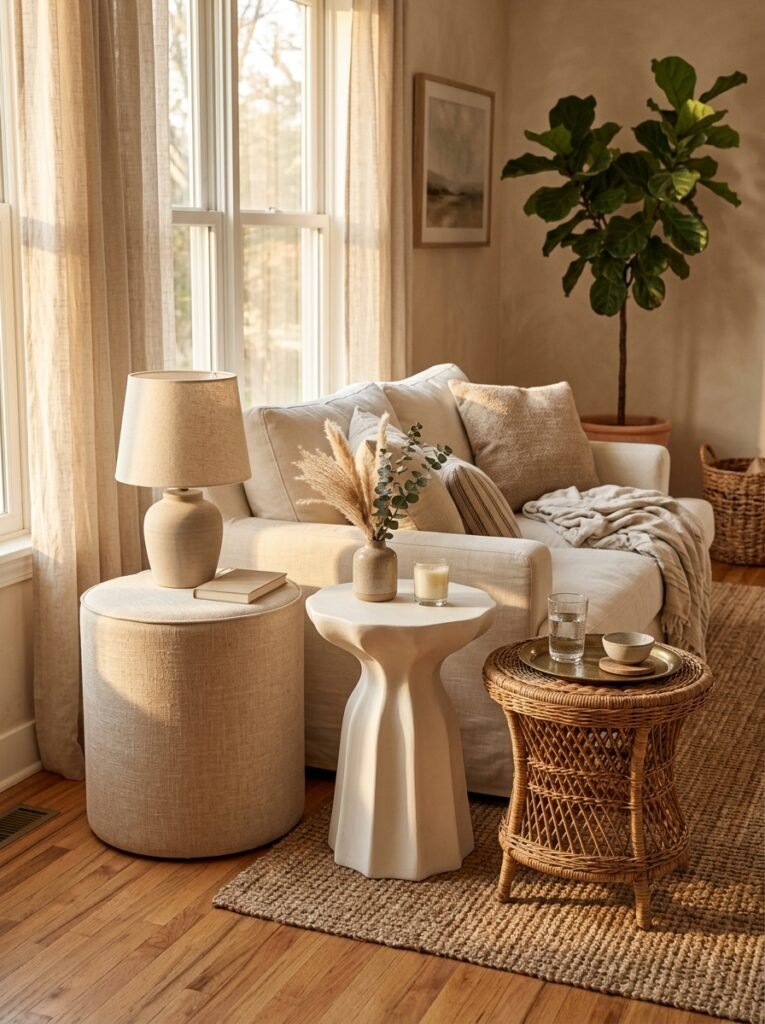
Let’s talk about round side tables specifically because they are everywhere right now and there’s a reason.
A round side table next to a sofa softens whatever’s around it, the same way the round coffee table does but in miniature. It also takes up less visual space — your eye doesn’t register a pedestal or drum table the way it clocks the sharp corner of a square side table.
In rooms that are heavily patterned or full of visual interest, a simple drum side table in a warm neutral — linen, mushroom, terracotta — gives the eye somewhere to rest.
In very minimal rooms, a sculptural pedestal side table in travertine or marble does something entirely different: it becomes the object. It carries visual weight.
The Pinterest saves on marble pedestal side tables have been consistent for three years now. That’s not a trend anymore. That’s a preference settling in.
—
8. What Happens When You Use a Trunk or Ottoman as a Coffee Table
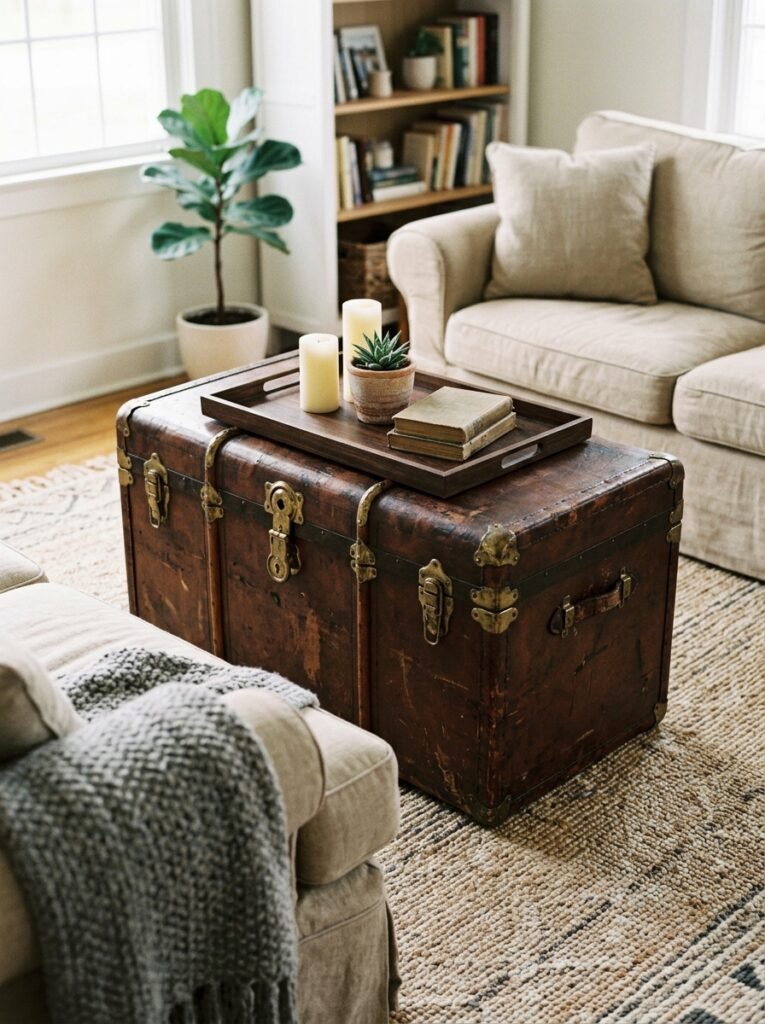
A lot, actually.
A storage ottoman in a neutral boucle or leather placed in the center of a living room gives you four things at once: a coffee table surface (add a tray to make it work as one), extra seating when people come over, hidden storage underneath, and a softness that no hard table can replicate.
In family homes, it’s genuinely a brilliant solution. Nothing breaks. Nothing has sharp edges. Kids can sit on it. You can put your feet up without feeling guilty.
The tray on top is essential — it defines the “table” part and stops things from slipping. A wooden tray with low sides works best. Keep it simple on top: a candle, a book, a small plant.
What it loses: you can’t have a glass of wine with a wobbly tray on an ottoman in the same easy way. There’s a slight softness tax. Worth it, for many rooms.
—
9. The Unexpected Material That Makes a Living Room Table Look More Expensive
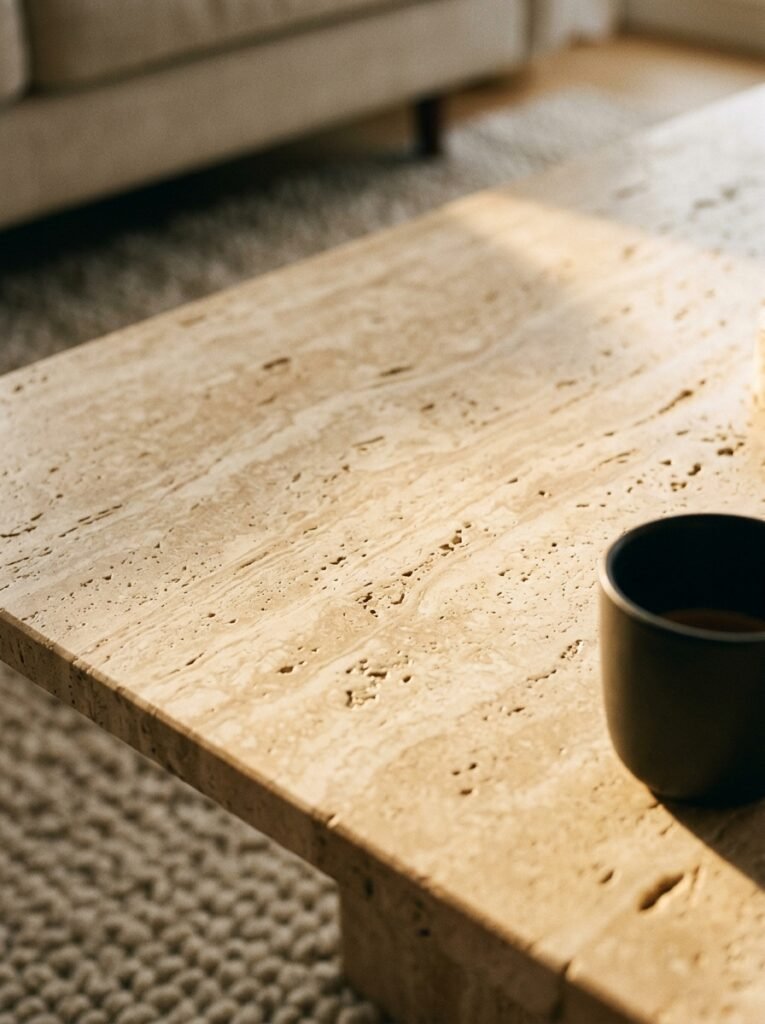
Concrete. Or travertine. Or stone with visible veining.
Not marble — or not necessarily. Marble is beautiful but it’s been everywhere so long it reads as expected now. What reads as quietly expensive in 2024 and 2025 is rough stone. Unpolished travertine. Concrete with variation in it. Limestone with its almost dusty surface.
These materials have weight. Not just physical weight — visual weight. They make a table look like it’s been there forever, like it belongs to the architecture of the room rather than something placed on top of it.
A small travertine side table. A concrete coffee table with a matte finish. These things work in rooms that are otherwise very warm and textile-heavy because the cool hardness of the stone provides contrast. That contrast is what makes the room feel designed rather than just decorated.
—
10. Glass Tables: When They Work and When They Make a Room Feel Like a Hotel Lobby
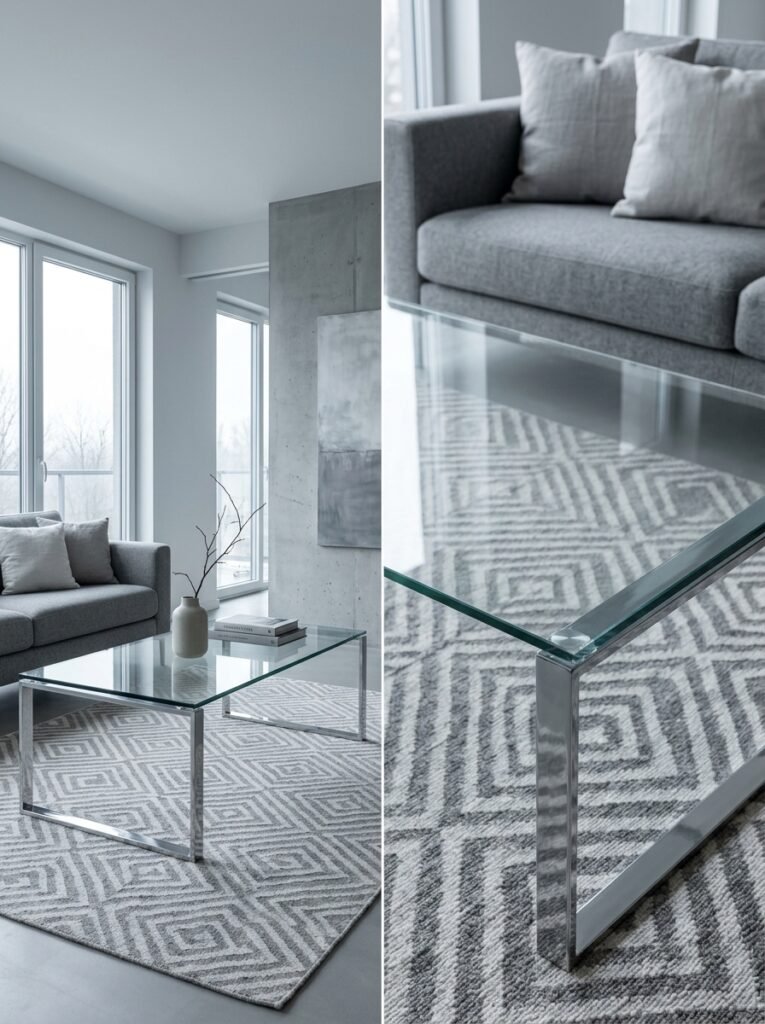
Glass coffee tables have a complicated reputation.
Here’s when they work: in a small room, a glass-topped table with a metal or stone base keeps the floor visible, which reads as space. The eye travels through the table rather than stopping at it. In a room that needs to feel lighter or larger, that’s a real advantage.
Here’s when they don’t work: when the room is already very cold in feeling — lots of grey, lots of metal, not much warmth — a glass table adds to that coldness. And glass shows every fingerprint, every water ring, every crumb. That’s not a style observation, that’s just life.
A smoked glass table is different. Smoked glass has warmth that clear glass doesn’t. It also hides evidence of being used, which is not nothing.
—
11. The Console Table Behind the Sofa — Why It’s the Most Underused Idea in This Whole List
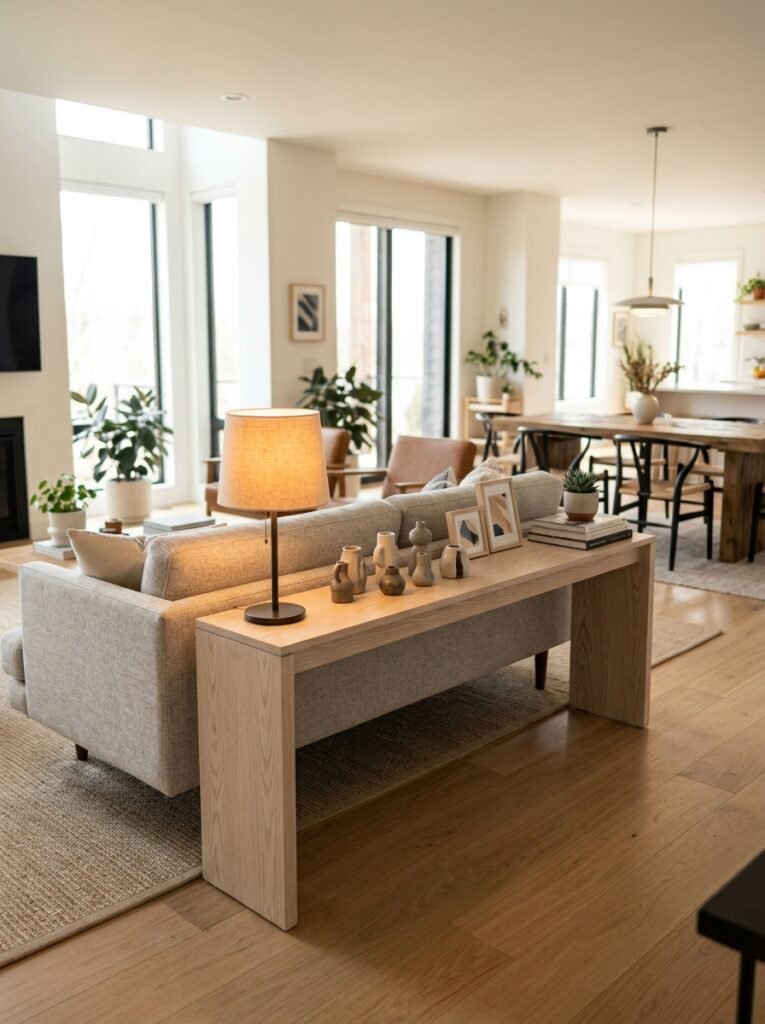
I keep coming back to this because I don’t think people use it enough.
A slim console table — 10 to 12 inches deep, pushed against the back of a sofa in a floating furniture arrangement — creates something genuinely special. It’s where you put the lamp that lights the sofa from behind, which is the warmest kind of lighting possible. It’s where a trailing plant sits and does its thing. It’s where you drop your phone and your book and your reading glasses without them disappearing into sofa cushions.
In a room where the sofa sits away from the wall (which creates better conversation, better traffic flow, better everything), the console table anchors the sofa’s position. The sofa and the console read as a unit, and the room feels more resolved.
This idea gets saved on Pinterest constantly. It deserves to actually get implemented more often.
—
12. How to Mix Table Materials Without It Looking Chaotic
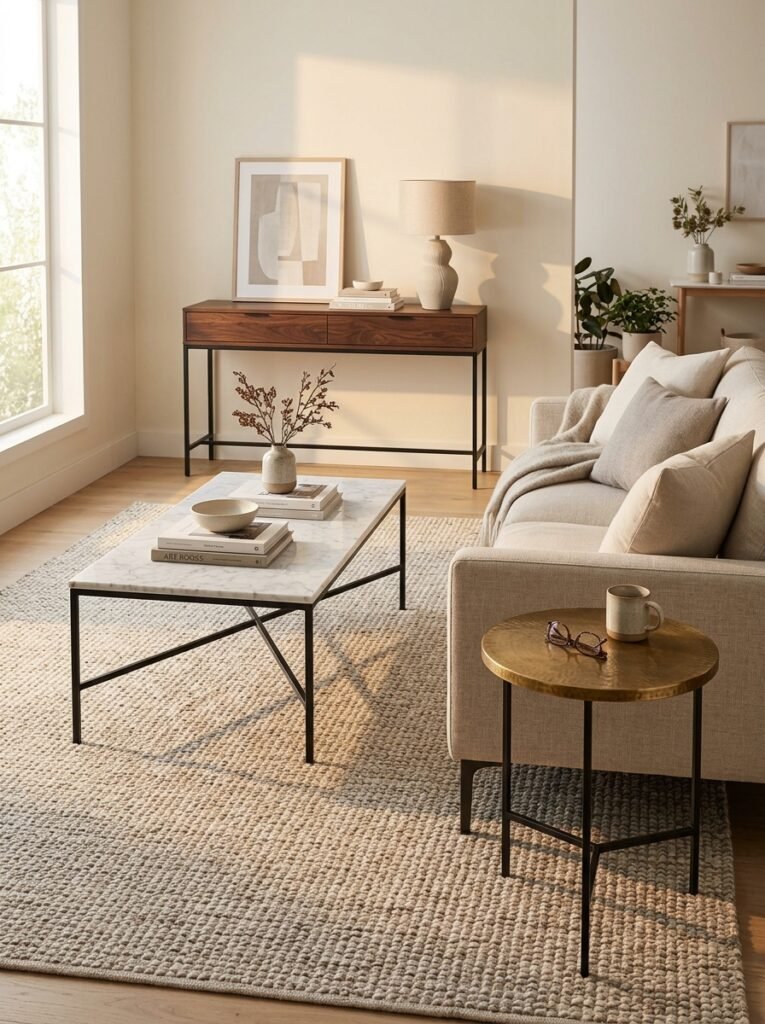
The anxiety: if my coffee table is wood and my side table is metal and the console is marble, will it look like I couldn’t make a decision?
The answer: only if the shapes don’t have a common language.
When mixing materials, keep the shapes coherent. If one table has tapered legs, all your tables should have tapered legs, or organic curved forms, or clean geometric bases — pick a shape vocabulary and stick to it. The materials can do their own thing.
Or: repeat a color across the different materials. A warm brass accent on a marble side table and the same warm brass on a wooden coffee table’s hardware — that thread running through the room ties everything together even when the materials are completely different.
This is how professional interiors work. They’re rarely all-matching sets. They’re internally coherent.
—
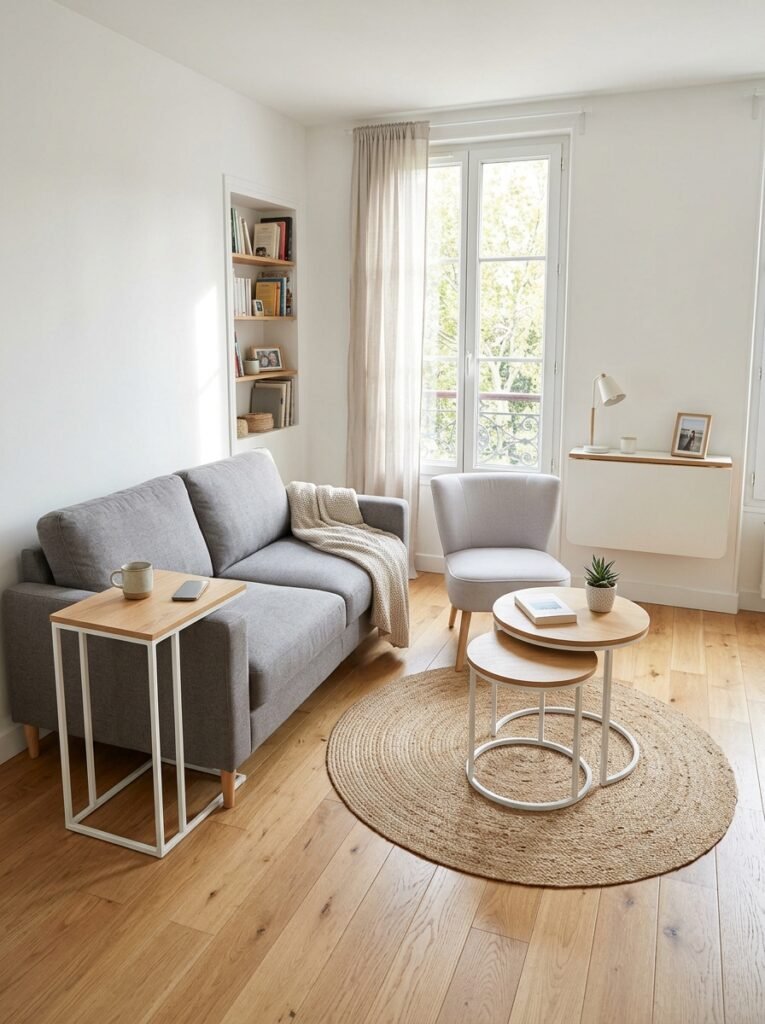
13. Three Small Living Room Table Ideas That Actually Solve the Small-Room Problem
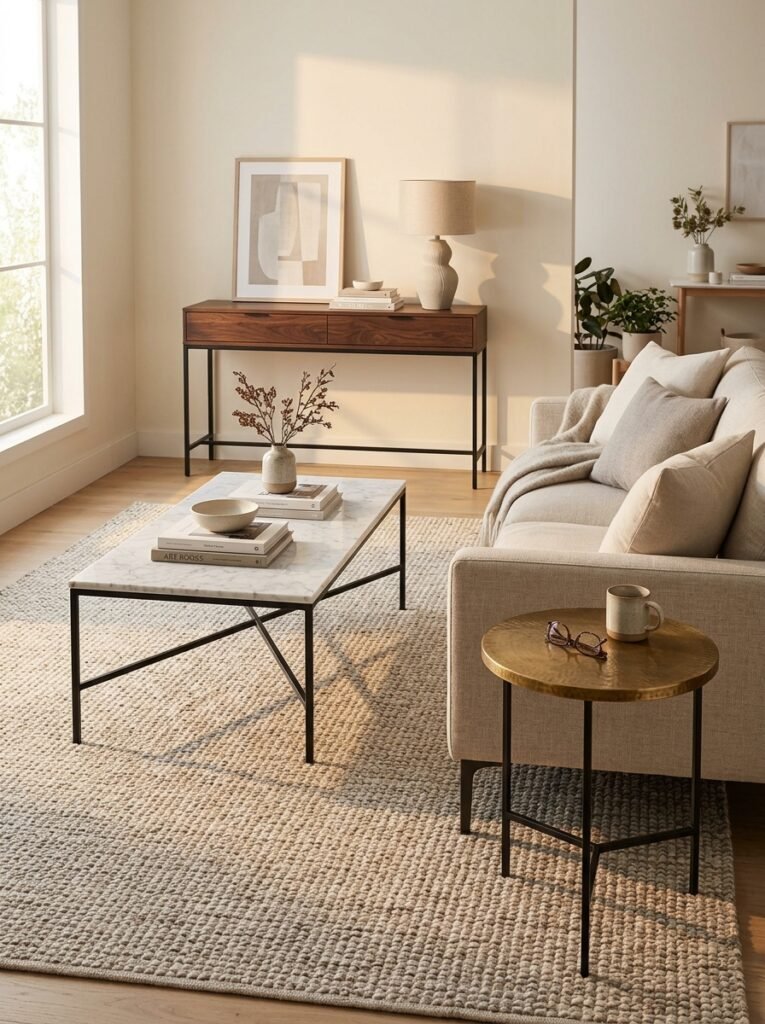
Small rooms need different thinking. Here’s what actually works:
Transparent and open-base tables keep the floor visible and the room feeling open. Glass, acrylic, wireframe metal bases — anything the eye can travel through.
One table instead of two — specifically for side tables. Instead of a side table on each end of the sofa, choose one slightly larger table at the end you actually use. The asymmetry doesn’t hurt the room. The visual clutter of two unnecessary tables does.
Height variation — a low coffee table and a taller side table create visual interest without adding volume. The different heights make the room feel layered rather than crowded.
—
14. The Coffee Table Book Stack That Actually Reflects Who You Are
This one’s personal. Stay with me.
Every living room needs at least one stack of books on or near the coffee table that are actually yours. Not styling props. Not books you bought because the spines photograph well.
Books you’ve read, books you’re reading, books someone gave you, books you’ve had since university that are slightly falling apart. That stack of three or four real books, slightly imperfect, some face up and some face down — it says more about a room than any single piece of furniture.
It also starts conversations. Strangers look at your coffee table, see what’s there, and suddenly you’re talking. That’s the whole point of a well-designed living room, when you strip everything back.
Connection. Ease. The feeling that someone actually lives here.
—
Frequently Asked Questions About Living Room Tables
What size coffee table should I get for my living room? Aim for a table that’s roughly two-thirds the length of your sofa and sits within two inches of the sofa cushion height. Most people go too small — when in doubt, size up.
Can I use a round coffee table in a rectangular living room? Yes, and it often looks better than a rectangle-on-rectangle arrangement. The contrast in shape adds visual interest and softens harder architectural lines.
What height should a side table be? Even with, or within two inches of, your sofa or chair arm height. This ensures comfortable reach without awkward arm positioning.
Is it okay to mix wood and metal tables in the same room? Absolutely. The key is keeping a consistent shape vocabulary — similar leg styles, similar proportions — even when materials differ. A shared metallic accent color helps tie different materials together.
What can I use instead of a traditional coffee table? A storage ottoman with a tray on top, a set of nesting tables, a large tray on a low base, or even a stack of very large, very sturdy books with a tray on top. Function first, then form.
How do I style a coffee table without it looking too staged? Use a tray to corral items, keep it to three or four objects maximum, and include one thing with genuine personal meaning. The imperfect personal object is what separates a styled surface from a store display.
What’s the best coffee table for a small living room? Glass or open-base tables keep the room feeling spacious. Nesting tables offer flexibility when you need them and disappear when you don’t. Round tables often work better than rectangles in smaller spaces because they allow easier movement around them.
—
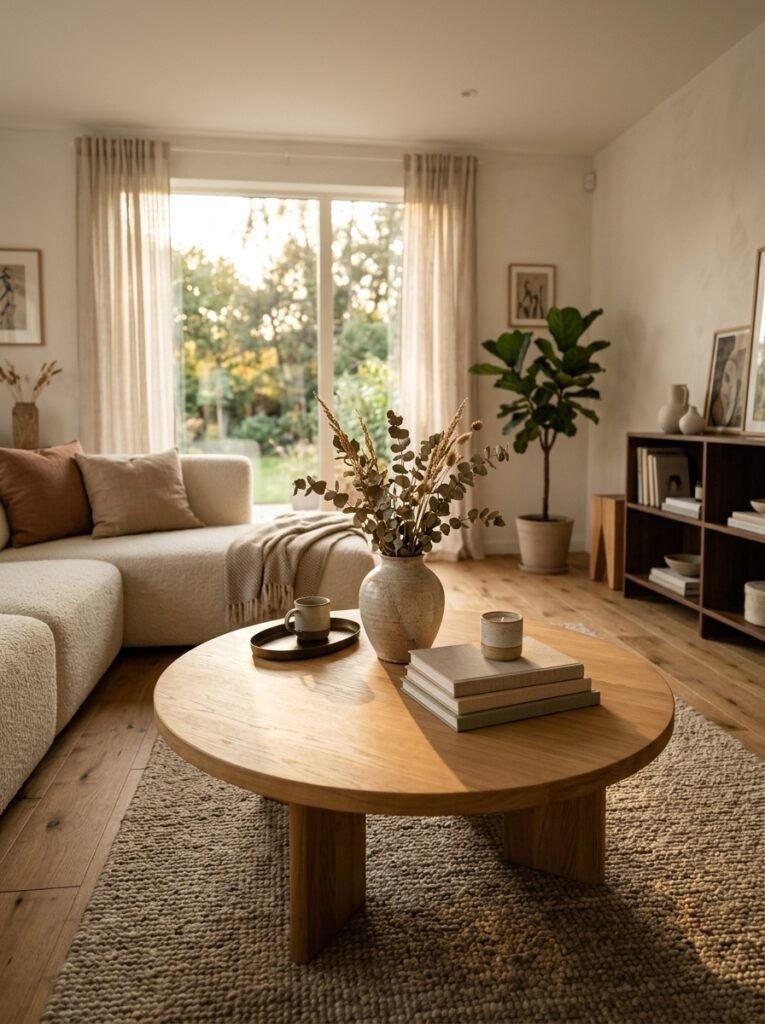
Here’s the thing about living room tables that I keep returning to: the best ones eventually stop being noticed. They just become part of how the room feels. The right height, the right material, the right scale — and suddenly the room has ease in it, the way a well-fitted jacket has ease, nothing pulling or straining or demanding attention.
That’s the goal, really. Not a room that looks perfect in a photograph. A room you walk into after a long day and exhale.
Tables are how you get there.