
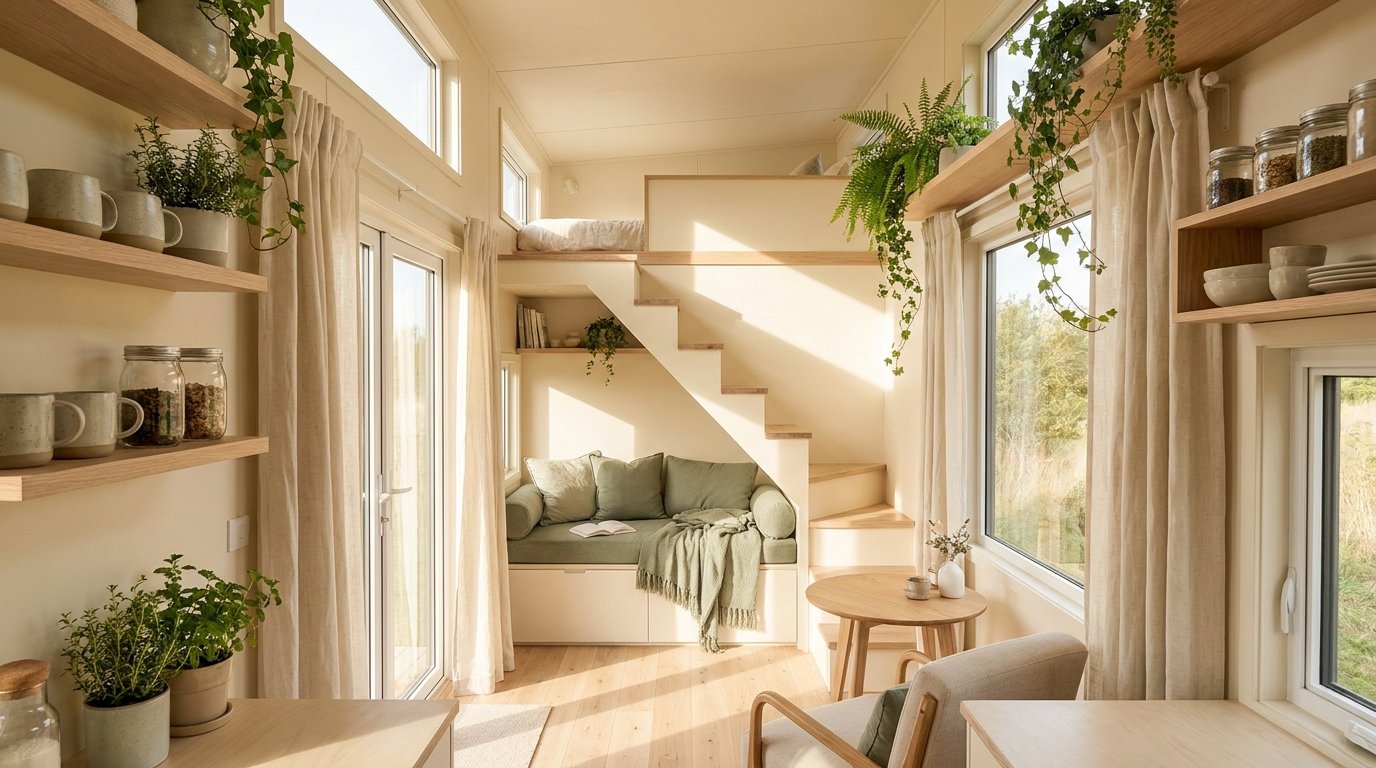
Modern Tiny House Interiors That Prove Small Spaces Hold the Biggest Dreams
There’s a quiet revolution happening — one built not on square footage, but on intention. People are trading sprawling rooms for carefully crafted corners, and in doing so, they’re discovering something surprising: a smaller home can hold an extraordinarily full life.
—
1. Why Modern Tiny Houses Are Capturing Hearts (and Pinterest Boards) Everywhere
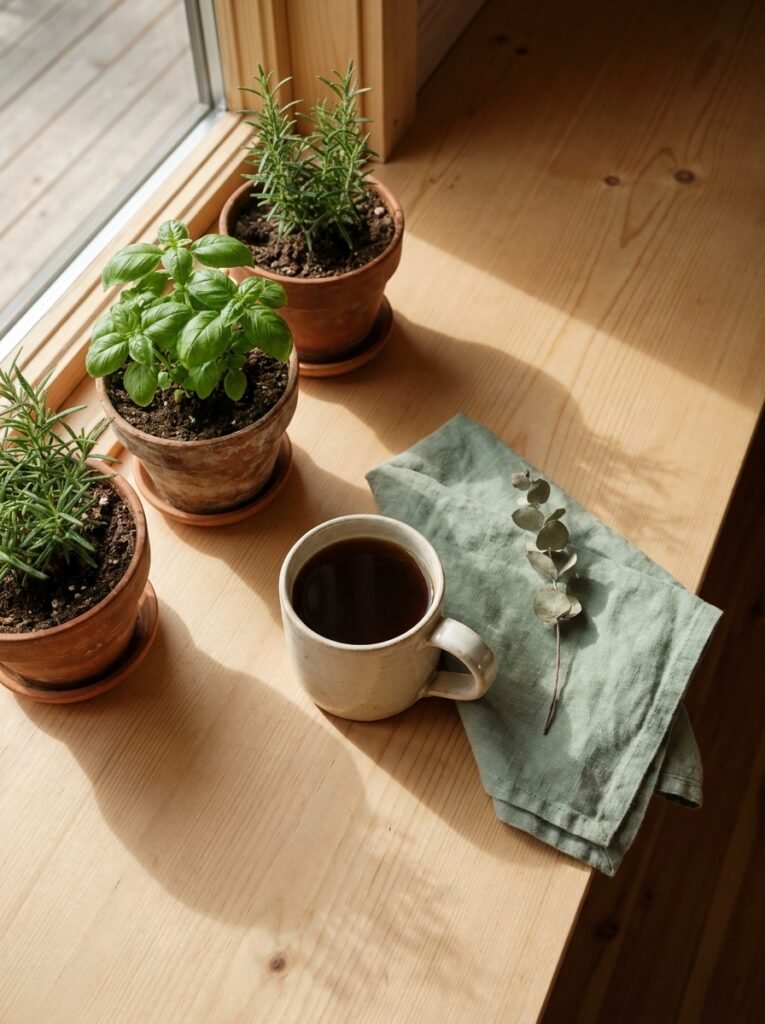
It starts with a feeling, not a floor plan. You scroll past a photo of a 350-square-foot home and something in your chest tightens — not with claustrophobia, but with longing. The warm wood tones, the perfectly placed linen curtains, the tiny kitchen with herbs growing on the windowsill. It looks like peace. It looks like enough.
Modern tiny house interiors have exploded across Pinterest for a reason that goes far deeper than aesthetics. They represent a fundamental shift in how people are choosing to live — prioritizing quality over quantity, experience over accumulation, and beauty over size. The idea that you need more space to live well is slowly, beautifully unraveling. A well-designed tiny house isn’t a compromise. It’s a choice — a deliberate, deeply personal one.
In fact, some of the most stunning interior design happening right now is taking place inside spaces under 500 square feet. Designers and homeowners alike are being forced to think creatively, and that creative pressure is producing interiors that are genuinely extraordinary.
“A tiny house doesn’t shrink your life — it sharpens it.”
2. The Design Philosophy That Makes Tiny House Interiors So Breathtaking
Before you hang a single shelf or choose a paint color, you need to understand the core philosophy behind great tiny house design: every single element must work twice as hard. In a large home, a decorative vase is just a vase. In a tiny house, it’s a vase that also echoes the color palette of your throw pillows, sits at the perfect height to draw the eye upward, and makes the room feel three times its actual size.
This intentionality is what separates a tiny house that feels cramped from one that feels curated. Modern tiny house interior design is rooted in the principle of purposeful minimalism — not the cold, sterile minimalism that strips joy from a space, but a warm, layered version that keeps only what is meaningful and arranges it with care.
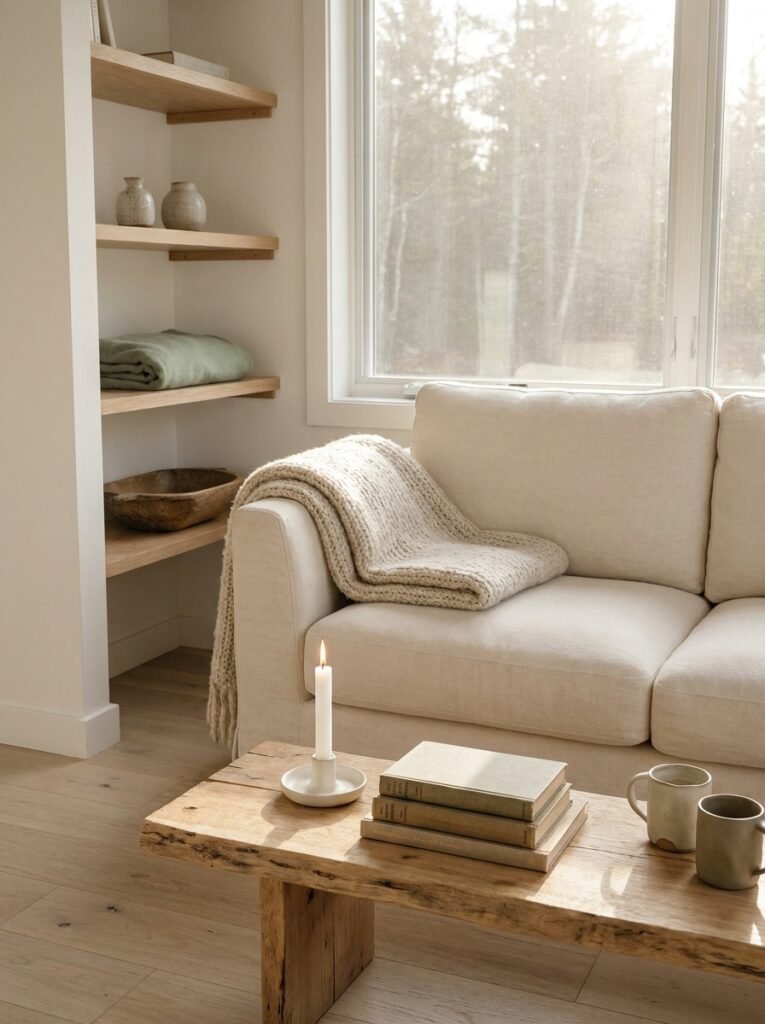
Japanese wabi-sabi philosophy plays beautifully into this. The idea that beauty lives in simplicity, in natural materials, in imperfection. When you layer this with Scandinavian hygge — that untranslatable sense of cozy warmth — you get interiors that feel both modern and deeply human. Light wood floors, natural linen, matte ceramic mugs on open shelves, a single candle burning on the table. It’s not about having less. It’s about having exactly right.
3. Color Palettes That Make Small Spaces Feel Expansive and Alive
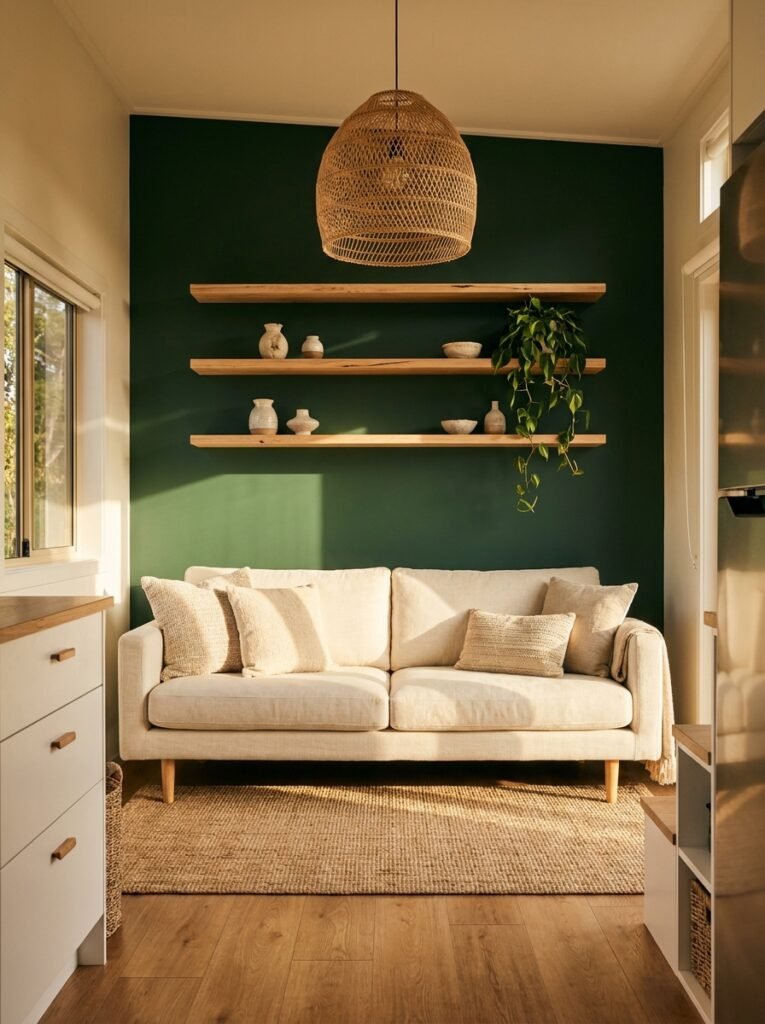
Color is one of the most powerful tools in a tiny house designer’s kit — and one of the most frequently misunderstood. The old rule was always “go white to make it bigger,” but modern tiny house design has moved well beyond that advice. Yes, light tones still have their place, but the magic is in how you use them.
Warm whites and soft creams — think Benjamin Moore’s White Dove or Sherwin-Williams’ Alabaster — reflect light without feeling clinical. They create that soft, glowing quality you see in those dreamy Pinterest photos where the morning light just seems to pour through every corner. Paired with natural wood accents, these tones feel lived-in and warm rather than stark.
Don’t be afraid of deeper tones, either. A single dark accent wall — a rich forest green, a moody terracotta, a deep navy — can actually anchor a small space and make it feel more intentional. Paradoxically, going bold in a small room can eliminate the “unfinished” feeling that sometimes plagues tiny spaces. It signals confidence. It says: this is not a small house trying to look big. This is a beautifully designed home that happens to be small.
Natural materials — raw wood, woven rattan, linen, stone — should appear throughout. They add texture without visual weight, warmth without clutter, and they age beautifully in ways that manufactured materials simply cannot.
4. Furniture That Transforms, Folds, and Does the Impossible
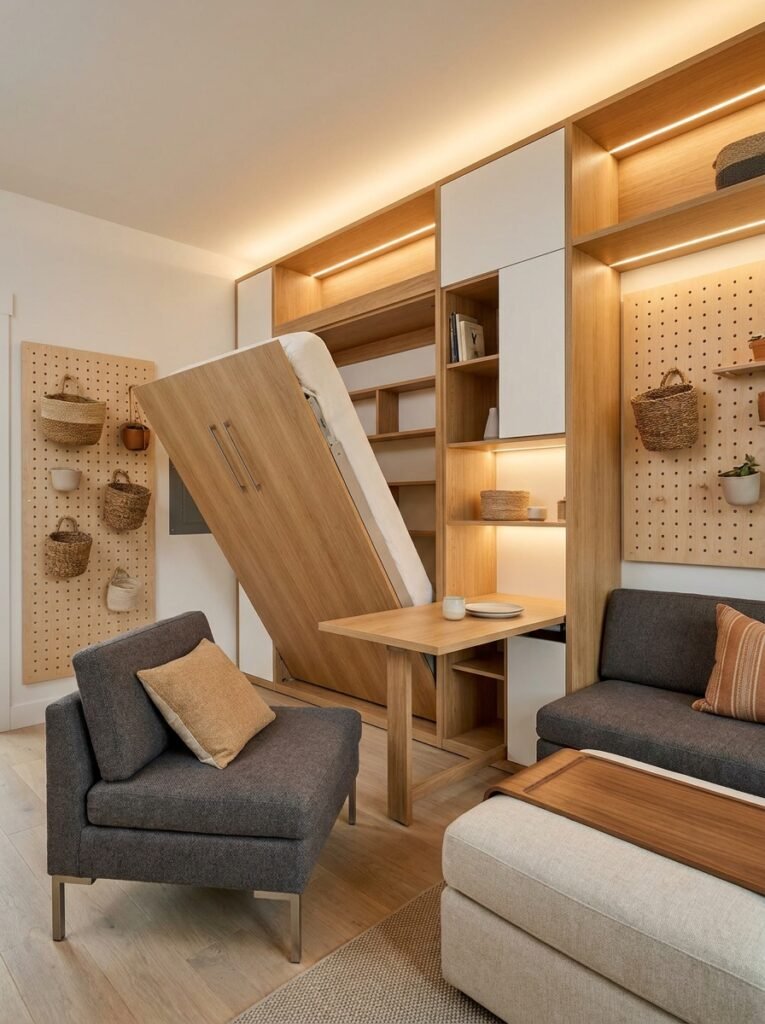
If you’ve ever watched a Murphy bed fold out from what appeared to be a living room wall, you understand the particular joy of multifunctional furniture. In modern tiny house interiors, furniture isn’t just furniture — it’s engineering, artistry, and problem-solving all wrapped into one beautiful object.
The sofa that becomes a guest bed. The dining table that folds against the wall and disappears entirely when it’s not needed. The ottoman that opens up to store blankets, board games, and last winter’s sweaters. The kitchen island on wheels that rolls out for meal prep and tucks away during a dinner party. Every piece of furniture in a well-designed tiny house has been chosen with the same question in mind: what else can this do?
Vertical space is everything. In tiny house design, your walls are not decoration — they are real estate. Floor-to-ceiling shelving systems, hanging pot racks in the kitchen, wall-mounted bedside tables, pegboards for kitchen tools, hooks for bags and coats — all of these draw the eye upward and use space that would otherwise be completely wasted.
Look for furniture with legs rather than pieces that sit directly on the floor. Raised furniture allows light to travel underneath, which makes a room feel larger and airier. A sofa with slim metal legs in a tiny living room will always feel more spacious than a bulky sectional that sits directly on the floor, regardless of how comfortable that sectional might be.
“The furniture you leave out of a tiny house matters just as much as what you bring in.”
5. Kitchen Design in a Tiny House: Small Space, Massive Flavor
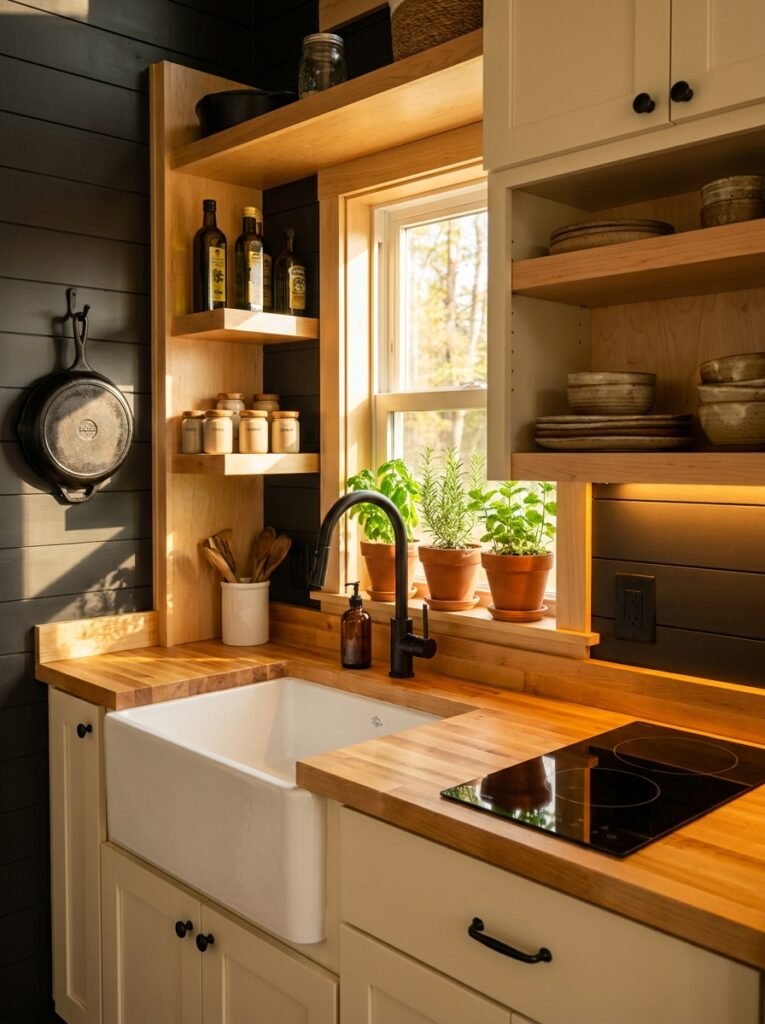
There is something deeply satisfying about a tiny kitchen that works beautifully. It’s tight, efficient, everything within reach — and when it’s designed well, it becomes the most-used, most-loved room in the whole house. Imagine Sunday morning in a tiny house kitchen: the coffee maker is already humming, herbs are growing in terracotta pots on the windowsill, a cast iron skillet hangs on the wall within arm’s reach, and golden light is pouring over the butcher block countertop.
Modern tiny house kitchens embrace open shelving over upper cabinets — it removes visual weight, forces you to keep only beautiful, useful things, and creates that magazine-ready look that photographs so well. Display your olive oils and vinegars in beautiful glass bottles, your spices in uniform ceramic jars, your everyday dishes in a simple stack. When everything is visible, you’re motivated to keep it beautiful.
Compact appliances have come incredibly far in recent years. Induction cooktops, counter-depth refrigerators, drawer dishwashers — these are no longer the compromises they once were. They perform beautifully, and in a tiny kitchen, their smaller footprint means more breathing room for you and your cooking.
A deep single-basin sink rather than a double basin gives you more usable prep and wash space. A magnetic knife strip on the backsplash keeps your knives accessible and off the precious counter. Under-cabinet lighting transforms both function and atmosphere — it makes the kitchen feel warm and intentional at night, and provides excellent task lighting while you’re cooking.
6. The Loft Bedroom: Where Sleeping Feels Like a Secret Retreat
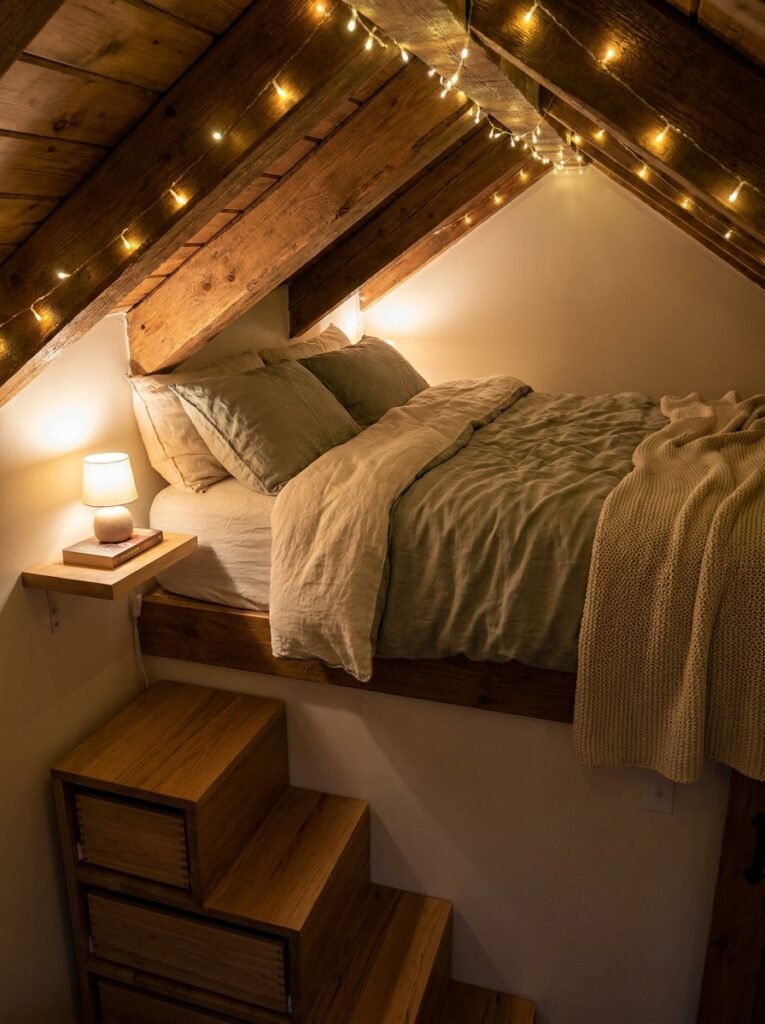
There’s a reason loft bedrooms are one of the most-pinned features of modern tiny house interiors. Tucked up above the living space, accessed by a beautifully crafted ladder or compact staircase, a loft bedroom feels like an adult treehouse — private, cozy, and entirely your own.
The key to a stunning loft bedroom is leaning into the coziness rather than fighting it. Low ceilings become an asset when paired with the right bedding — layer upon layer of linen, cotton, and knit textures in soft, calming tones. Warm string lights draped along the ceiling rafters create an ambiance that no overhead fixture can replicate. A small reading shelf, a tiny lamp, a candle holder — everything you need, nothing you don’t.
Built-in storage under the loft stairs is a design move that never fails. Pull-out drawers, small closets carved into the stair structure, bookshelves along the stair wall — this otherwise wasted transitional space becomes some of the most valuable storage in the entire house.
7. Bathroom Design That Feels Like a Boutique Hotel
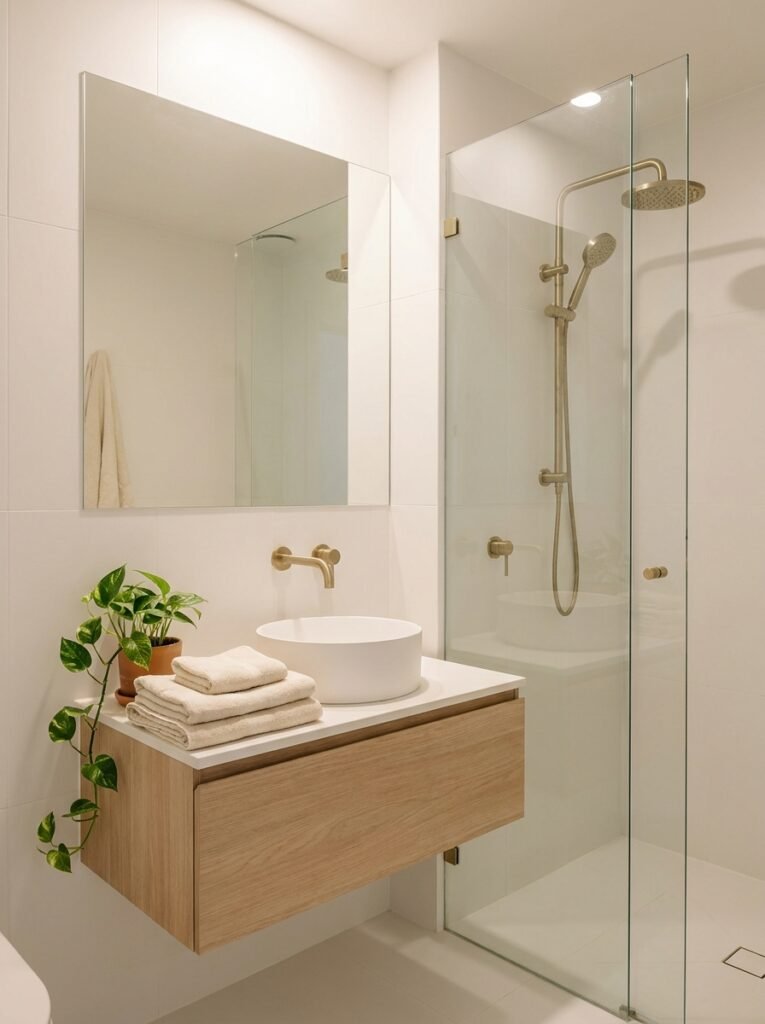
Small bathrooms are often the overlooked afterthought in tiny house design — which is exactly why the ones that are done beautifully stand out so dramatically. A well-designed tiny bathroom doesn’t feel like a sacrifice. It feels like a boutique hotel powder room: compact, intentional, and quietly luxurious.
Large-format tiles — counterintuitive as it sounds — work better in small bathrooms than small mosaic tiles. They reduce the number of grout lines, which reduces visual noise, making the space feel calmer and more expansive. A single large mirror expands the perceived space more than any other single element in the room.
Frameless glass shower enclosures have become a staple of modern tiny bathroom design because they allow the eye to travel through the space uninterrupted. A matte black or brushed brass fixture set adds a sophisticated editorial quality that photographs beautifully and elevates the entire feel of the space.
8. Light — Natural and Artificial — as the Real Interior Designer
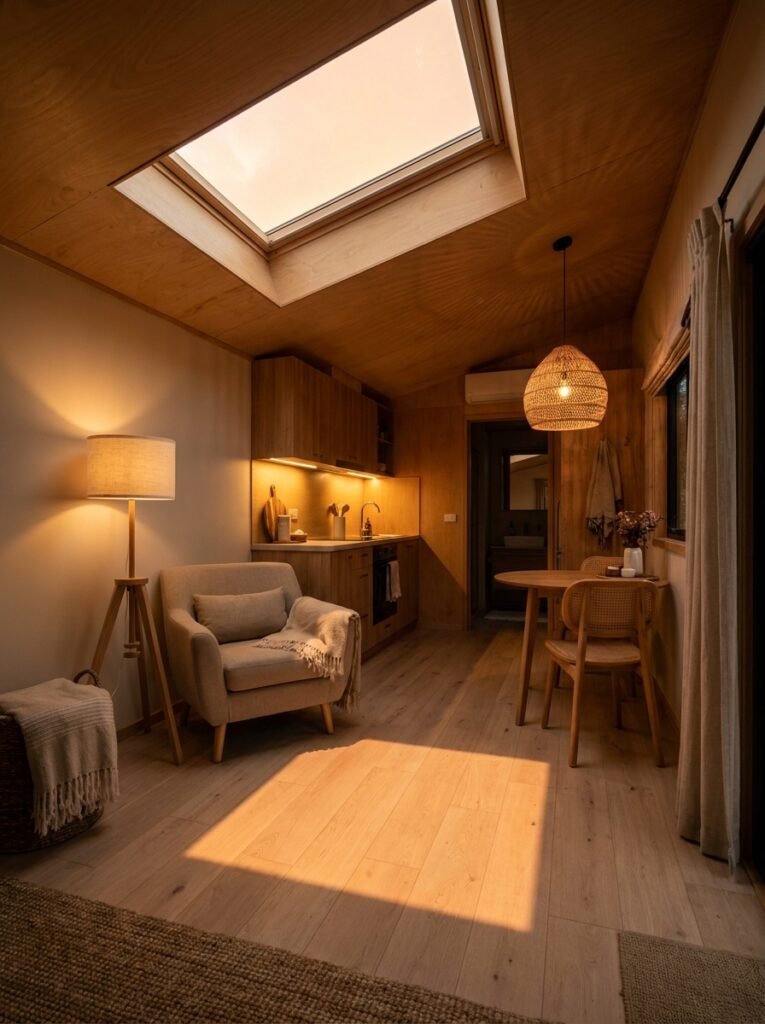
If you had to choose one single design element to get right in a tiny house, it would be light. Light is what makes the difference between a tiny house that feels cramped and one that feels expansive, between one that feels dreary and one that feels alive.
Maximize natural light at every opportunity. Skylights are extraordinary in tiny houses — they bring in light from above without sacrificing wall space, they make ceilings feel higher, and the quality of light they deliver has a softness that side windows simply can’t replicate. Wherever possible, choose windows that are larger than you think you need.
For artificial light, layer your sources. Never rely on a single overhead fixture. Task lighting, ambient lighting, and accent lighting together create depth and warmth that overhead light alone can never achieve. Under-cabinet kitchen lighting, a reading lamp beside the sofa, a warm bulb in a rattan pendant over the dining table — each source adds a layer of atmosphere that makes the tiny house feel designed, considered, and genuinely beautiful after dark.
“In a tiny house, light isn’t just practical — it’s the atmosphere itself.”
9. Bringing the Outside In: Nature as a Design Partner
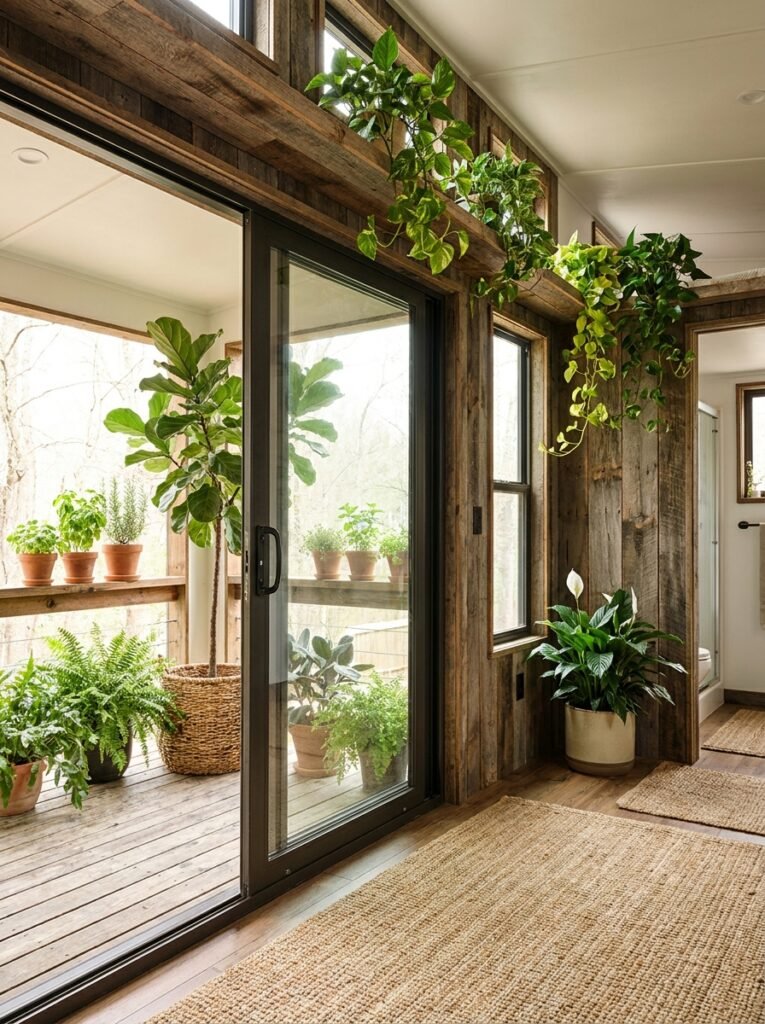
One of the most powerful design moves in any tiny house interior is blurring the boundary between inside and outside. When your living space is small, extending it visually into nature can make it feel exponentially larger and more alive.
Large sliding glass doors that open onto a deck, a porch, or even just a small garden create a seamless flow that expands the perceived square footage immediately. When those doors are open and the breeze moves through the space, the tiny house doesn’t feel contained — it feels connected to something much larger.
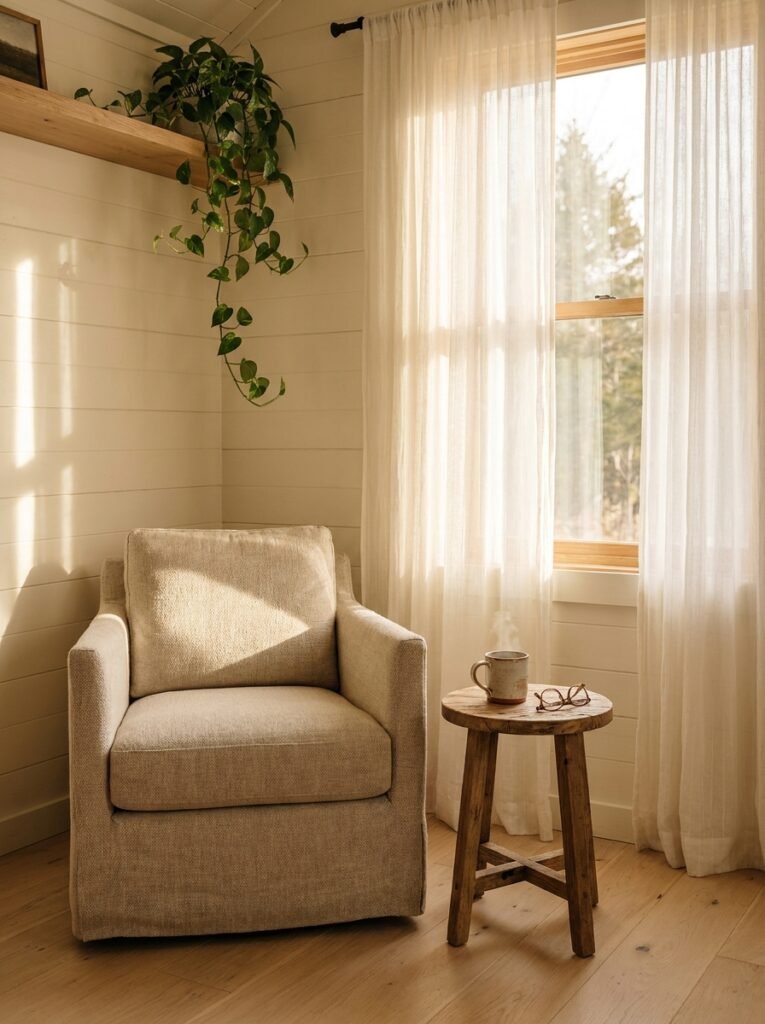
Inside, bring nature in through plants. Not a single decorative succulent in the corner, but a real, living collection of greenery. Trailing pothos from a high shelf, a fiddle leaf fig by a south-facing window, herbs on the kitchen sill, a peace lily in the bathroom. Plants do something to a space that no paint color or piece of furniture can replicate — they make it feel genuinely alive.
Natural materials — reclaimed wood, river stones, linen, jute, raw clay — echo the outdoor world inside and create that deeply grounding feeling that makes tiny houses feel not just livable but deeply nourishing.
10. Storage Solutions That Would Make an Engineer Weep With Joy
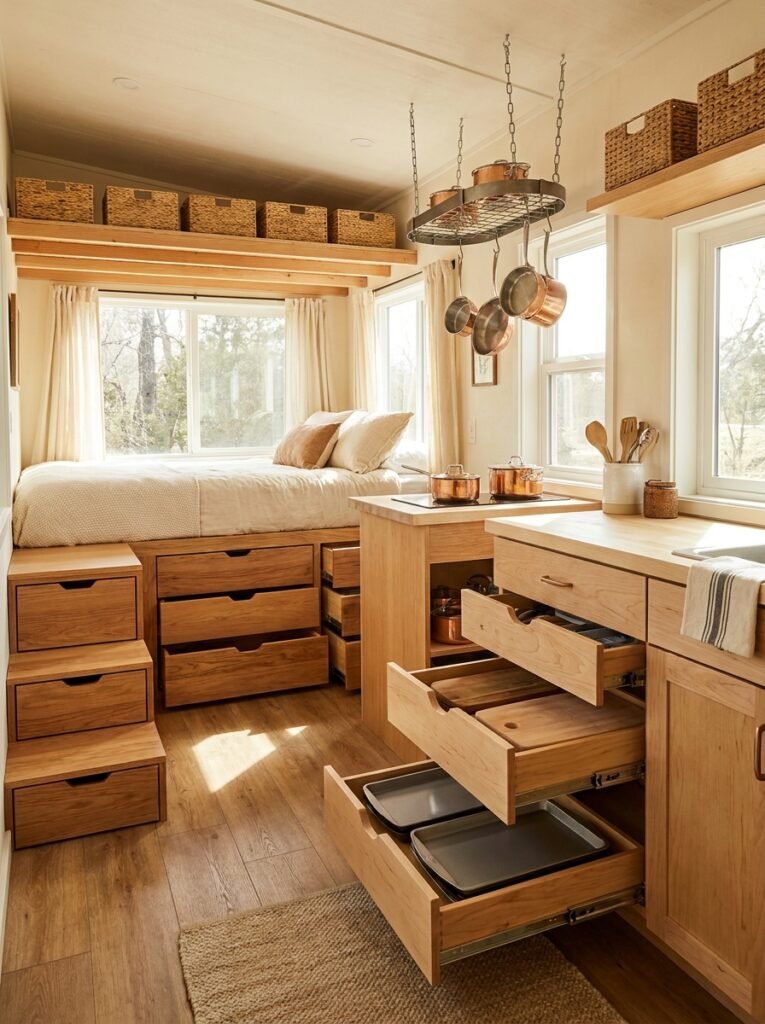
The storage in a well-designed modern tiny house is nothing short of remarkable — and studying it is one of the most genuinely useful things a designer or homeowner can do, regardless of the size of the home they’re working with.
Under-stair storage, as mentioned, is a classic. But consider also: a platform bed with drawer storage integrated into its base, kitchen toe kicks converted into shallow pull-out drawers for baking sheets and cutting boards, a bathroom vanity with interior organizers that make use of every cubic inch, window seats built over deep storage boxes, and ceiling-mounted pot racks that keep the kitchen functional without overwhelming the counter space.
The secret to making storage feel elegant rather than utilitarian is keeping it beautiful at the point where it meets the eye. The inside of your storage can be organized purely for function, but where storage is open or visible, it should be curated. Use uniform containers, matching baskets, labeled jars. When storage is beautiful, it becomes part of the decor.
11. The Emotional Architecture of a Tiny House: How Small Spaces Shape How We Feel
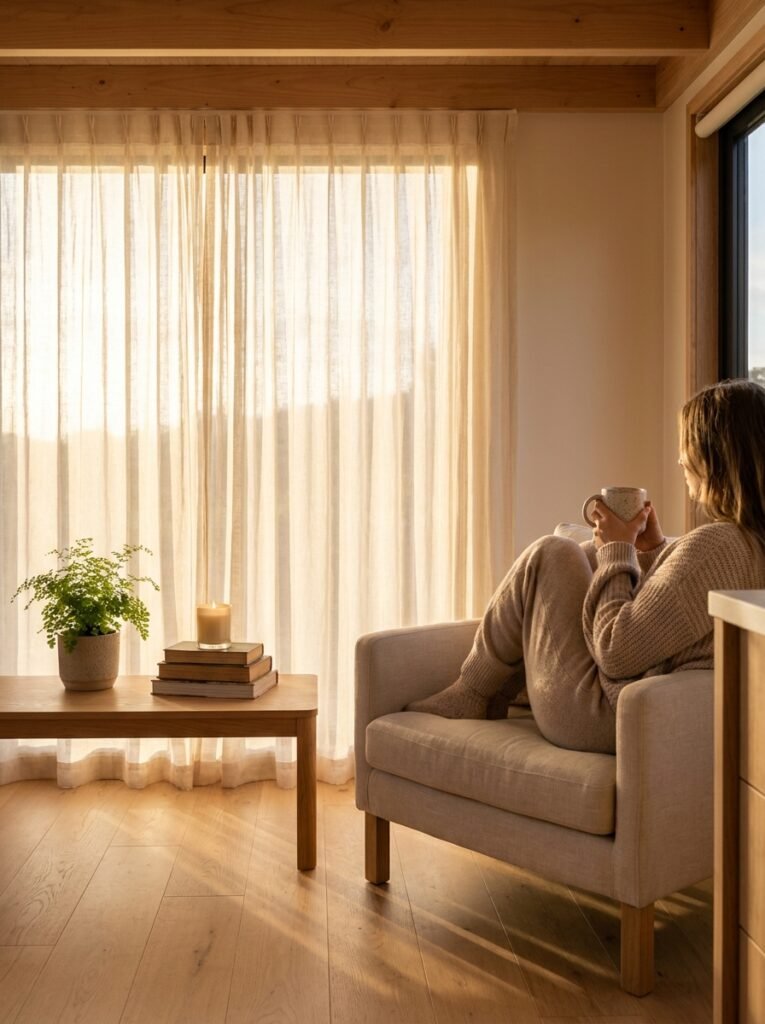
Here is something that interior designers have known for decades and scientists are only now beginning to document: the spaces we inhabit shape our emotions in profound and measurable ways. The size of a room, the quality of its light, the texture of its surfaces — all of these things communicate directly with our nervous systems in ways that operate below conscious awareness.
Tiny houses, when designed well, tend to produce a very specific emotional effect: calm. The absence of excess stimulation — too much furniture, too many objects, too much visual noise — allows the nervous system to settle. People who live in well-designed small spaces consistently report lower stress levels, better sleep, and a greater sense of control over their lives.
This isn’t a coincidence. It’s architecture. When every object in your home has been chosen with care, when nothing is there by accident, your environment stops demanding your attention and starts supporting it. Your home becomes a container for your life rather than a distraction from it.
12. Personalizing Your Tiny House: Making Small Feel Like Yours
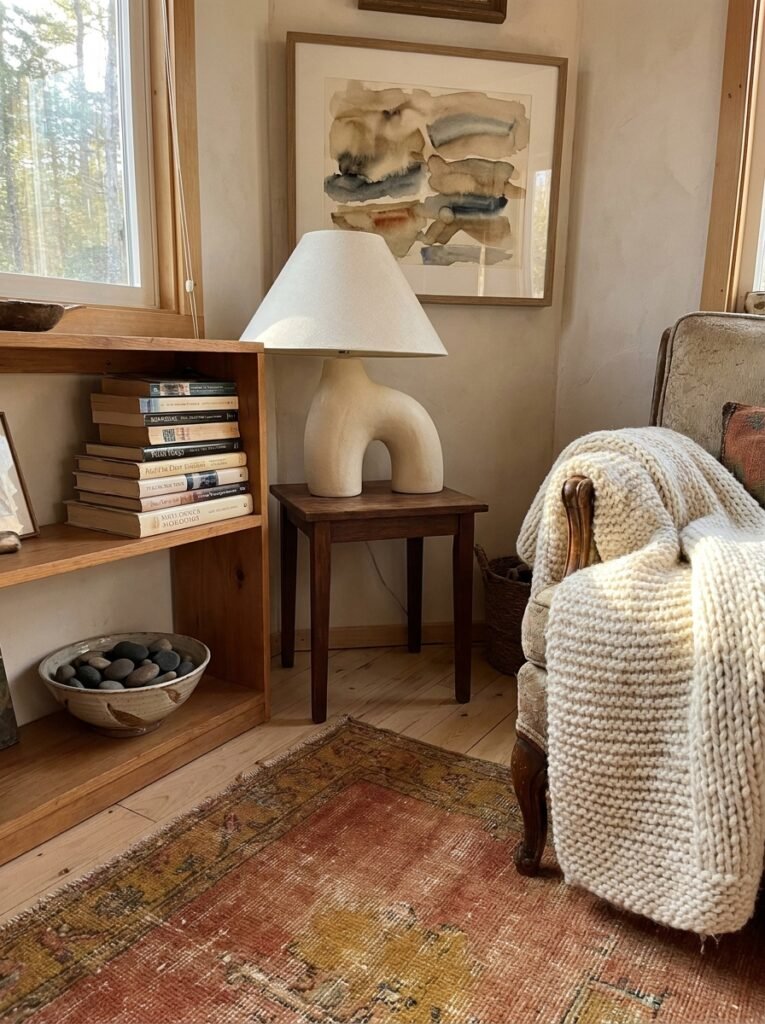
The biggest mistake people make in tiny house design is treating “minimalism” as “personality-free.” Nothing could be further from the truth. Your tiny house should feel unmistakably, completely yours — every object, every textile, every piece of art a reflection of who you are and how you love to live.
The difference between a tiny house that feels like a catalog and one that feels like a home is always personal detail. A collection of paperbacks stacked horizontally on an open shelf. A hand-thrown ceramic bowl you bought at a farmers market three years ago. A framed watercolor print from an artist you found on Etsy. A throw blanket your grandmother knitted in 1987. These things cannot be sourced from a design store. They exist only in your life, and they are what make your tiny house irreplaceable.
Choose one or two “statement” pieces — a piece of art that takes up real wall space, a vintage rug with real character, a sculptural lamp that surprises the eye. Let those pieces anchor the room while the rest stays simple and breathing. This contrast between the calm and the bold is what makes tiny house interiors genuinely compelling to look at.
—
🌿 How to Take Care of Your Tiny House Interior
Maintaining a tiny house interior in a way that keeps it looking beautiful and feeling calm requires consistency rather than effort — and that consistency is much easier to sustain than most people expect.
First, practice the “one in, one out” rule with genuine commitment. Every time something new comes into your tiny house, something old leaves. This prevents the slow accumulation of clutter that erodes the intentional quality of a small space over time.
Second, give everything a home. In a tiny house, objects without designated places don’t stay charming for long — they become chaos. Spend real time figuring out where each thing lives, and make returning things to their place a daily habit rather than a weekly chore.
Third, clean as you go rather than letting things build. In a small space, a single cluttered counter or a pile of unfolded laundry has an outsized visual impact. A quick ten-minute tidy each evening keeps your tiny house looking the way it did in your best daydream of it.
Finally, revisit your space seasonally. What works beautifully in summer may need adjusting for winter — lighter textiles swap for heavier ones, lighter scents give way to warmer ones. Treating your tiny house as a living, evolving space keeps it feeling fresh and intentional year after year.
—
❓ FAQ
Q: What is the average cost to design a modern tiny house interior? A: The cost varies enormously depending on the level of custom work, the quality of materials, and whether you hire a professional designer. A beautifully furnished and designed tiny house interior can range from $15,000 to $80,000, with many homeowners achieving stunning results on the lower end by sourcing vintage pieces, doing DIY projects, and choosing materials thoughtfully.
Q: How do I make a tiny house feel larger without renovating? A: The most impactful changes are also the most accessible — maximize natural light by keeping window treatments minimal, use mirrors strategically to reflect light and depth, choose furniture with legs to allow light to travel under pieces, and clear all flat surfaces of clutter. A consistent, limited color palette across all rooms also creates a visual flow that makes the space feel more expansive.
Q: Can a tiny house interior work for a family with children? A: Absolutely, and many families are doing it beautifully. The key is investing deeply in smart storage, creating dedicated zones for children’s play and creativity, and choosing durable, easy-to-clean materials throughout. Many families find that a smaller space encourages more togetherness, creativity, and outdoor time — outcomes that prove genuinely positive for children’s development.
—
💭 Final Thought
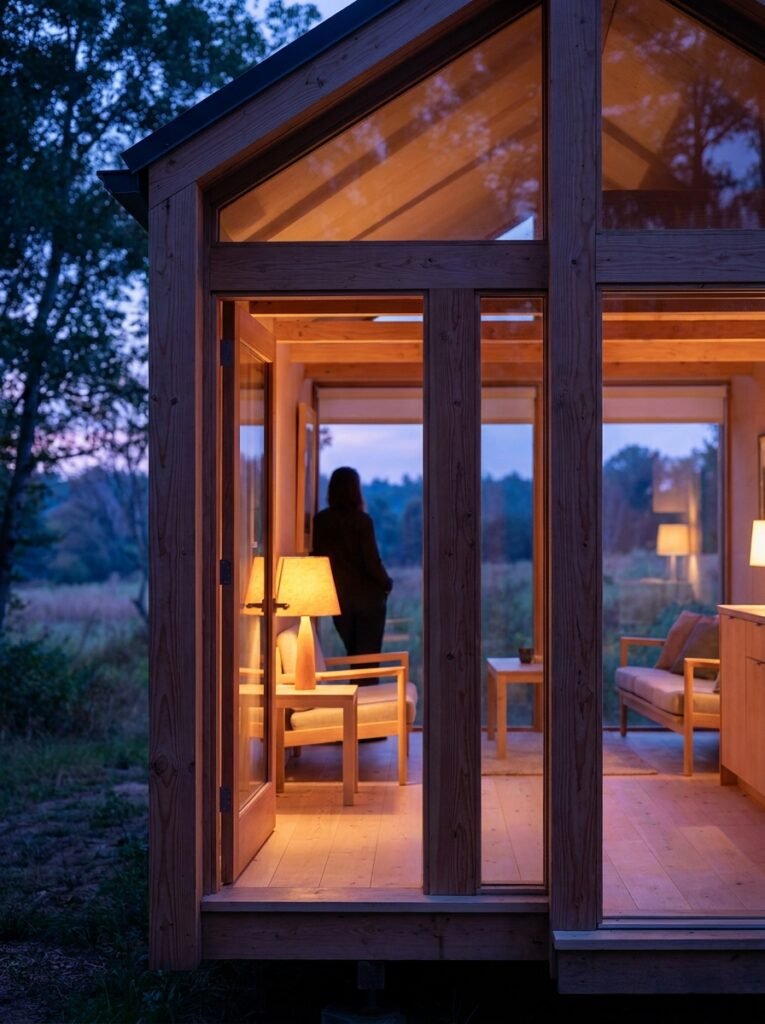
A modern tiny house interior is not a consolation prize for people who couldn’t afford more space. It is a considered, courageous statement about what actually matters — and the people who make it tend to find that they have more: more calm, more clarity, more connection to the things and people they’ve chosen to share their space with. There is a deep and underrated joy in living with exactly enough.
So here is the question worth sitting with tonight: if you had to live with only what you truly loved, what would be left — and what might you finally feel free to let go?