The Art of Shelf Styling: How to Turn Your Living Room Shelves Into the Most Beautiful Corner of Your Home
There’s something quietly magical about a well-styled shelf — it holds your stories, your travels, your taste, and your life all in one place. If you’ve ever stared at your living room shelves feeling like something is off but you can’t quite name it, you are not alone. This guide exists to change that feeling forever.

—
1. Why Your Living Room Shelves Are the Soul of the Space

Think about the last time you walked into someone’s home and immediately felt something. Warmth, curiosity, personality — chances are, their shelves had something to do with it. A bookcase or floating shelf arrangement in a living room does something no other piece of furniture can: it reveals who you actually are. It’s not just storage. It’s a self-portrait in objects.
Interior designers have long known that the eyes travel naturally to vertical surfaces. When your shelves are beautiful, the entire energy of your room shifts. The ceiling feels higher. The room feels more intentional. Even budget furniture begins to look curated when the shelves beside it are thoughtfully arranged.
“Your shelves don’t just hold things — they hold your identity. Style them like it.”
The problem most people run into is thinking shelf styling is about acquiring more things. It isn’t. It’s about editing, balancing, and giving each object breathing room to speak. Once you understand that principle, everything else falls into place.
—
2. The Rule of Three: Why Odd Numbers Feel So Right

If there is one principle that professional stylists return to again and again, it’s the rule of thirds — or more specifically, the power of odd numbers. Group objects in threes and fives rather than twos and fours. Our brains are wired to find symmetrical, even-numbered groupings somewhat boring. They feel finished, closed, resolved. Odd groupings feel dynamic. They invite the eye to keep moving.
Try this right now: place two candles on a shelf. Then add a third. Notice how suddenly the arrangement comes alive? That tension — that slight imbalance — is what makes a shelf feel styled rather than just filled. Vary the heights within each grouping too. A tall vase, a medium candle, and a short stack of books creates rhythm. Rhythm creates beauty.
—
3. The Secret Ingredient Most People Forget: Empty Space

Here’s the truth that goes against every instinct when you’re standing in front of an empty shelf: empty space is not wasted space. It is, in fact, one of the most powerful styling tools you have. Negative space — the breathing room between objects — is what makes each item feel intentional and precious rather than crowded and chaotic.
Interior stylists often call this “letting your shelves breathe,” and it’s an almost perfect metaphor. When you pack every inch with books, trinkets, and plants, the shelf starts to feel anxious. When you leave deliberate gaps, something settles. The whole arrangement relaxes — and so does the viewer.
A good benchmark: aim to leave roughly 20 to 30 percent of your shelf surface visually open. This doesn’t mean empty in a sterile way. It means strategic breathing room that gives your eye a place to rest between moments of visual interest.
—
4. Books as Design Elements (Not Just Reading Material)

Books might be the most underestimated styling tool in the entire living room. Most people slide them spine-out in a row and call it a day — but there is so much more you can do. Try stacking three to five books horizontally instead of vertically. Now place a small object on top: a crystal, a succulent, a tiny framed photo. Instantly, you’ve created a layered, magazine-worthy vignette.
Color-coordinating your books is another approach that has genuinely gone viral on Pinterest for good reason. Arranging books by spine color — moving through a gradient from warm neutrals to deep greens or navy — creates an almost painterly effect on your shelves. It looks incredibly intentional without requiring a single new purchase.
You can also face certain books outward — cover facing the room — when the cover art is beautiful. This trick works especially well with art books, coffee table books, or vintage hardcovers with illustrated spines. Don’t be afraid to treat your books like the design objects they already are.
—
5. Choosing a Color Story That Ties Everything Together
One of the fastest ways to make a shelf look professionally styled is to commit to a color story. This doesn’t mean everything must match perfectly — it means there should be a loose, cohesive thread pulling through. Think of it as a palette rather than a color rule.
For warm, cozy living rooms, earthy tones work beautifully: terracotta, cream, warm wood, dusty rose, and sage. For a more contemporary, editorial feel, try a high-contrast palette — black, white, natural linen, and a single accent color like deep burgundy or forest green. For maximalist lovers, rich jewel tones layered together — amber, cobalt, emerald — create a moody, opulent effect that photographs stunningly.
“A cohesive color story doesn’t restrict you — it sets your shelves free.”
The trick is to preview your choices. Pull all the objects you’re considering and lay them on the floor first. Step back. Do they speak the same visual language? If one object feels like it’s shouting in a completely different dialect, set it aside. Editing is the real art here.
—
6. Layering Textures: The Trick That Makes Shelves Look Expensive

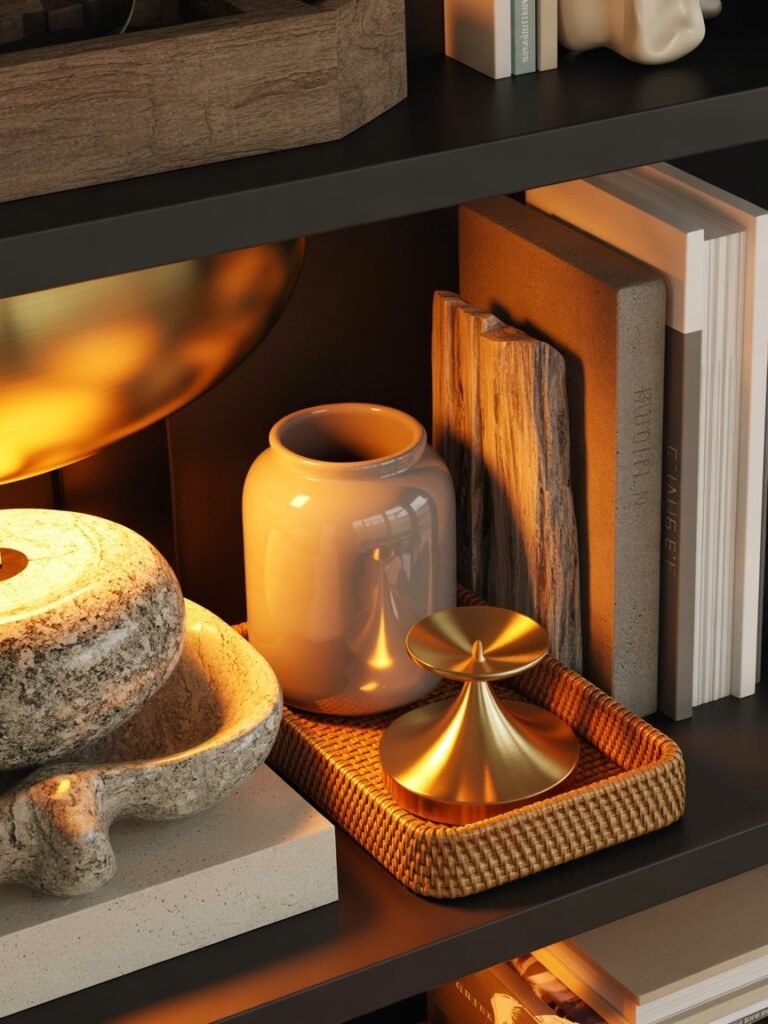
Walk through any high-end interiors showroom and pay attention to the shelves. You’ll notice that what makes them feel luxurious isn’t necessarily expensive objects — it’s the layering of textures. Smooth ceramic next to rough linen. Polished brass beside matte concrete. Glossy books beside a weathered wooden sculpture.
Texture contrast activates the sense of touch even from across the room. It creates visual richness that makes a shelf feel considered and alive. When every object on your shelf has the same surface quality — all shiny, or all matte — the whole thing flattens out. Introduce contrast deliberately: one woven basket, one glass object, one ceramic piece, one metal element. Even a small candle with a linen-wrapped base adds a completely different sensory note.
This is also where natural materials earn their keep. A small piece of driftwood, a woven rattan tray, a stone bookend — these organic elements ground a shelf and prevent it from feeling sterile or too “decorated.”
—
7. Plants and Greenery: How to Add Life Without Chaos

Nothing transforms a shelf quite like greenery — but there is a fine line between “lush and intentional” and “crowded and chaotic.” The key is choosing the right plants and the right number of them. A shelf does not need to be a greenhouse. One or two carefully chosen plants, placed with purpose, will do more for the space than five small pots crammed in wherever they fit.
Trailing plants like pothos, string of pearls, or heartleaf philodendron are particularly magical on shelves because they spill downward and create a vertical dimension that draws the eye beautifully. Position a trailing plant at the end of a shelf or in the upper corner of a bookcase, and let it cascade naturally. The effect is effortlessly organic.
For shelves in lower-light areas, consider high-quality faux botanicals. The stigma around artificial plants has lifted considerably in recent years — especially in interior design communities — and today’s faux options are extraordinarily realistic. What matters is that the space feels alive and warm, and well-chosen faux greenery absolutely achieves that.
—
8. The Art of Meaningful Objects: What Belongs on Your Shelves

Here’s a question worth sitting with: do you actually love everything currently on your shelves? Not “it was a gift so I keep it out” love, and not “I bought it on sale” love — but genuine, joyful “this makes me smile every single time I see it” love. If the answer is no, it’s time to edit.
Shelf styling is most powerful when it’s personal. That ceramic bowl you brought home from a trip to Portugal. The worn paperback that changed how you see the world. Your grandmother’s vintage clock. A framed photo from a moment you want to hold onto forever. These objects carry emotional weight, and that weight is felt — even by guests who know nothing about them.
The practical rule: mix memory with beauty. For every decorative object that exists purely for aesthetics, try to include one object that carries meaning. That balance creates shelves that feel both beautiful and deeply human — which is exactly what makes them memorable.
—
9. Framed Art and Photography on Shelves: A Forgotten Trick

Most people hang all their art on walls and never consider propping framed pieces on shelves — but this is one of the most effective styling moves you can make. Leaning a framed print or photograph against the back wall of a shelf adds instant depth and creates a gallery-like quality that feels collected over time rather than decorated all at once.
The key is scale. Choose frames that are proportionate to your shelf height — a frame that’s too small will look lost, and one that’s too large will crowd the space. A medium-sized framed art print leaned casually at the back of a shelf, with smaller objects arranged in front of it, creates a beautifully layered vignette with almost no effort.
“When you lean art instead of hanging it, your home starts to feel like a curated life — not a catalog page.”
Mix frame finishes too: a warm brass frame beside a natural wood frame beside a simple black frame. Mismatched frames that share a cohesive color palette feel intentionally eclectic — which is one of the most coveted aesthetics in contemporary interior design.
—
10. Shelf Lighting: The Underrated Detail That Changes Everything

If you’ve ever styled a shelf beautifully only to feel like something is still missing, the answer might be light. Shelf lighting is one of the most impactful yet underutilized tools in home styling, and it transforms a well-arranged shelf from lovely to breathtaking — especially in the evenings.
Small battery-operated LED puck lights placed at the top of a bookcase shelf cast a warm downward glow that makes every object look more intentional and beautiful. Clip-on picture lights work wonderfully to illuminate a framed piece propped on a shelf. Plug-in LED strip lights running along the back edge of a shelf create a soft halo effect that is genuinely stunning after dark.
Even a single small table lamp placed within a bookcase — yes, a lamp on a shelf — creates an intimate, cozy glow that makes the whole corner feel like a destination. It sounds unconventional, but once you see it, you’ll wonder why you never tried it sooner.
—
11. Seasonal Shelf Styling: Keeping Your Home Feeling Fresh Year-Round

One of the most beautiful things about shelf styling is that it doesn’t have to be permanent. In fact, some of the most passionate home stylists approach their shelves the way a chef approaches a seasonal menu — always evolving, always reflecting the current moment in time.
In autumn, swap in warm amber tones, dried botanicals, pinecones, and earthy ceramics. In winter, introduce soft whites, metallics, candlelight, and evergreen sprigs. Spring calls for fresh botanicals, pastel ceramics, and light linen textures. Summer leans into natural materials, coastal references, and bright, sun-kissed colors.
This practice doesn’t require buying new objects every season. It’s about rotating what you already own, adding one or two seasonal accents, and editing out what no longer fits the mood. Your home feels fresh, you feel more connected to the passing of time, and your shelves tell a living, breathing story — not a frozen one.
—
12. The Edit: Why Removing Things Is the Final Act of Great Shelf Styling

Every great shelf styling session ends not with adding something, but with taking something away. Once you’ve arranged everything beautifully, step back across the room. Look at the shelf from the distance a guest would see it from. Then ask yourself: is there anything here that is competing for attention without deserving it?
Editing is the most courageous part of the process because it requires making decisions. It requires saying “this is beautiful but it doesn’t belong here.” The objects that don’t make the final cut aren’t failures — they simply belong somewhere else in your home, or perhaps somewhere else in your life.
The stylists who create the most stunning, Pinterest-saving shelf arrangements are ruthless editors. They trust negative space. They trust simplicity. They understand that a shelf with twelve perfectly chosen objects will always outshine one with forty randomly assembled ones. Restraint is not emptiness — it is confidence.
—
🌿 How to Take Care of Your Shelf Styling Long-Term
Great shelf styling isn’t a one-time project — it’s a gentle ongoing practice. A few simple habits will keep your shelves looking beautiful without requiring a complete overhaul every few months.
Dust your shelves and objects regularly. This sounds obvious, but a dusty vignette loses all of its magic. A quick weekly wipe-down keeps everything looking intentional and cared for.
Revisit your arrangement every season with fresh eyes. You’ll often notice things that have crept in without thought — mail, random objects, clutter disguised as décor. A ten-minute seasonal edit keeps the vision clear.
Rotate objects from storage. Many stylists keep a small collection of objects in a box or cabinet that they rotate onto shelves seasonally. This keeps the arrangement feeling fresh without spending money.
Photograph your favorite arrangements. When you find a shelf composition you love, take a photo. On days when everything feels scattered, that photo becomes your reference point — a map back to the vision you had.
Trust your eye above all else. Rules are guides, not laws. If something feels right to you in your space, it probably is right. Your home is not a showroom — it’s a place where your real life unfolds.
—
❓ FAQ
Q: How do I style shelves without making them look cluttered? A: The single most effective strategy is editing down to fewer, more intentional objects, and leaving deliberate empty space between groupings. Aim to keep roughly 20 to 30 percent of your shelf surface visually open. When in doubt, remove one more thing.
Q: What are the best objects to put on living room shelves? A: The most beautiful shelf arrangements mix functional items (books, trays, baskets) with meaningful personal objects (travel finds, family heirlooms, sentimental pieces) and a few purely decorative elements (vases, sculptures, candles). The mix of all three creates depth and authenticity.
Q: Do my shelves need to match my overall room decor? A: They should feel cohesive — meaning they share the room’s general color palette and tone — but they don’t need to be matchy-matchy. In fact, shelves that introduce a slightly contrasting texture or a complementary accent color often make the whole room feel more layered and interesting.
—
💭 Final Thought

Your living room shelves are not just a backdrop — they are a living, evolving expression of who you are right now, in this season of your life. They deserve the same thoughtfulness you bring to everything else you care about. Style them slowly. Edit them bravely. Let them change as you change.
So here’s the question worth sitting with tonight: if your shelves could tell the story of the life you actually want to be living, what would they hold?