The Big Living Room Problem Nobody Talks About (And How to Finally Fix It)
You walked into your big living room and felt… nothing. Not cozy. Not impressive. Just a lot of empty floor and furniture that looks scared of each other. Yeah. I’ve been there.
—
1. Why Big Rooms Feel Cold and Furniture-Scared (It’s Not Your Fault)
Here’s the thing about large living rooms — and I say this after years of staring at Pinterest boards and wondering why mine never looked like that — the size is both the gift AND the problem. Designers don’t really tell you this upfront. They just show you the beautiful finished rooms without explaining how many people cried over them first.
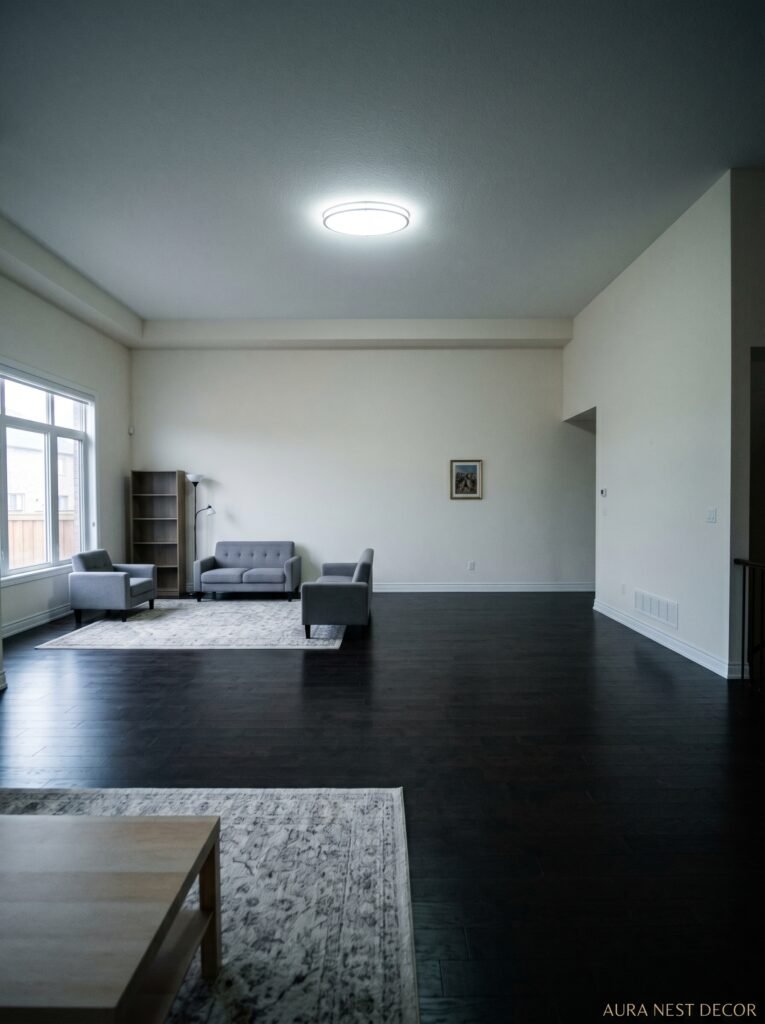
Big rooms fail for one very specific reason: furniture floats. You push a sofa against one wall, an armchair against another, and suddenly your living room looks like a waiting room at a dentist’s office. Cold, functional, sad. The walls are too far apart, the conversation feels like a tennis match, and nobody wants to sit in there for longer than twenty minutes.
The other culprit? Scale blindness. We buy furniture that’s the right size for a normal room — a standard sofa, a coffee table that would look perfectly proportionate in a smaller space — and plunk it into a huge room where it immediately looks like it’s hiding. A 7-foot sofa in a 20-foot room doesn’t look luxurious. It looks lost.
And don’t even get me started on rugs. The number of too-small rugs floating like little life rafts in the middle of enormous living rooms is genuinely alarming.
“The furniture isn’t the problem. The floating is.”
—
2. The Zoning Rule That Changes Everything About How a Big Room Feels
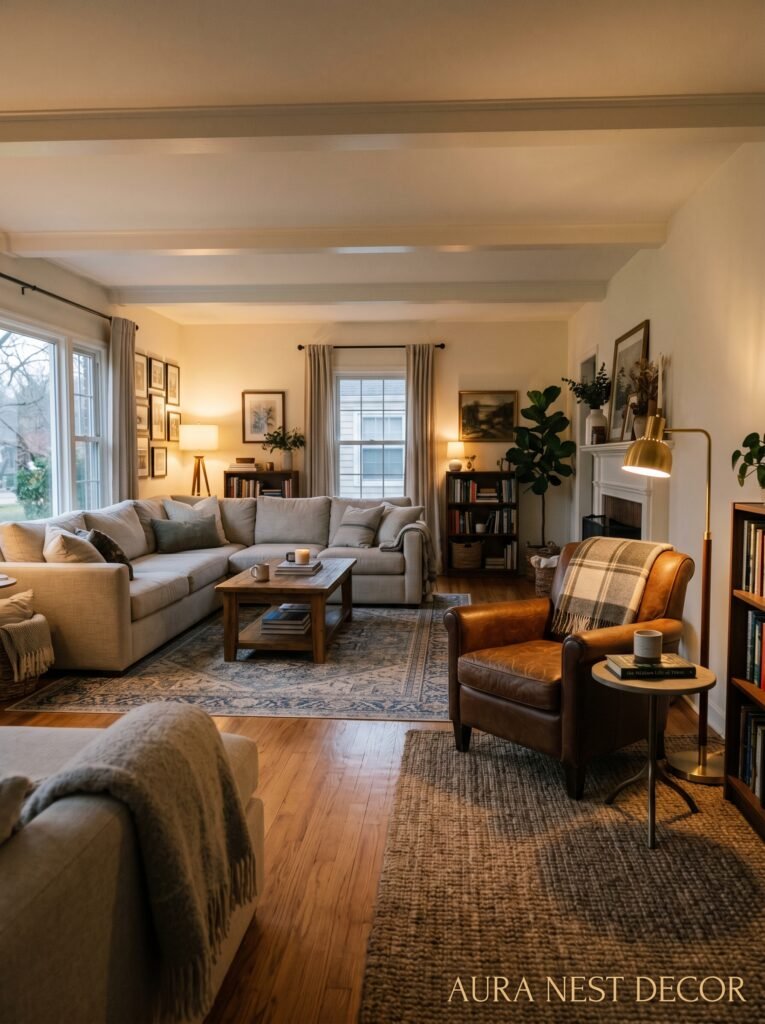
Stop thinking of your living room as one room. That’s the whole thing, actually.
A large living room isn’t one space — it’s two or three spaces that happen to share a floor plan. Once you accept that, everything starts making sense. You’ve got room for a proper seating area, PLUS a reading corner, PLUS maybe a little drinks station or a game area or a writing nook. The square footage is begging you to get specific.
Zoning sounds intimidating but it’s really just about creating visual clusters. Your main sofa and chairs should be arranged as if they’re having a conversation — facing each other or slightly angled inward, with a rug underneath to tie them together. That cluster becomes Zone One. Then you pick a corner, tuck in a chair with a floor lamp and a small side table, and that becomes Zone Two. Done. You’ve got depth, intention, and a room that suddenly feels like a place where actual life happens.
The gap between zones matters too. Don’t push them so far apart they feel disconnected, but don’t crowd them either. Think of it like the white space in a good magazine layout — the space between zones is part of the design. British homes often do this brilliantly in Victorian reception rooms, layering multiple seating arrangements without it ever feeling cramped. There’s something to learn from that.
—
3. The Rug Size You Actually Need (It’s Bigger Than You Think)
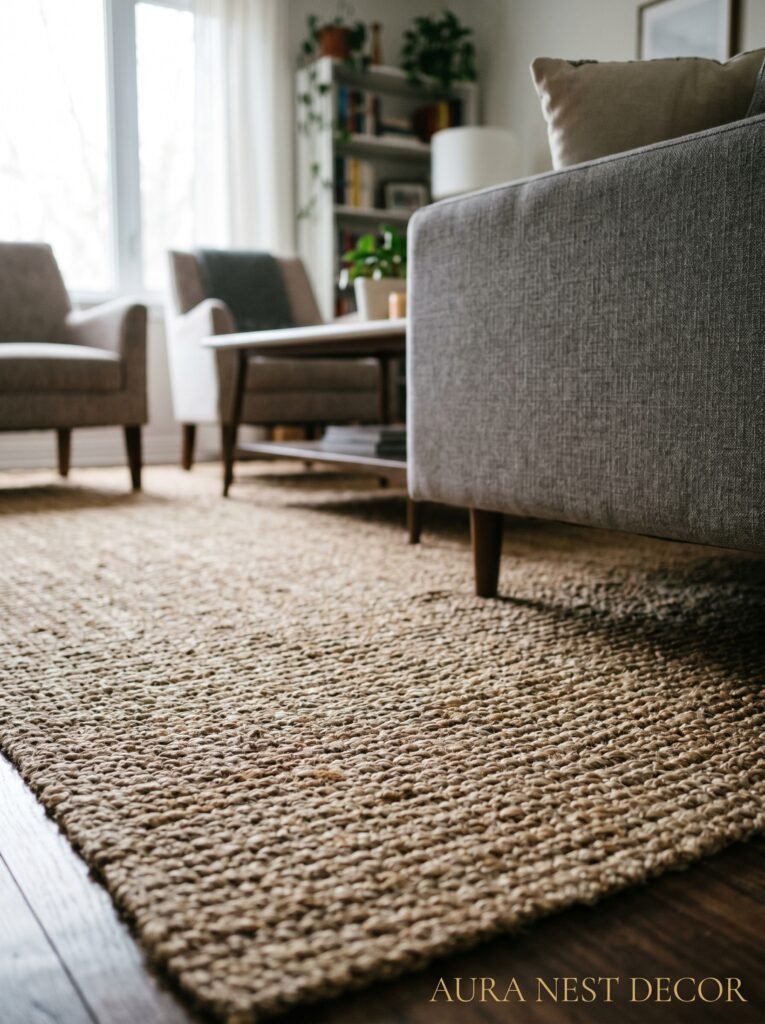
Okay, I need to say this clearly because it genuinely changed my life: YOUR RUG IS TOO SMALL.
I know. I said the same thing. “My rug is fine.” It’s not fine. In a large living room, a standard 8×10 rug shoved under just the coffee table looks like a postage stamp. You want the front legs of every single piece of seating furniture to sit ON the rug. At minimum. Ideally all four legs. This anchors the room so the furniture stops looking like it’s scared to commit.
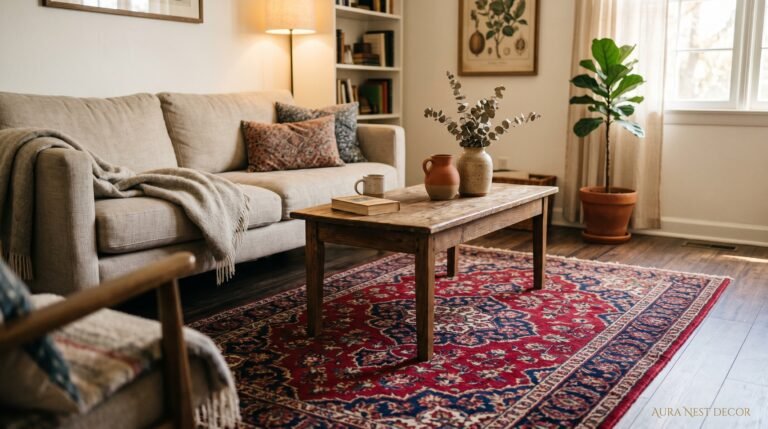
For a genuinely large living room, you’re looking at a 9×12 at absolute minimum. Many large rooms need a 10×14 or even two rugs — one for each zone. And yes, layering rugs works beautifully if you do it with some confidence. A natural jute or sisal as the base layer with a patterned or textured rug on top? So good. The texture adds warmth and the layers make it feel LIVED in rather than showroom-perfect.
Material matters too. In a big cold-feeling room, avoid anything too flat or too shiny. Wool, cotton, jute — anything with physical texture that your eye can rest on. A flatweave kilim in a big room just makes it feel more echoey somehow. Not gonna lie, I learned this one the expensive way.
—
4. Lighting Is the Only Thing Standing Between You and a Cave
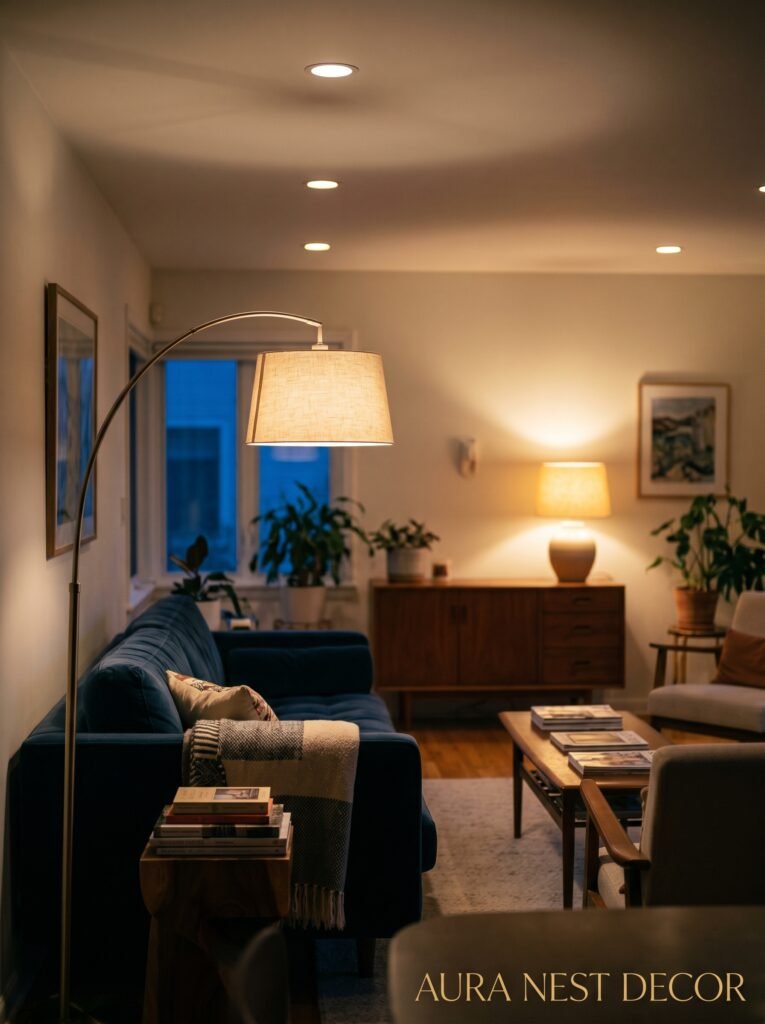
One overhead light in a big room. I don’t know who approved this in every house built between 1970 and 2010 but they should have to apologize.
A big room with only ceiling lighting feels like a school gymnasium. The light is everywhere and also somehow nowhere — it doesn’t create intimacy, it doesn’t warm corners, it doesn’t make anything feel particularly intentional. You need LAYERS, and not in a vague “get some lamps” way. I mean specific, placed, purposeful light sources.
The amber glow of an Edison bulb at 7pm in a reading corner while the rest of the room settles into dimness — THAT’S what we’re after. You want your eye to be pulled around the room by light, not blasted by it from one central point.
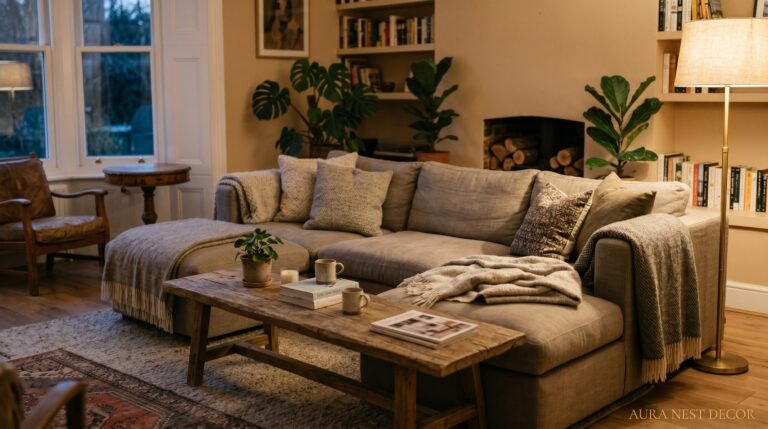
Here’s my actual approach for big living rooms: one floor lamp per zone minimum, table lamps on any console or side tables, candles or candlelike LED lights during evening hours, and the overhead on a dimmer that lives permanently at about 40%. If you only do one thing from this entire article, PUT CEILING LIGHTS ON DIMMERS. It costs maybe $15 and a YouTube tutorial.
“You don’t need more furniture. You need one more lamp in the corner you keep ignoring.”
Wall sconces are criminally underused in American living rooms. In the UK, they’re pretty standard in older homes and they do so much heavy lifting — they break up a big blank wall and add warmth at eye level, which is exactly where you want it.
—
5. The Sofa Situation: Why Sectionals Are Both the Answer and the Trap
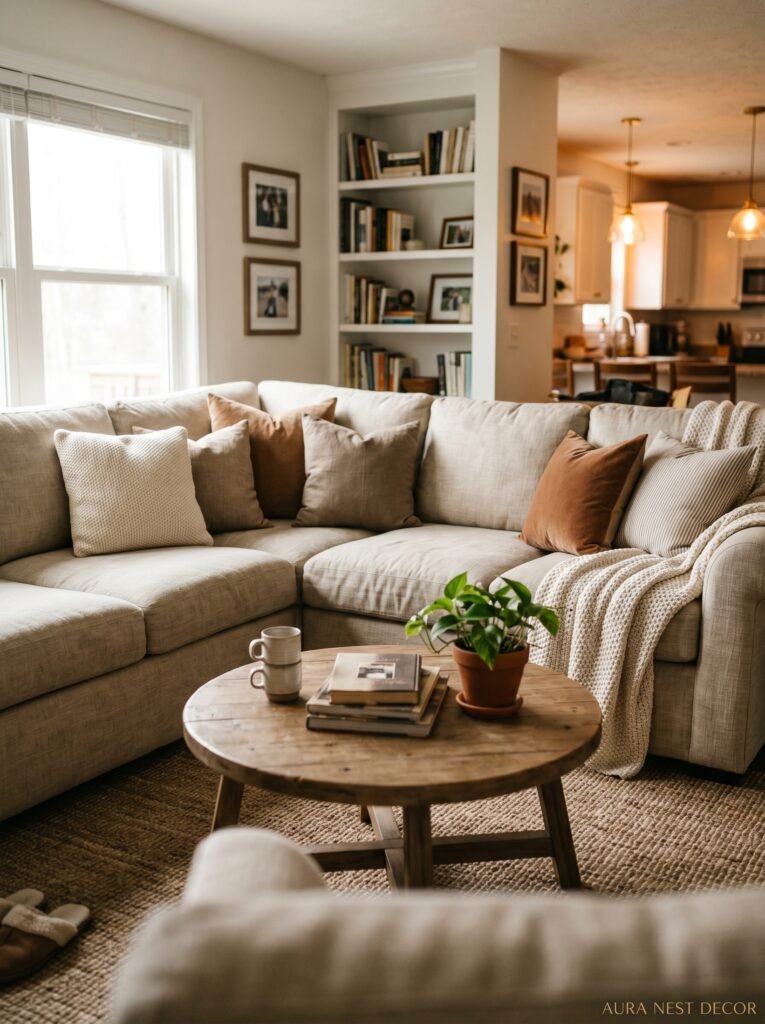
Everyone with a big living room immediately thinks: sectional. And honestly? Not wrong. But also not always right.
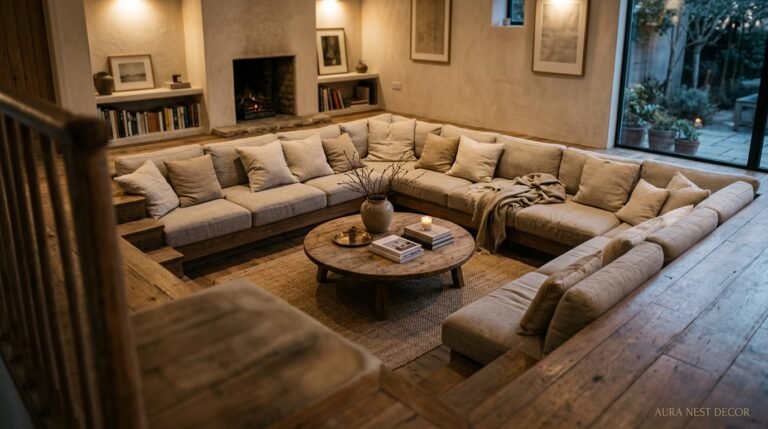
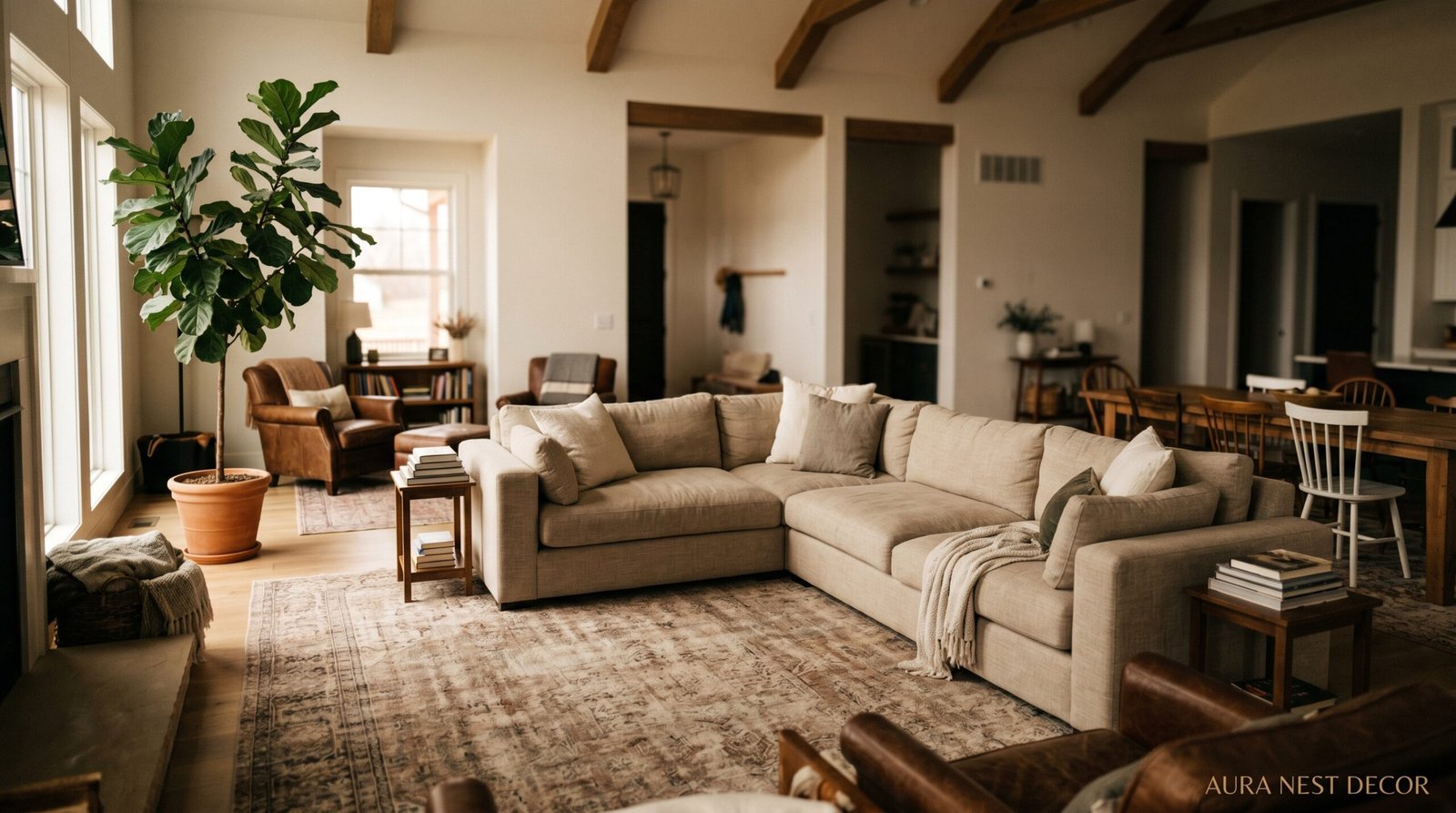
A proper large sectional — we’re talking 110 to 130 inches — can anchor a big room brilliantly. It creates instant coziness because everyone is close together, it defines the space without requiring much else, and if you pick the right shape, it can serve as the room’s visual centerpiece. An L-shape works well if you’ve got a clear corner to tuck it into. A U-shape is incredible for families and people who love to truly sprawl.
But here’s where people go wrong with sectionals in big rooms: they pick the wrong DEPTH. A shallow sectional (like under 35 inches deep) in a large room looks weirdly small, because our eyes judge furniture scale relative to the space around it. You want something with presence. Deep seats, solid arms, fabric with some texture. Bouclé, velvet, a soft boucle-weave — something that reads as luxurious from across the room.
If you go against the grain and choose two separate sofas facing each other instead, make sure they’re substantial. Two slim 6-foot sofas in a 400-square-foot room just look like they’re having an uncomfortable standoff. Go big or add a chaise. Life’s too short for awkward sofa standoffs.
—
6. The Color Showing Up in Every Beautiful Big Living Room Right Now
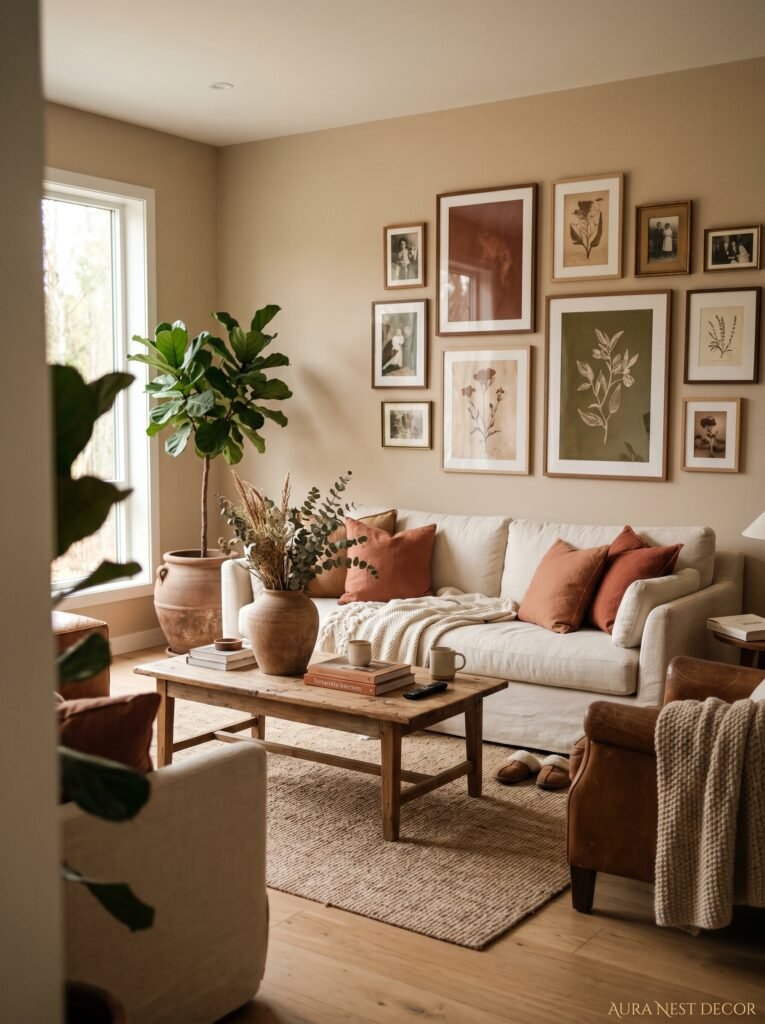
Warm white. Off-white. Linen. Whatever you want to call it — that almost-beige, almost-white that’s just warm enough to feel like an embrace rather than a hospital.
I’ve noticed it everywhere for the past couple of years and I completely understand why. In big rooms, stark white walls make everything feel even more cavernous. But warm neutrals — think Benjamin Moore White Dove, Farrow & Ball’s Dimity or Elephant’s Breath, or Sherwin-Williams’ Accessible Beige — they actually SHRINK a room visually without making it dark. They create the illusion of warmth and texture just from the wall color alone.
Side note — Farrow & Ball’s Elephant’s Breath is one of those colors that sounds awful and looks extraordinary on a wall. Every single time.
That said: don’t sleep on going DARK in a big room. A deep sage, a dusty charcoal, a forest green — these colors make big rooms feel deliberate and cocooning rather than vast and echoy. Americans especially tend to be afraid of dark paint on big walls, but British interiors have been nailing this for decades. Look up any Georgian townhouse sitting room and you’ll see what I mean. The darkness makes it WARM.
—
7. Why Everyone Gets Big Room Artwork Wrong (And the Fix Is Cheaper Than You’d Think)
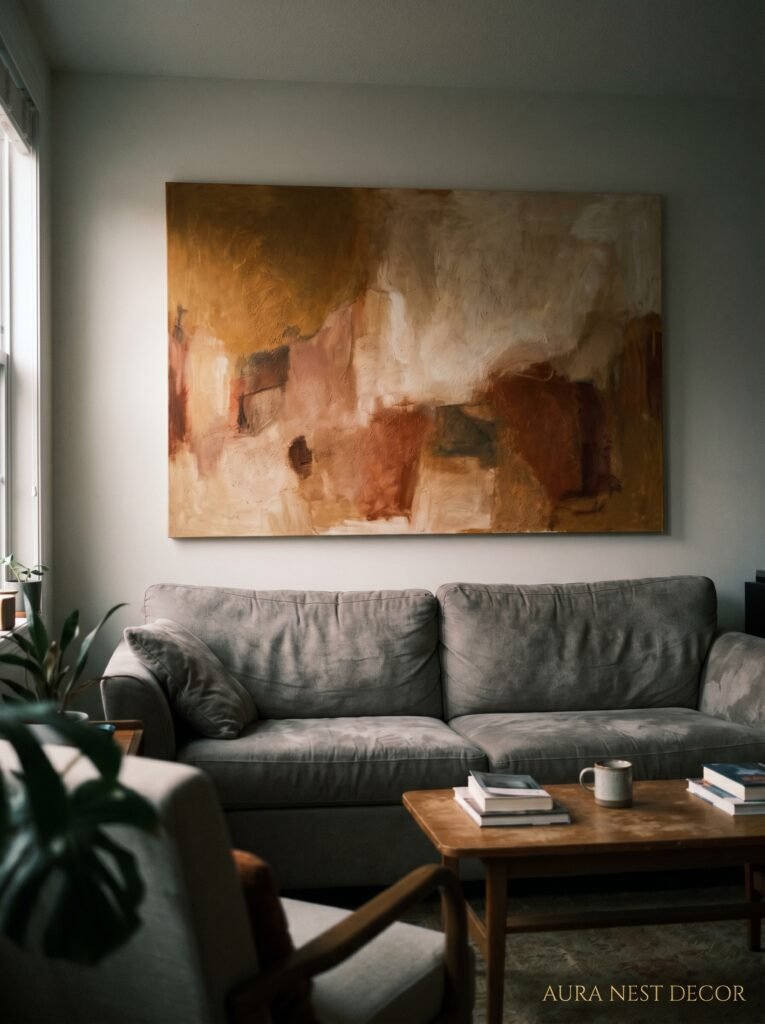
Art gets weird in big rooms. People either go too small — a standard 24×36 print on a 12-foot wall that looks like a postage stamp again — or they panic and just don’t put anything up, which results in vast stretches of blank wall that make everyone feel vaguely unsettled.
Gallery walls are one answer, but they’ve got to be done with some intention. Random collections of different frames in slightly different colors, different mat widths, hung at random heights — this is how you get visual chaos rather than curated charm. Pick ONE frame color. Stick to it. Let the art itself be varied.
“Big walls don’t need more art. They need the RIGHT art, at the right scale.”
But honestly? The most underrated move for large walls is a single oversized piece. Something 48 inches wide minimum. A large abstract painting, a dramatic botanical print, a black and white photograph blown up to poster scale. Printed canvas from an online print shop, not some £2,000 gallery purchase. The impact is identical at a fraction of the cost.
Leaning artwork against the wall rather than hanging it also does something really interesting to a space — it looks intentional and considered rather than precious, and in a big room that’s sometimes exactly the vibe you’re after.
—
8. The Overlooked Middle Ground: Console Tables, Credenzas, and the Furniture That Actually Anchors Big Rooms
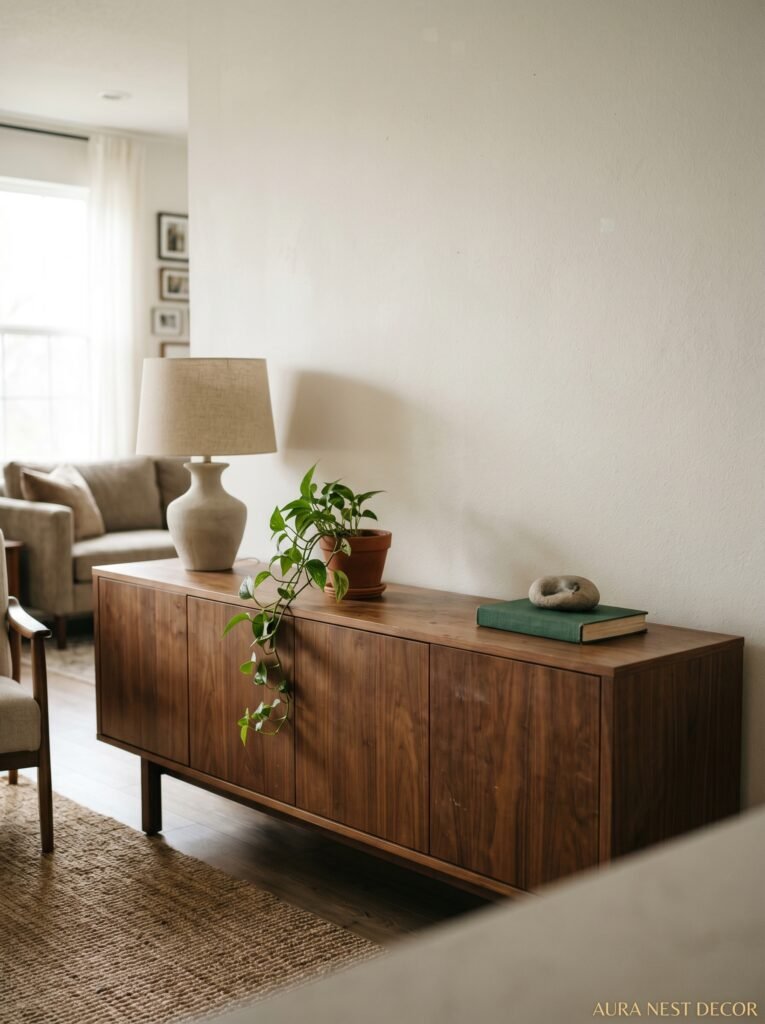
I want to talk about the furniture everyone forgets about, because I think this is where a lot of big living rooms quietly fall apart.
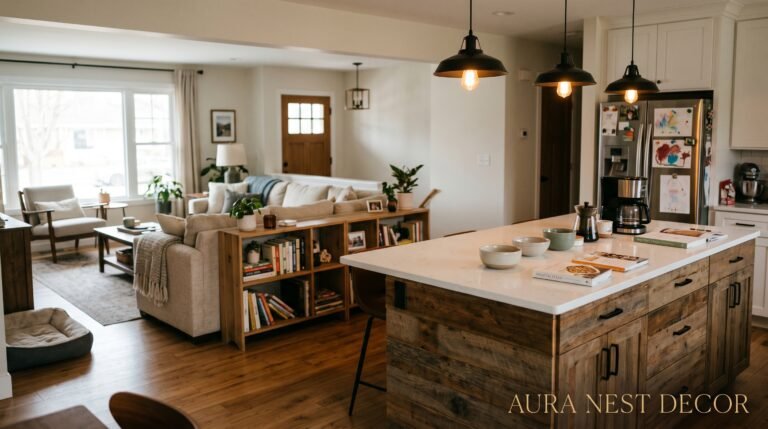
When you’ve got huge walls and you’ve sorted your main seating zone, there’s still all this… perimeter space. The walls between the windows, the stretch of wall behind the sofa, the big blank nothing across from the TV. This is where console tables, sideboards, credenzas, and open shelving units do extraordinary work.
A long credenza — 72 to 84 inches wide — along a big wall creates an immediate sense of scale and intention. It gives you surface space for lamps, plants, objects, books. It fills vertical space. It communicates that this room was THOUGHT about. Same goes for a substantial bookshelf — not an IKEA Billy unit by itself, but a wide, full, styled bookshelf that goes from floor to ceiling if possible. That’s furniture that earns its place in a big room.
Don’t leave the wall behind your sofa completely bare either. A long, low console table behind the sofa creates depth and layering — you can put a pair of table lamps on it, a trailing plant, a stack of art books. It’s so simple and it completely changes how sophisticated a room feels.
—
9. Plants — But Not in the Way Every Article Says
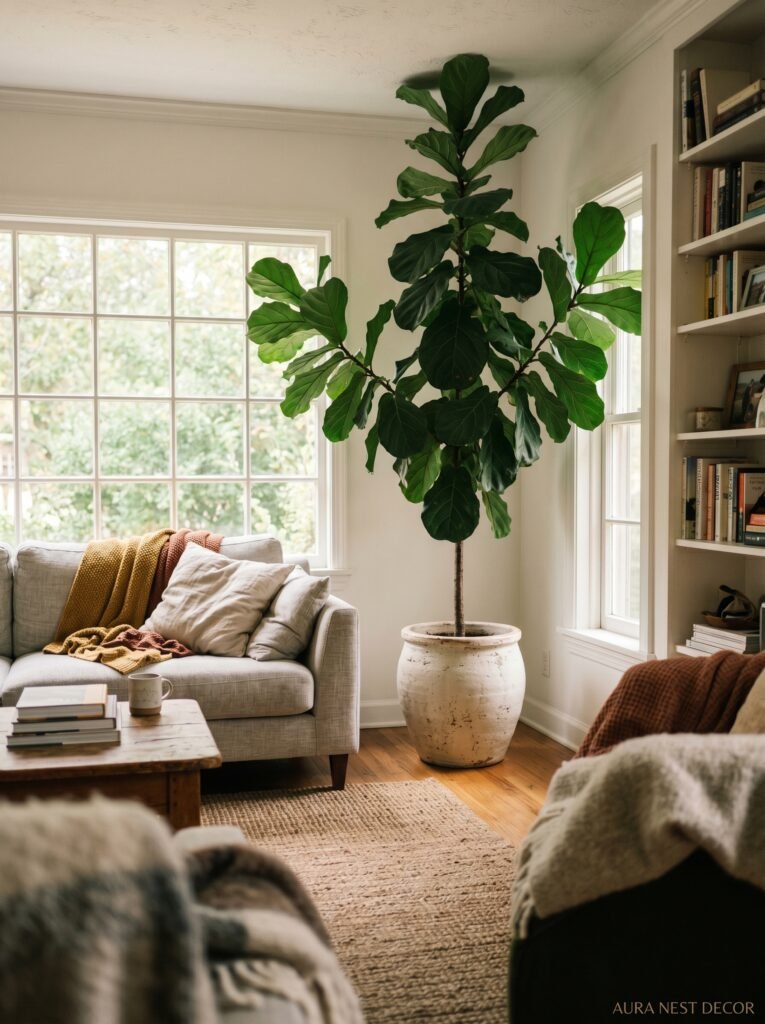
Every home decor article says “add plants.” And they’re right but they’re also not telling you the whole thing.
In a big living room, small plants just disappear. A collection of tiny succulents on a shelf does nothing for the scale of the room — it’s charming up close but invisible from across the space. You need DRAMA. Tall plants. Big plants. Plants with presence.
A fiddle leaf fig or olive tree in the corner of a seating zone? Game changing. Not just because they’re beautiful (though they are) but because they give a room a sense of LIFE that no piece of furniture can replicate. They break up clean lines, add organic texture, and warm a room in a way that’s genuinely hard to explain but immediately felt when you walk in.
I’d take two genuinely large, striking plants over six medium-sized ones in a big room. Always. The scale matters more than the quantity.
—
10. The Fireplace Factor: How to Make It the Focal Point It Deserves to Be
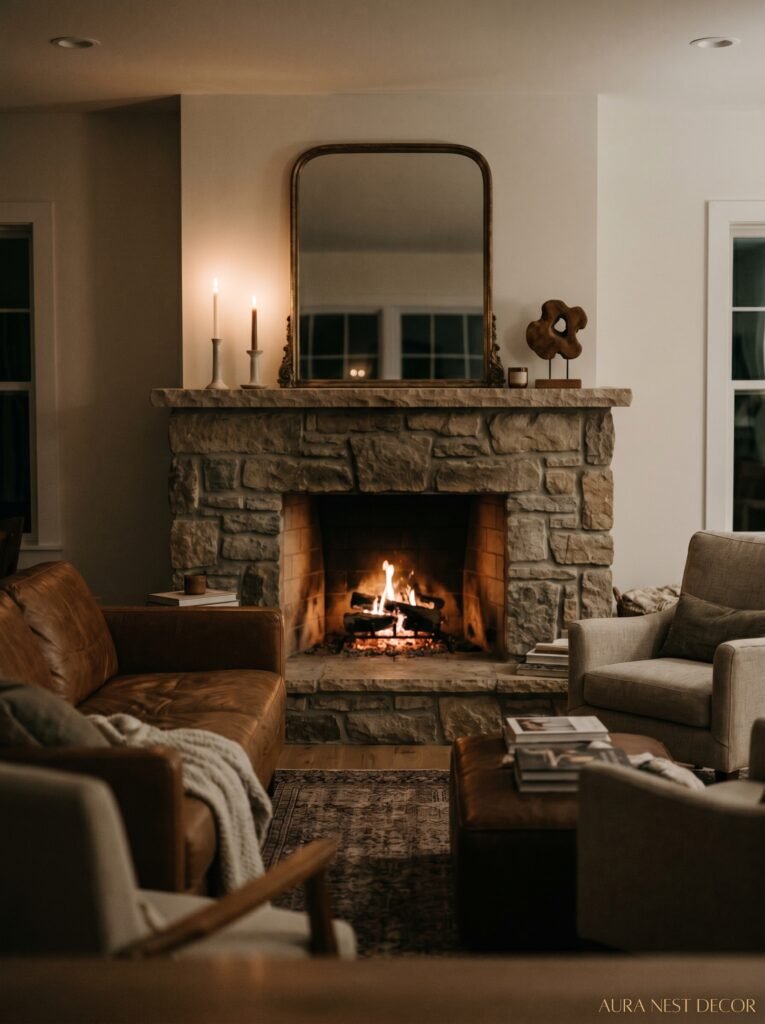
If you have a fireplace in your large living room, it should be the absolute boss of the space. The commanding center that everything else organizes around.
But a lot of big rooms have fireplaces that look… shy. Overwhelmed by the space, with furniture that’s not really facing it, with a mantel that’s either completely bare or completely cluttered. Neither extreme is good.
Arrange seating to FACE the fireplace. Directly. Make the sight line to it clear and obvious. And then treat the mantel like a piece of art — not too full, not too sparse, with at least one taller element (a mirror, a large piece of art, an architectural object) that reinforces the vertical draw of the fireplace itself.
An oversized mirror above a fireplace in a big room is basically a cheat code. It reflects light, makes the room feel bigger (or in this case, warmer and more layered), and doubles the visual impact of whatever’s around it.
—
11. The Part Everyone Skips: Ceiling and Height
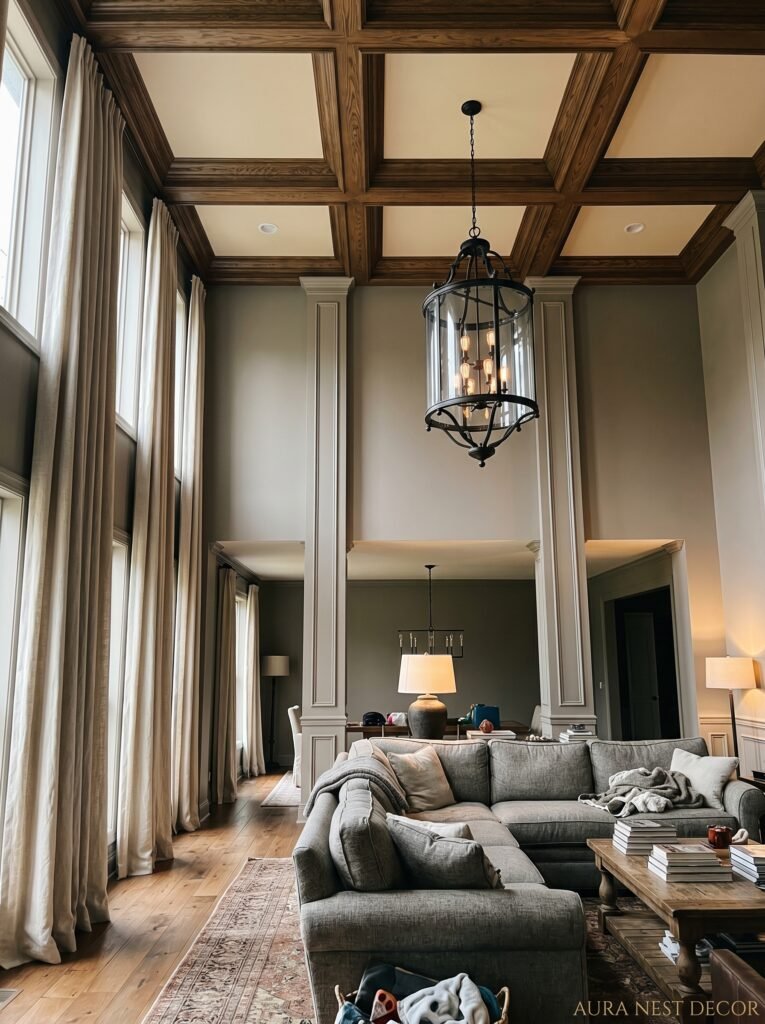
You’ve got high ceilings in your big living room and you’re mostly ignoring them, aren’t you? Yeah. Most people do.
High ceilings are magnificent until they’re not — until the room feels like a church nave and all the warmth lives somewhere near the floor while the top half of the room is just… ceiling. There are ways to bring the eye down and make it feel intentional.
Curtains hung from ceiling to floor, even on modestly sized windows, are the most dramatic and effective way to do this. Full-length curtains make a room feel RICH, they soften acoustics (big echoy rooms, anyone?), and they draw the eye along a vertical plane that feels complete rather than abandoned. Go floor-to-ceiling. Always.
A statement pendant or chandelier works similarly — it pulls the eye up and then back down, connecting the floor plane to the ceiling in a way that feels resolved. In a big room, a single pendant that’s too small just emphasizes how much ceiling there is. Go large.
—
12. The Last Thing I Always Notice in Beautiful Big Living Rooms
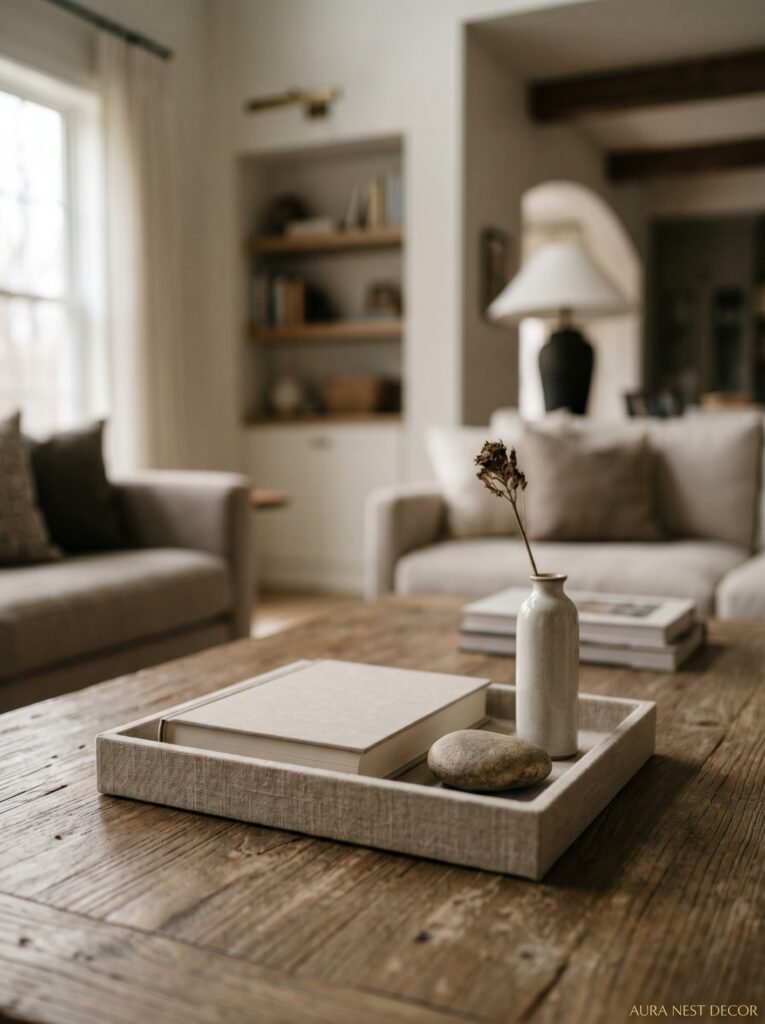
Books. Objects. Evidence of a person.
This sounds soft but I mean it practically. Big living rooms can feel so staged, so arranged, so perfect that they lose any sense of inhabitation. And we don’t actually want to live in a room that looks like a hotel lobby, do we? Even a luxurious hotel lobby.
The best big living rooms I’ve ever walked into — in real life, not on Pinterest — have had a stack of books on the coffee table. A worn throw draped over one armchair. A candle that’s clearly been burned. A plant that’s slightly imperfect. These details signal that this is a ROOM, not a showroom, and they make the whole space instantly warmer.
You can have perfect proportions, beautiful lighting, layered rugs, zoned seating — and still have a room that feels empty if it doesn’t have the little bits of life in it. So stack the books. Leave the candle out. Throw the blanket imperfectly.
That’s the room people actually want to sit in.
—
❓ FAQ
Q: How do you make a big living room feel cozy without making it look cluttered? A: The secret is layers in the right places, not stuff everywhere. Textured rugs, curtains that reach the floor, warm lighting at multiple heights — these add coziness at a sensory level without adding visual clutter. Keep surfaces relatively clear but make sure textiles are doing heavy work.
Q: What size rug do I need for a large living room? A: Bigger than you think. For most large living rooms, a 9×12 is the starting point, not the maximum. All the front legs of your seating furniture should sit on the rug — ideally all four legs of every piece. If the room has two separate zones, consider two separate rugs rather than trying to cover everything with one.
Q: Should I use a sectional or separate sofas in a big living room? A: Depends on how you use the space. Sectionals are great for families and anyone who prioritizes comfort and gathering — they create an instant cozy hub. Two separate sofas work beautifully if you want a more formal, symmetrical look or if you’re working with two distinct zones. Either way, go big on scale. Undersized seating in a large room is the most common mistake I see.
—
💭 Final Thoughts
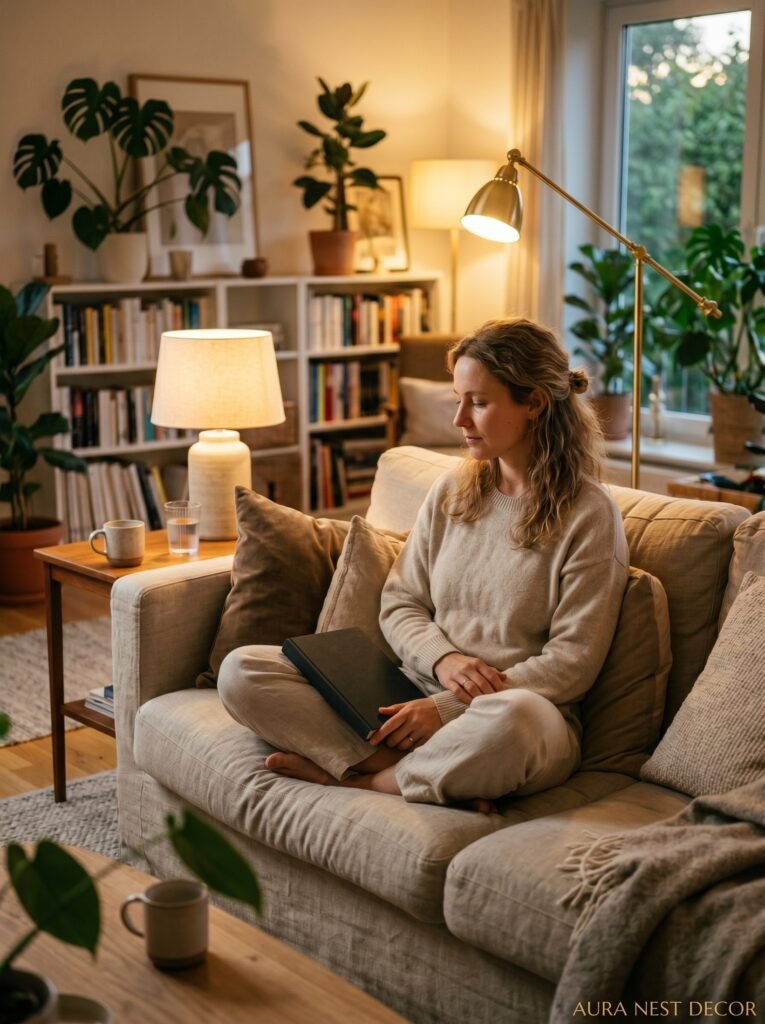
A big living room isn’t a problem to solve — it’s an invitation, once you know what it’s asking of you. Scale, warmth, intention, and that little bit of honest mess that proves someone actually lives there. Get those four things right and you’ve got something.
So — what’s the one thing in your big living room that you’ve always known wasn’t quite working, but kept hoping nobody would notice?