The College Apartment Living Room That Actually Feels Like Home (Not a Waiting Room)
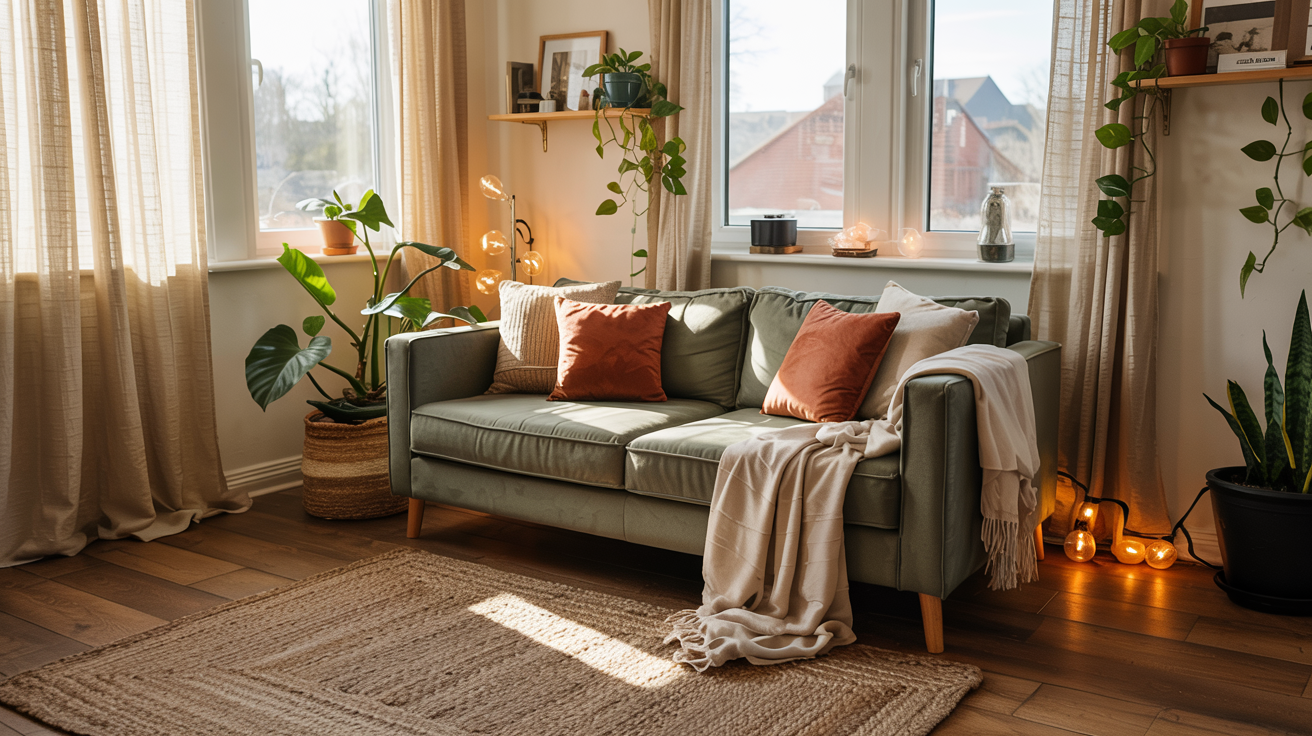
You moved in with a secondhand couch, a lamp from Target, and the best intentions. But somehow, three months later, it still feels like a place you’re staying rather than a place you live. Here’s how to change that — on a budget that doesn’t make you cry.
—
1. The Reason Your Room Feels Empty Even When It’s Full of Stuff
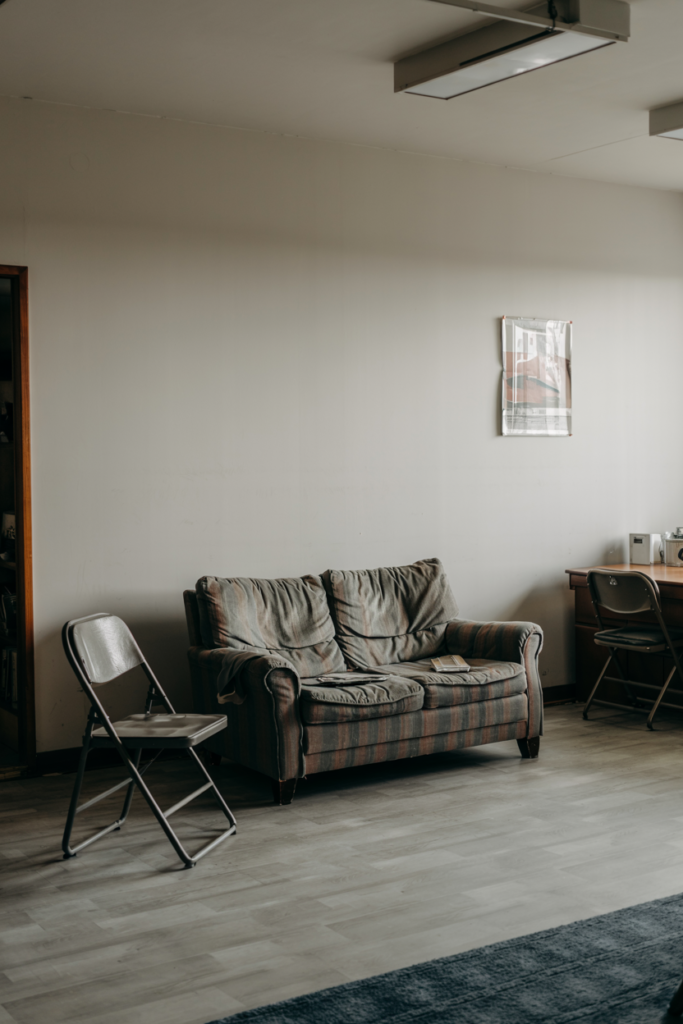
This is the one nobody talks about. You can have a couch, a rug, a TV, plants on the windowsill — and the room still feels like a hotel lobby. Hollow. Temporary. And the reason is almost never about what you have. It’s about how everything is floating.
In most college apartments, furniture gets pushed against the walls. It’s instinct — you’re trying to make the space feel bigger. But it actually does the opposite. When your couch is shoved up against the drywall and your coffee table is a mile away, the center of the room becomes dead space. Nothing converses with anything else. Your furniture looks like it’s waiting to be picked up.
The fix is so simple it feels like a trick. Pull everything in. Even six inches off the wall makes a difference. Create a shape — an implied square or circle — where the seating faces each other or faces a center point. The room starts to feel intentional almost immediately. Like someone thought about it. Like someone actually lives there.
This is where cozy starts. Not with throw pillows. Not with candles. With furniture that faces each other like people having a conversation.
“Cozy isn’t about what you add. It’s about how close everything is willing to get.”
—
2. The Rug Size That’s Making Your Room Look Accidentally Smaller
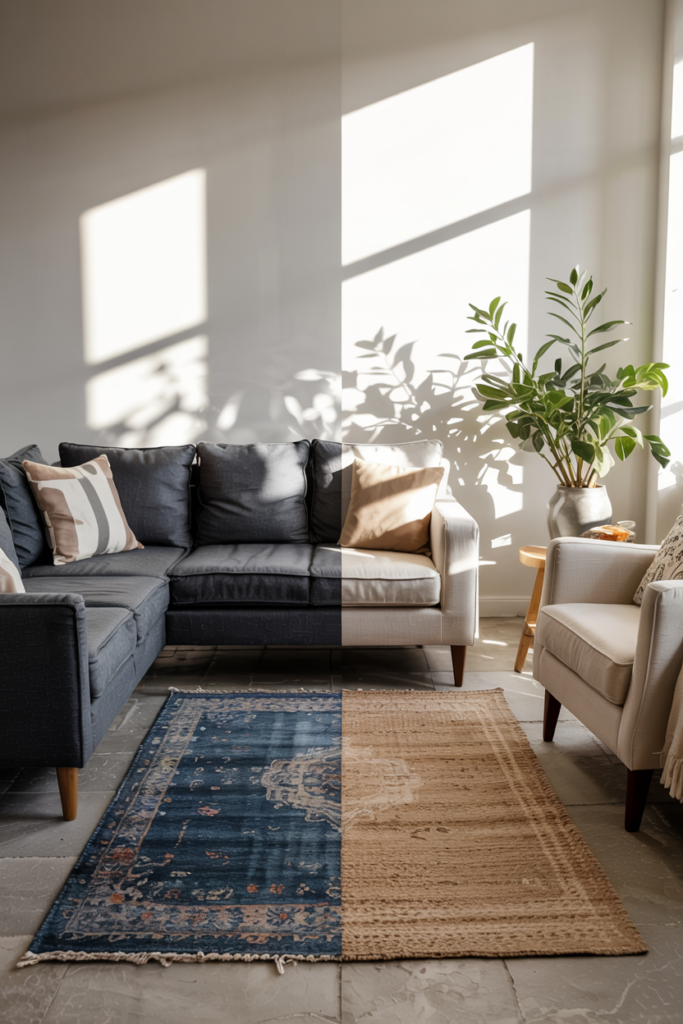
If your rug is small, your room looks small. Full stop. This is possibly the most common mistake in college apartment decorating, and it’s understandable — small rugs are cheaper, easier to move, easier to find at HomeGoods or IKEA on a Sunday afternoon.
But a rug that only fits under the coffee table, leaving all four sofa legs hovering in mid-air on bare floor? It reads as an afterthought. It sections the room into a little island and makes everything around it feel disconnected.
For a typical college apartment living room, you want at least a 5×8 — ideally a 6×9 or 8×10 if the space allows it. The front legs of your sofa and chairs should sit on it. That’s the rule. Front legs on, back legs off — it anchors everything without requiring you to cover every inch of floor.
Can’t afford a big rug? Layer two smaller ones. A jute or sisal base underneath something with texture or pattern on top. The layered rug look is everywhere right now and it genuinely solves the budget problem while adding something that looks deliberately styled rather than accidentally thrifted.
—
3. The Color That Keeps Showing Up in Every Beautiful College Living Room Right Now
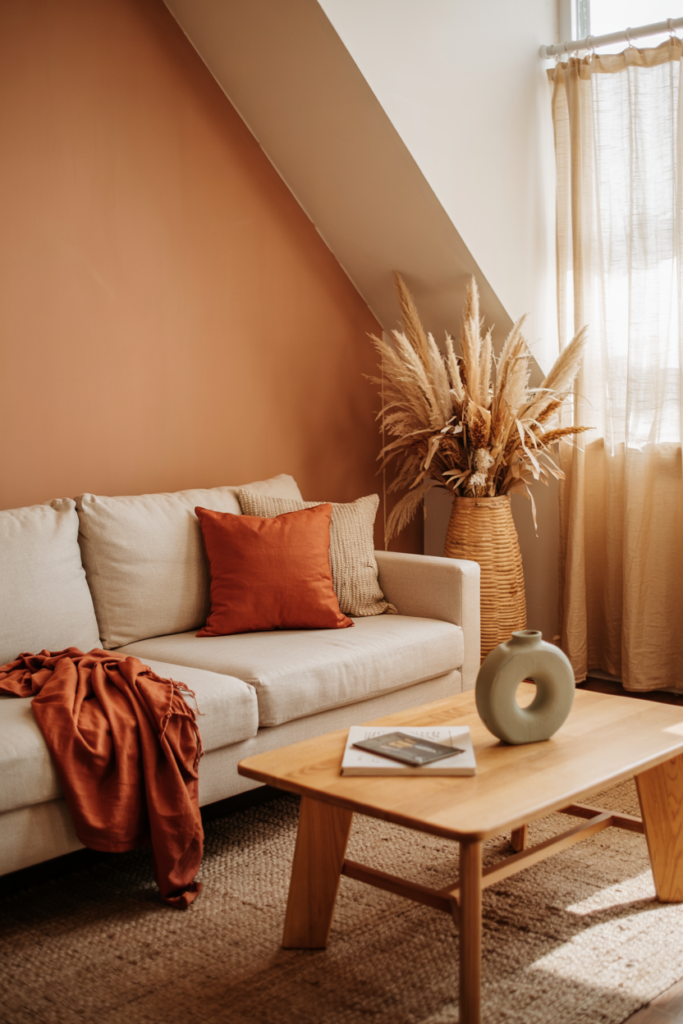
It’s not white. It’s not gray. It’s warm terracotta, dusty sage, and the kind of deep cream that looks like it has memories baked into it.
The shift away from cold, stark interiors has been happening for a few years now, but in 2024 it’s fully arrived in the college apartment space. People are done with the cold gray couch on cold white walls under cold overhead lighting. They want warmth. They want their room to feel like the inside of a café they’d never want to leave.
You don’t need to repaint. (Most rental apartments won’t let you anyway.) The color comes through in everything else. A sage green throw blanket draped over the arm of a cream sofa. Terracotta-toned pottery on a shelf. Amber glass bottles on the windowsill catching afternoon light. Burnt orange cushions against a dark green velvet accent chair.
The trick is to pick one warm anchor color and let everything else orbit around it. Don’t try to include every trend at once. Sage green plus terracotta plus mustard plus rust is too much. Sage green plus cream plus one deep natural wood tone? That’s a room.
—
4. What IKEA Gets Right (and the One Thing You Should Never Buy There)
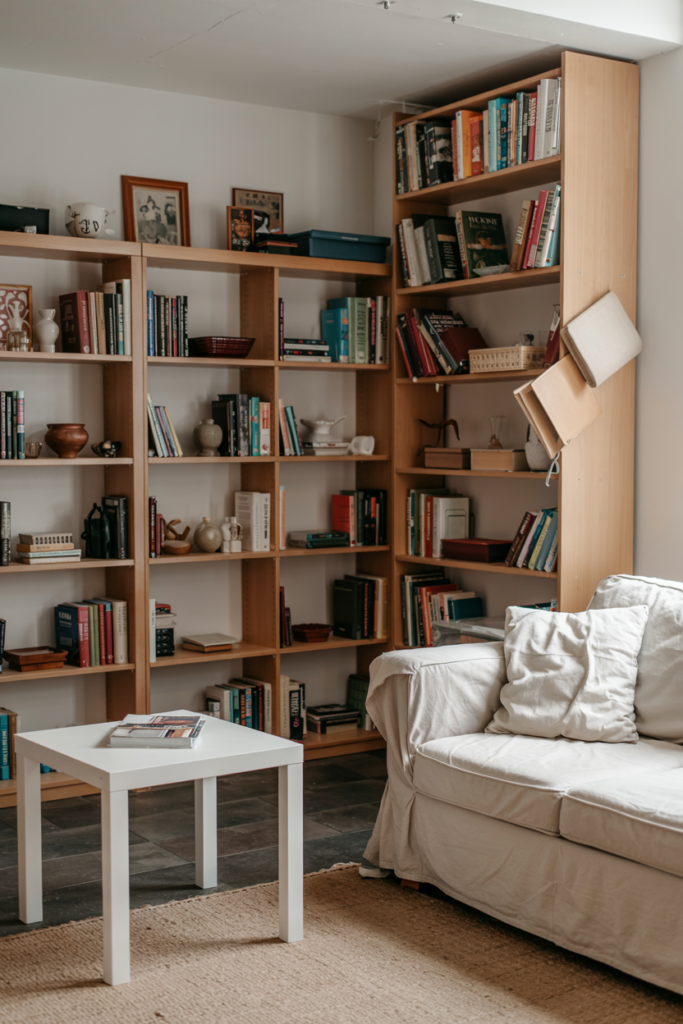
IKEA is the college apartment bible. We all know this. The KALLAX shelf unit has probably furnished more dorm rooms and first apartments than any other piece of furniture on earth. And there’s a reason — it’s modular, it’s cheap, it does exactly what it says it will do.
The pieces worth buying: the KALLAX, the LACK tables used as a side table stack, the RIBBA frames in bulk for a gallery wall, the SANELA velvet curtains, which look three times more expensive than they are when you hang them high and wide. The POÄNG chair in the right color will outlive your entire lease and then some.
But here’s what to skip: the soft seating. The sofas and armchairs. Not because they’re ugly — some of them are actually quite nice — but because in a small apartment, the couch is the piece that sets the emotional tone of the whole room, and IKEA’s sofas tend to feel flat and temporary. Spend more on a secondhand sofa with real cushion depth and character, even if it’s not perfect. A slightly worn velvet sofa from Facebook Marketplace will do more for your living room than a brand new FRIHETEN ever will.
“Buy secondhand for the thing that holds you, and IKEA for everything that holds your stuff.”
—
5. Hanging Curtains the Way Interior Designers Actually Do It
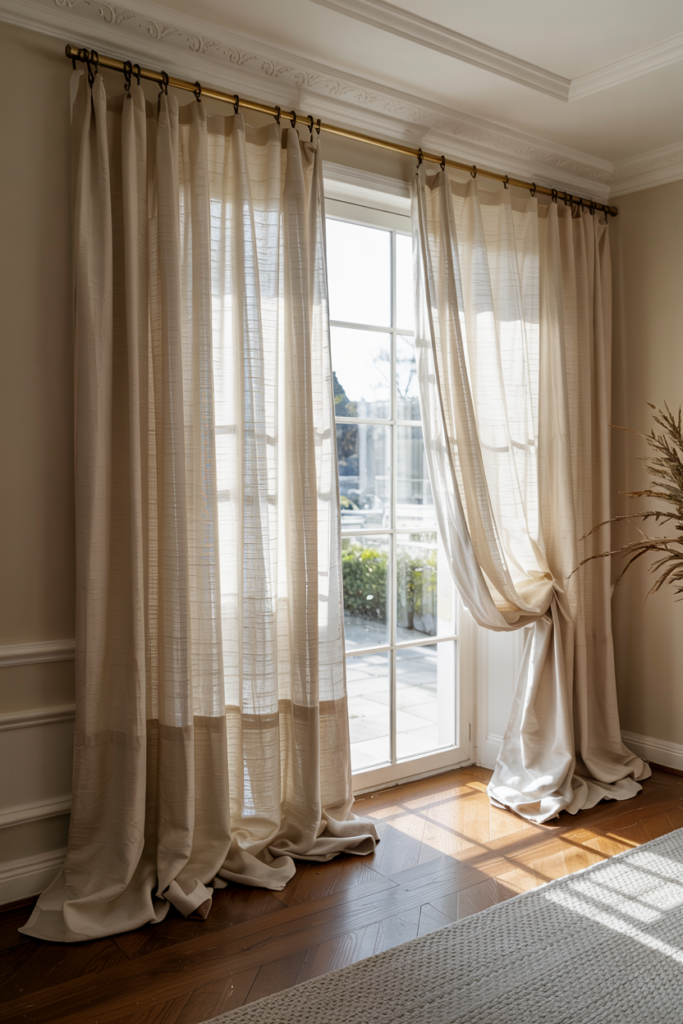
Your curtains are probably in the wrong place. Not the wrong style, not the wrong color — the wrong position. Hanging curtains at window height is one of those things that makes total logical sense and yet completely kills a room’s sense of height and grandeur.
Hang them high. As high as you can get them — ideally within a few inches of the ceiling, or right at the top of the wall if you can manage it. Then hang them wide, so they clear the window completely when open, letting in the maximum amount of light and making the window look twice the size.
This single change makes a standard 8-foot ceiling feel like it’s reaching. It makes a small window look architectural. It transforms rental-white walls into something that feels deliberate and designed.
In terms of fabric: linen is the dream. It’s textural, it pools beautifully, it catches light in a way that polyester simply doesn’t. You can find affordable linen-look curtains at IKEA (the DYTÅG is excellent), at Amazon, and at HomeGoods. Even if the rest of your room is still a work in progress, properly hung linen curtains will make people ask if you hired someone.
—
6. The Lighting Setup That Makes Any Cheap Apartment Feel Expensive After Dark
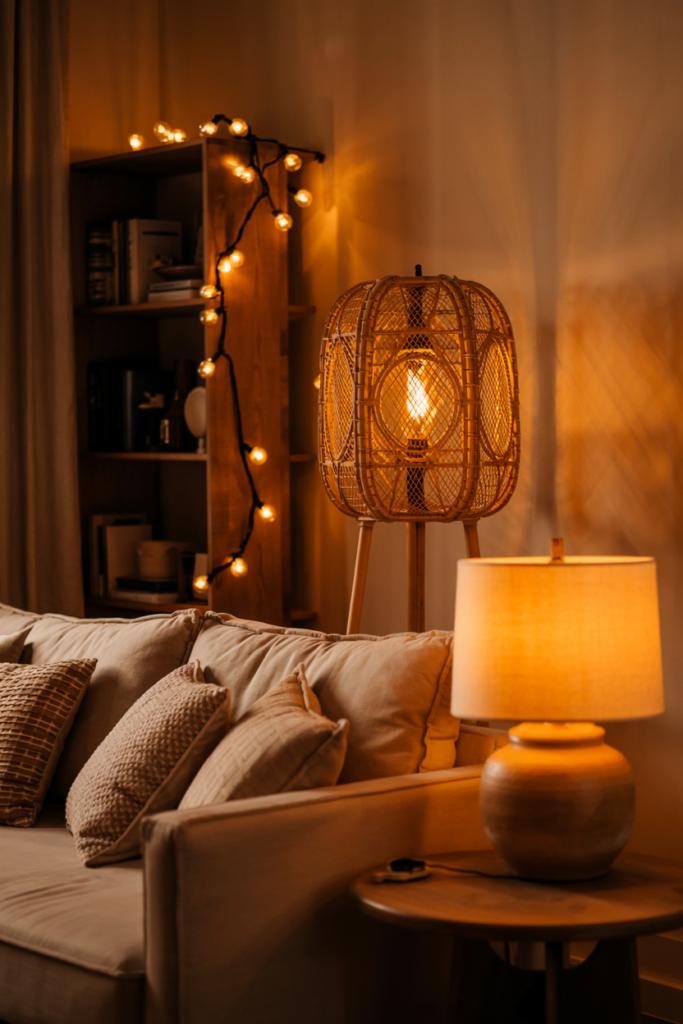
Overhead lighting is the enemy. There. Said it. The flat, shadowless wash of a single ceiling fixture is the reason so many college apartments feel like hospital waiting areas. You’re not living under fluorescents at a doctor’s office. You deserve better.
Lamps. Multiple lamps. Placed at different heights. That’s the whole secret.
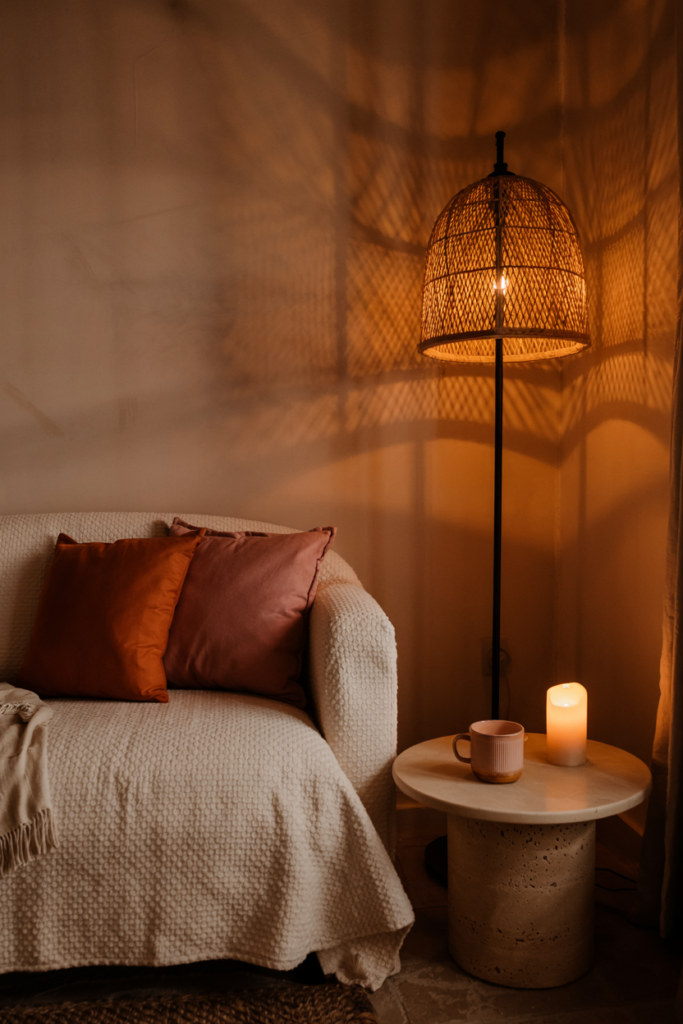
A floor lamp in one corner. A table lamp on a side table. Maybe a string of warm Edison bulbs along a shelf or around a window frame. You’re building layers of light, all of it warm (2700K bulbs — not the cool blue ones), all of it low to the ground and intimate.
The goal is amber. The amber glow of an Edison bulb at 7pm when the rest of the apartment has gone dark. That’s the feeling you’re after. That’s the feeling that makes a $400-a-month apartment feel like somewhere worth staying in.
Smart plugs on a timer help enormously. Set your lamps to come on automatically at sunset. You come home and the room is already warm and glowing. It changes everything.
—
7. Gallery Walls That Don’t Look Like Everyone Else’s Gallery Walls
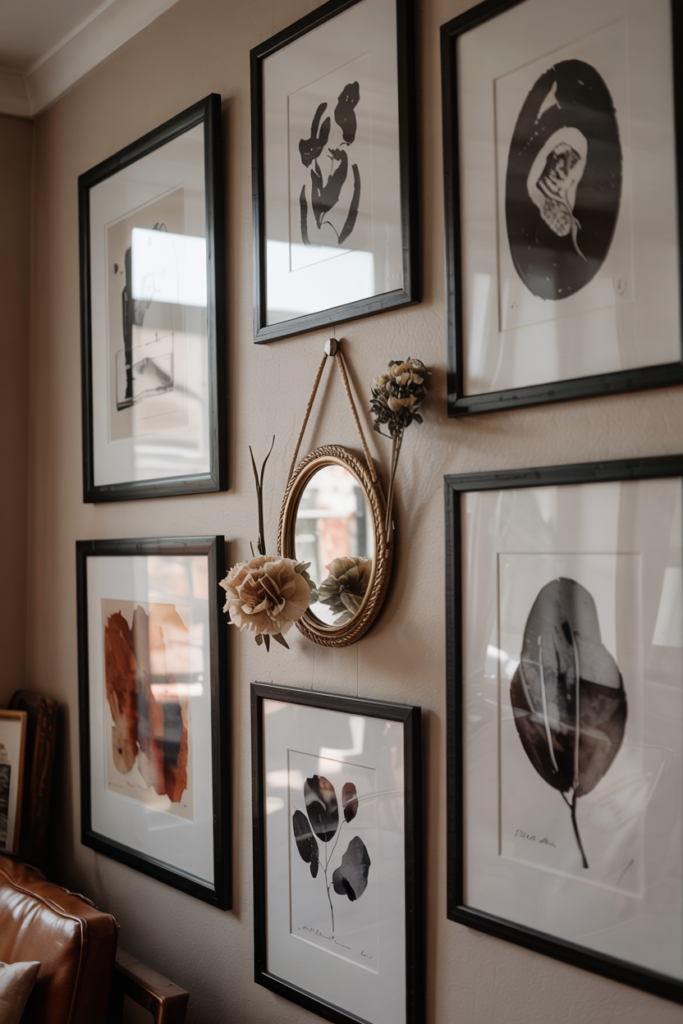
The classic gallery wall — a grid of matching black frames, a mix of prints and photos on white walls — has been done. It’s fine. It’s safe. But if you want your space to feel like yours and not a Pinterest template, you need to think differently.
Start with the frames themselves. Don’t match them. A mix of thin black metal, raw wood, wide cream, and vintage gold is infinitely more interesting than a uniform set. Size variation matters too — one large anchor piece surrounded by smaller frames reads much better than a grid of identical sizes.
Then think about what goes inside. The beautiful truth about gallery walls in college apartments is that the content matters far more than the quality of the prints. A photograph you took yourself, printed at Walgreens or Boots for a few dollars, means infinitely more than a generic botanical print downloaded from Etsy. Your gallery wall should have at least a few things that are genuinely yours — a postcard from a trip, a handwritten note, a film photograph from a disposable camera.
Mix print types too. A black and white photo next to a full-color painting next to a small mirror (yes, mirrors in gallery walls are stunning). Varying the visual texture is what makes it feel curated rather than assembled.
“Your gallery wall should be able to tell someone who you are in under thirty seconds.”
—
8. The One Plant That Thrives in Dark Apartments (and Makes the Room)
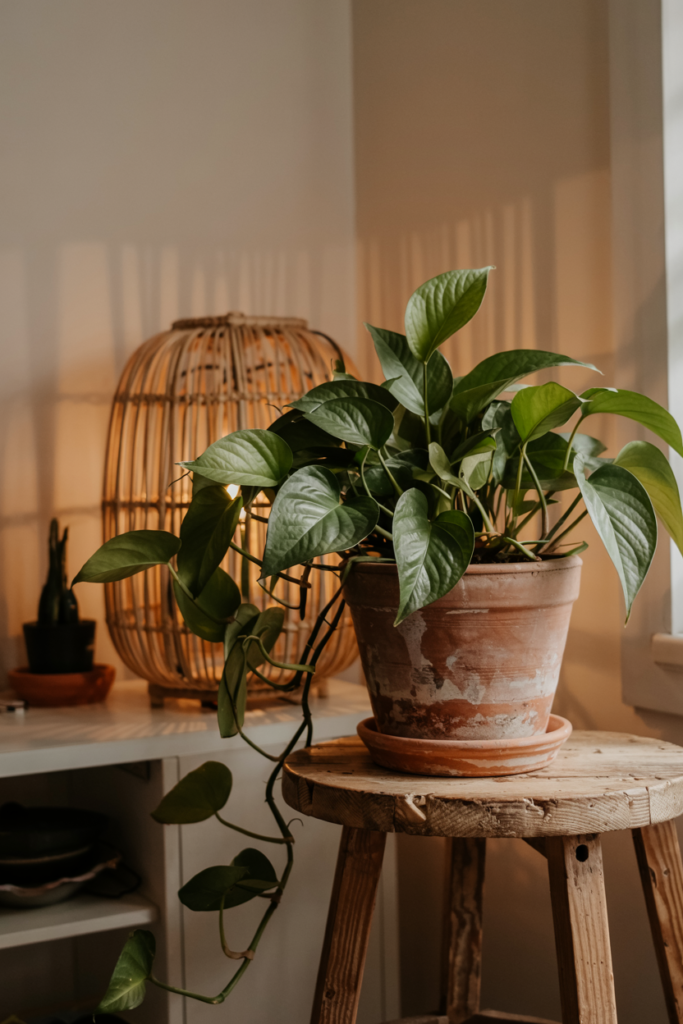
Most college apartments have one small window facing the wrong direction, and whatever natural light comes in gets filtered through the building across the street. Which means most plants die. Which means most people give up on plants entirely. And that’s a shame, because a living green thing in a room does something that no throw pillow ever can.
The answer is pothos. Golden pothos, marble queen pothos, neon pothos — any of them. These plants are nearly impossible to kill. They grow in low light, they forgive irregular watering, they trail beautifully from a high shelf or cascade down a bookcase in a way that adds organic life to a room that might otherwise feel static and hard-edged.
Put them high. A trailing pothos on the top shelf of a bookcase, draping its vines down through the shelf levels below, is one of the most effortlessly beautiful things you can do to a college apartment. It costs ten dollars from a garden center or a farmers’ market and looks like it should be in a magazine.
ZZ plants are another excellent choice — waxy, dark green, architectural, completely unbothered by neglect.
—
9. How to Make a Secondhand Sofa Look Like You Meant to Buy It That Way
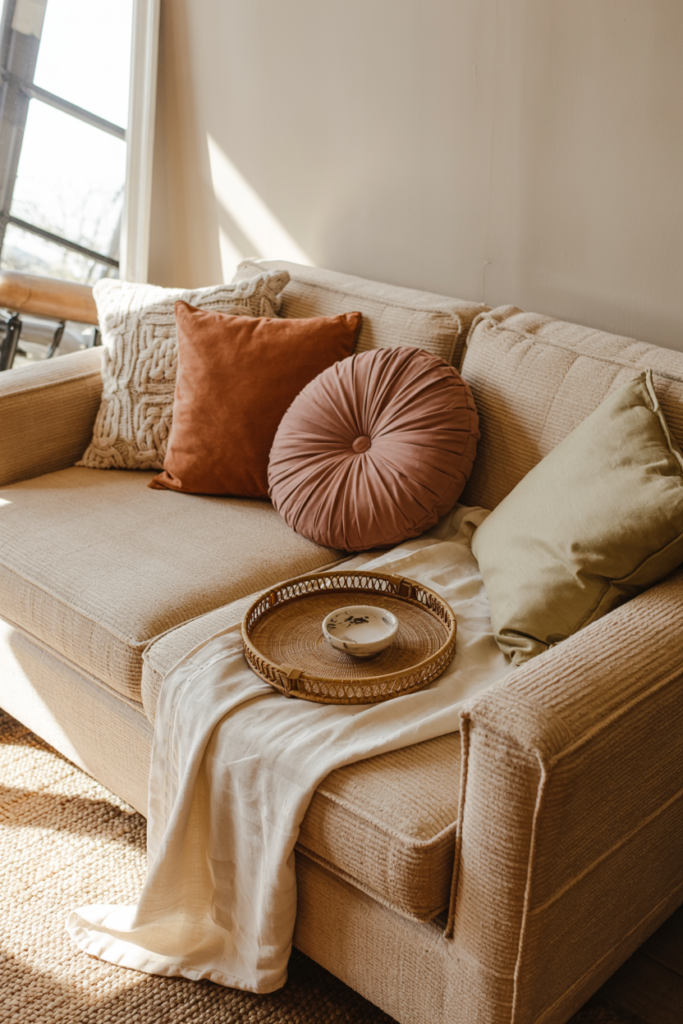
The thrift store sofa. The Facebook Marketplace pickup. The piece your roommate’s roommate’s cousin left behind. We’ve all been there. You have a couch. It is not beautiful. But it is free, and beggars can’t be choosers, and here we are.
Here’s the thing: most secondhand sofas are eminently salvageable. The structure is usually fine — it’s just the surface that’s telling the wrong story.
A fitted sofa slipcover in a neutral linen or cotton is the cleanest solution. IKEA makes them for their own sofas; Amazon has universal options that work surprisingly well on a variety of shapes. Go natural — cream, oatmeal, stone. They make any sofa look like it came from a house that has towels that match.
Throw pillows are the other tool. Three to five, in varying sizes, in textures that contrast with the sofa fabric. Chunky knit against smooth cotton. Velvet against linen. The goal is to make the sofa look layered and considered rather than inherited and apologized for.
And then — the throw blanket. Casually draped over one arm. Not folded. Not too tidy. Like someone was just using it and stepped away for a moment.
—
10. Shelves Are Not Just Storage: They’re the Personality of Your Room
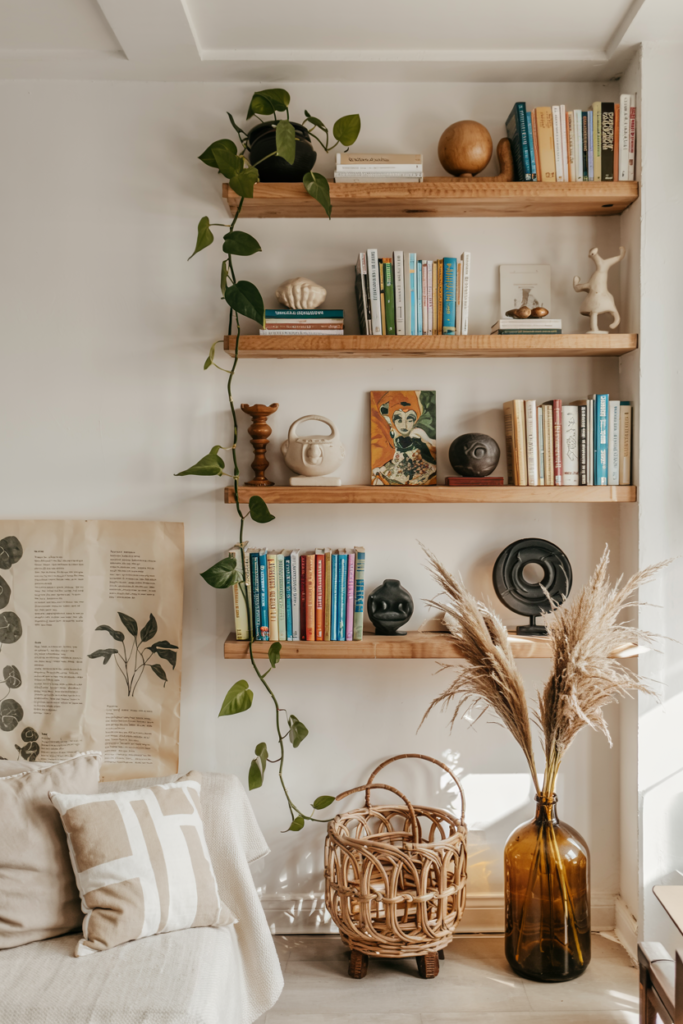
Empty shelves are fine. Full shelves are overwhelming. The sweet spot — and it takes a few tries to find it — is somewhere around 70% full.
Leave breathing room. Don’t fill every inch. Let things have space around them to exist as objects rather than as clutter.
The styling formula that always works: stack a few books horizontally rather than all vertically. Place one small object on top of the horizontal stack — a little sculpture, a crystal, a candle. Stand a plant next to it. Add one item that has no practical purpose whatsoever but makes you happy to look at. Repeat, with variation.
Varying heights are crucial. A low row of books, a tall vase, a medium candle, a trailing plant — the eye moves through them and reads the shelf like a sentence rather than a wall.
—
11. The Cozy Corner That No College Apartment Has (But Every One Could)
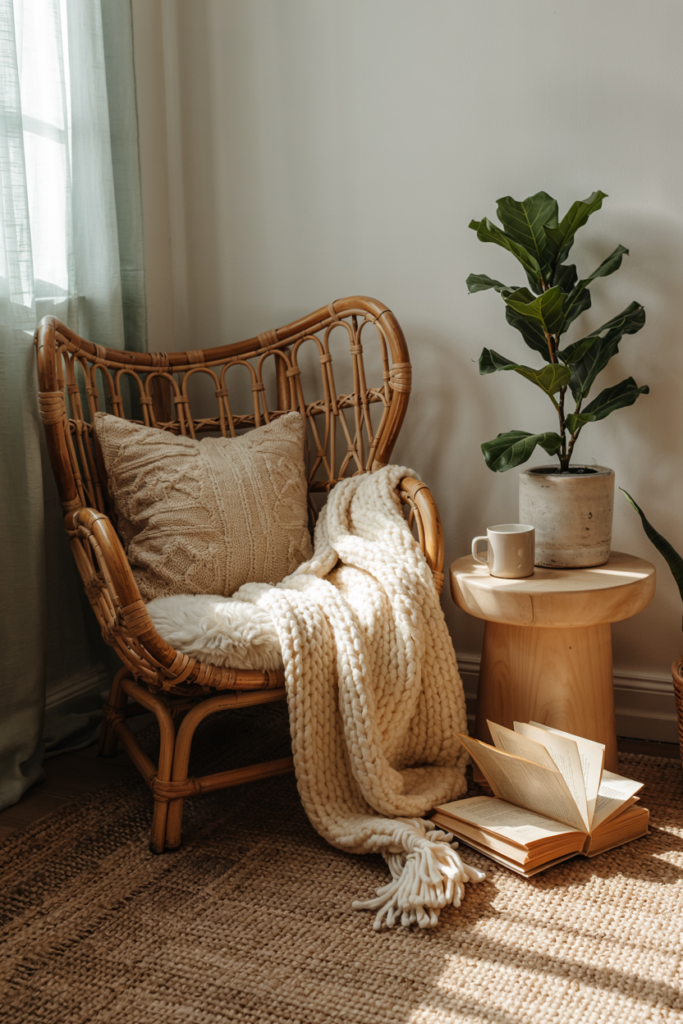
Take your least used corner and commit to it. A reading chair. A floor lamp right next to it. A small side table for a mug. A basket of blankets on the floor beside it. Maybe a plant in the corner behind the chair, just visible.
That’s it. That’s the whole thing.
But what it creates is remarkable. A destination within the room. A place that says this is what this room is for. Not just passing through, not just watching TV, but actually being somewhere. The cozy corner signals intention. It says someone thought about this room, loves this room, lives in this room.
The chair doesn’t have to be expensive. A secondhand armchair in good structural shape, recovered with a slipcover or refreshed with a throw, costs maybe forty dollars. The lamp from IKEA, fifteen. The side table — the LACK from IKEA, less than ten dollars. The basket from HomeGoods or TK Maxx, eight dollars.
The whole corner, under a hundred dollars. The feeling it creates: priceless in the most literal way.
—
12. The Last Ten Minutes That Make the Whole Room Work
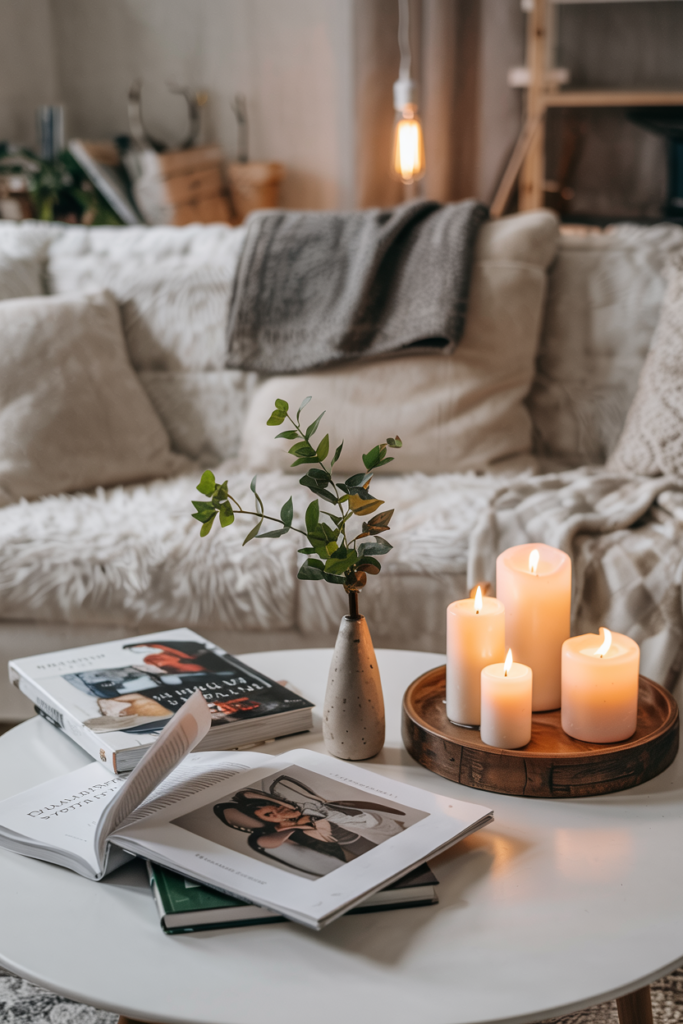
Here’s what nobody tells you about interior styling: the final layer isn’t furniture or paint or curtains. It’s the living layer. And it takes about ten minutes to add.
Light your candles. Not all of them — one or two. Drape the throw blanket with intention — one arm of the sofa, casually. Stack the coffee table books so the spines face the same direction. Put one fresh or dried flower in a small vase, even a drinking glass. Turn on the lamps and turn off the overhead light.
Leave one small thing slightly imperfect on purpose — a book left open and face-down, a mug on the side table, a pillow pushed to one side. Perfect rooms feel staged. Rooms with one small beautiful imperfection feel lived in.
This is the difference between a room that photographs well and a room that feels well. You want both. And you can have both. It just takes the ten minutes that most people skip.
—
🌿 Quick Tips
Put your coffee table slightly closer to your sofa than feels right — within comfortable arm’s reach means within comfortable feel reach too, and it makes the seating area feel cozy rather than formal.
Swap out any cool-white bulbs the moment you move in. Take them out, put them in a drawer, replace with warm 2700K bulbs throughout. It takes fifteen minutes and changes the entire mood of every room.
Dried flowers last for months and cost almost nothing at a farmers’ market or grocery store. A small bunch of dried pampas, eucalyptus, or lavender in a simple vase does more for a shelf or mantel than most decorative objects.
Don’t buy all your decor at once. The best-looking rooms are assembled slowly, over time, with pieces that were found rather than purchased in a single anxious trip to HomeGoods. Give it time.
If you have white walls you can’t paint, add warmth through wood. A wooden tray, a cutting board leaning against the wall, floating wood shelves, a raw wood picture frame — these neutralize the cold, blank feel of rental-white better than any paint color.
—
❓ FAQ
Q: How do I make a college apartment living room feel cozy when it’s really small? A: The biggest mistake in small rooms is pushing everything against the walls trying to create space — it actually makes rooms feel more empty and awkward. Pull the furniture in toward the center, use a large rug (at least 5×8), and layer lighting from multiple low sources instead of relying on overhead light. Small rooms feel cozy when things are close together, not spread out.
Q: What’s the best way to decorate a rental apartment living room without losing a deposit? A: Command strips for artwork and hanging shelves, removable wallpaper on a single accent wall, curtains hung from tension rods if drilling isn’t allowed, and furniture-based styling rather than wall-based changes. Most of the impact in a living room comes from furniture arrangement, lighting, and textiles anyway — none of which requires a single hole in the wall.
Q: What’s the cheapest way to make a college living room look more expensive? A: Curtains hung high and wide (even cheap ones from IKEA), a large enough rug, and warm lamp lighting instead of overhead lighting. These three changes cost under $150 combined and produce a more dramatic improvement than almost anything else you can do to a rental apartment.
—
💭 Final Thought
The funny thing about making a college apartment feel like home is that it’s not really about the apartment at all. It’s about the decision to care about where you live — to believe that your space deserves thought and softness and things that make you happy, even when it’s temporary, even when you’re leaving in nine months. Especially then.
A room that feels like yours changes how you work in it, rest in it, recover in it.
What’s the one thing your living room is missing that would make you actually want to stay in it?