
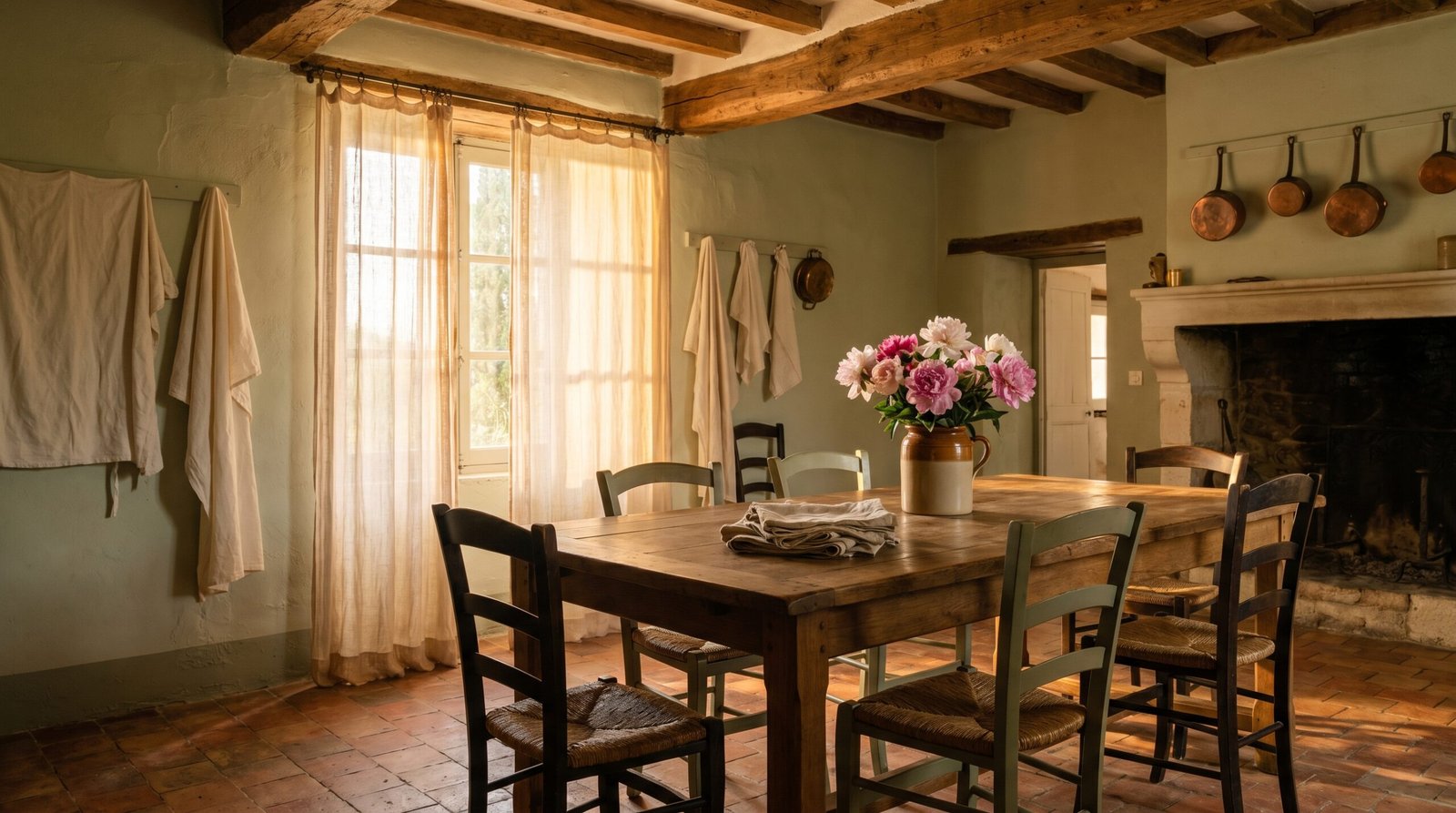
The French Country House Interior That Makes You Want to Slow Down and Stay Forever
There’s a certain kind of home that stops you in your tracks — not because it’s perfect, but because it feels lived in, warm, and deeply, quietly beautiful. French country house interiors are exactly that kind of home. They whisper history, comfort, and artistry all at once, and once you understand what makes them so magnetic, you’ll never look at a bare white wall the same way again.
—
1. What “French Country” Actually Means — And Why So Many People Get It Wrong
French country style is one of the most searched and most misunderstood design aesthetics on Pinterest. People often confuse it with shabby chic, rustic farmhouse, or Parisian minimalism — but it’s none of those things exactly. It’s something richer, more layered, more human.
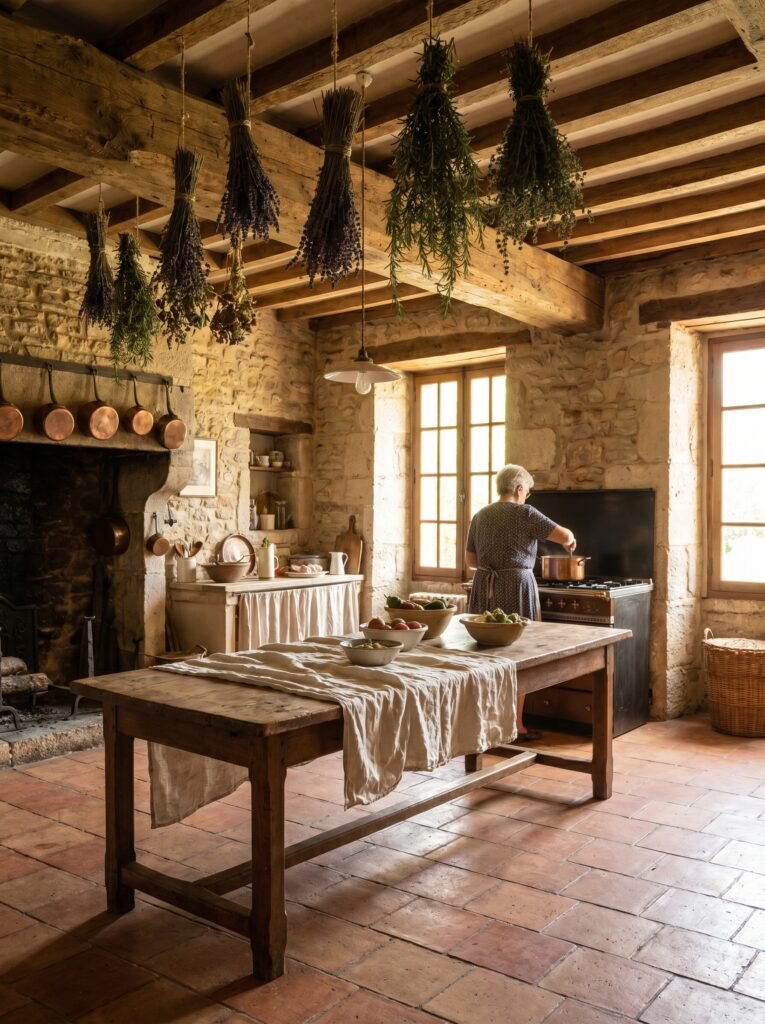
The true French country interior draws its soul from the rural south of France — Provence, the Dordogne, the Languedoc — where homes were built for generations, not for seasons. These were farmhouses and stone manors where grandmothers made lavender sachets and dried herbs from the rafters, where the kitchen table was the center of family life, and where beauty was never bought in a showroom but gathered slowly over a lifetime.
The defining characteristics? Warm, sun-kissed color palettes. Natural materials like stone, linen, and aged wood. Furniture that carries a story. Patterns that feel garden-fresh — toile de Jouy, florals, checks. And always, always, a sense that someone lives here — not just decorates here.
“French country interiors don’t try to impress you. They invite you in, pour you a glass of wine, and make you forget to leave.”
Getting this style right means letting go of the idea that everything needs to match. It means choosing patina over perfection and warmth over sterility. It means designing for real life — for children running through the hall, for bread rising on the counter, for afternoon light falling across a stone floor.
—
2. The Colors of French Country — A Palette That Feels Like Provence in August

Close your eyes for a moment and picture a summer morning in the south of France. The lavender fields are just outside the window. The shutters are open. The light is golden and soft, filtering through thin cotton curtains. That is the color story of French country design.
The palette centers on warm, muted, sun-bleached tones. Think aged cream, buttery yellow, soft sage green, dusty rose, terracotta, and the particular blue of weathered French shutters — not bright cobalt, but a faded, almost grey-blue that looks like it has spent a hundred summers in the sun.
These colors work because they’re rooted in nature — in the limestone walls of Provençal villages, in the lavender and rosemary of country gardens, in the honey-colored wheat fields that stretch to the horizon. When you bring them indoors, they create an atmosphere of warmth and ease that no trendy grey-and-white palette can replicate.
The key is layering. A French country room rarely has just one or two colors. Instead, the palette builds gradually — warm walls, slightly deeper trim, linen textiles in a complementary shade, a rug that picks up the terracotta from the tiles. Nothing clashes, but nothing matches too perfectly either. It breathes.
—
3. Stone Floors, Wooden Beams, and the Architecture That Changes Everything
Before you buy a single piece of furniture, consider this: in a true French country home, the architecture is the decoration. The bones of the house carry so much beauty that they simply don’t need to be covered up or competed with.
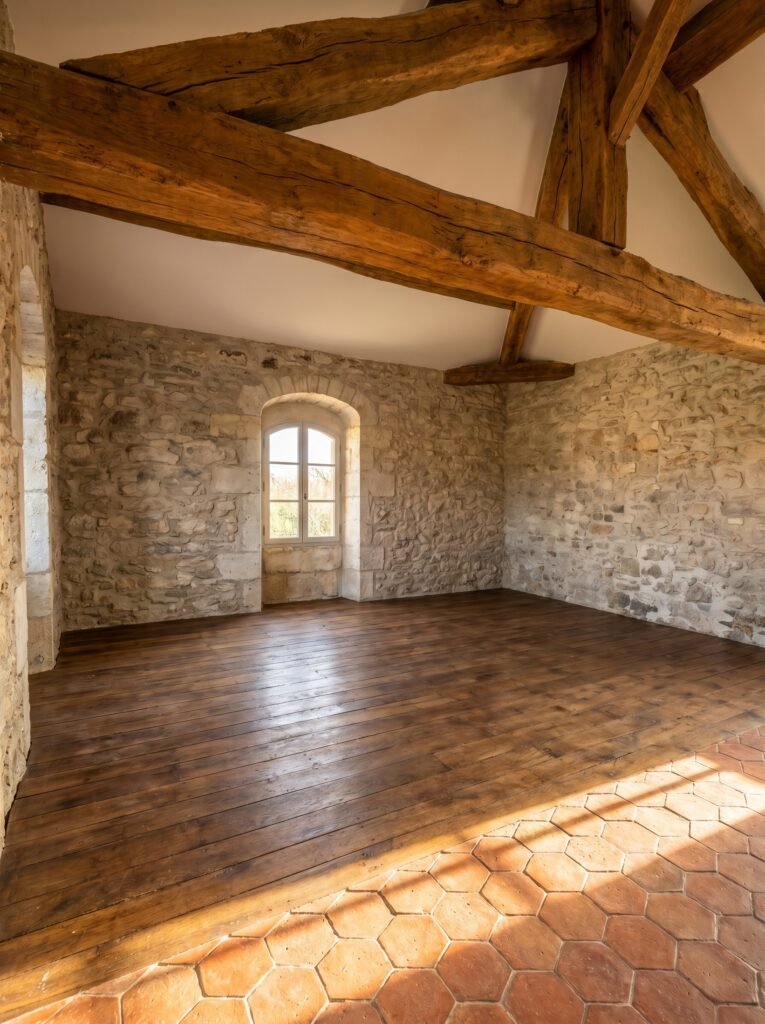
Exposed stone walls — whether natural or artfully recreated — set an immediate tone of age, solidity, and warmth. They’re cool to the touch in summer and absorb heat in winter, and their texture alone adds more visual interest than any gallery wall ever could. If you have original stone in your home, celebrate it. If you don’t, look into lime wash techniques or stone-effect plaster that captures the same organic quality without the renovation budget.
Wide plank wooden floors are another cornerstone — preferably old, slightly uneven, and worn smooth in the places where generations of feet have walked. French terracotta tiles, called tomettes, are the other classic choice: hexagonal, rust-colored, imperfect, and extraordinarily beautiful when the light catches them in the late afternoon.
And then there are the beams. Exposed ceiling beams in aged chestnut or oak are perhaps the single most defining architectural feature of a French country interior. They add height, drama, and an irreplaceable sense of history. Even in modern homes, adding reclaimed wood beams — real or decorative — can completely transform the character of a room.
—
4. The French Country Kitchen — Where Life Actually Happens
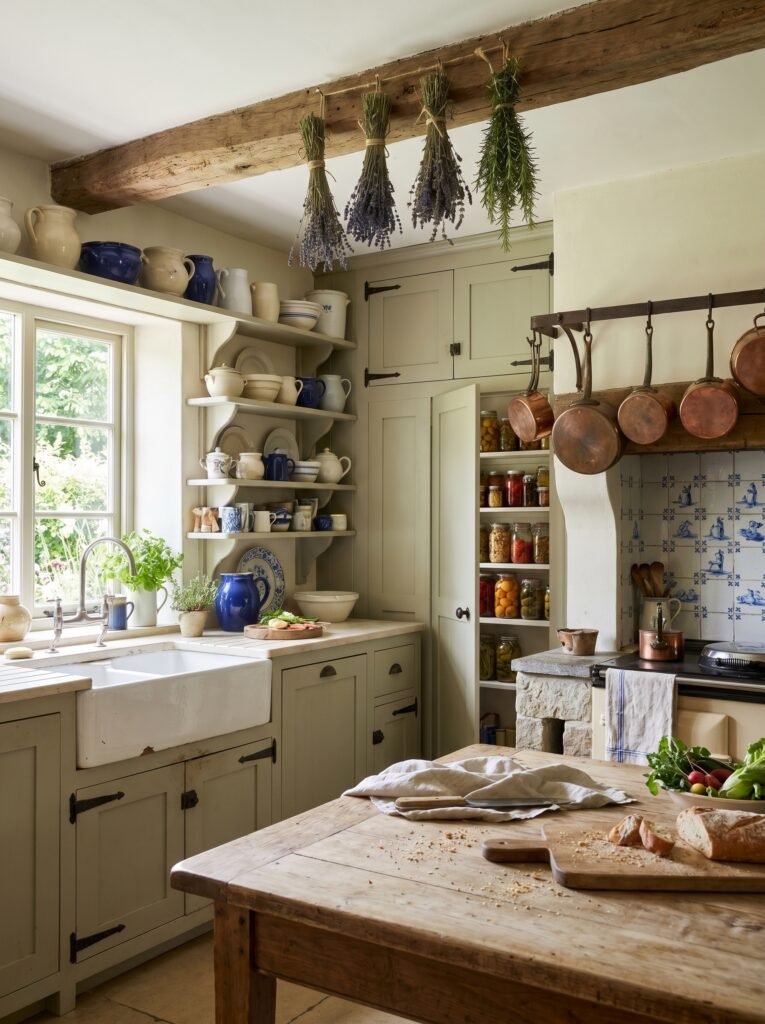
If the French country house has a heart, it beats in the kitchen. This is not a sterile, Instagram-staged room with hidden appliances and empty countertops. It’s a working, breathing, beautifully chaotic space where the evidence of real cooking is not just allowed but celebrated.
Imagine open shelves lined with mismatched pottery in cream and blue. A large farmhouse sink — deep, white, slightly chipped at the edge — positioned under a window with a garden view. A worn wooden table in the center of the room that serves as prep surface, dining table, homework spot, and the place where the best conversations always seem to happen.
Copper pots hang from iron hooks above the stove. Bundles of dried lavender and rosemary are tied to a beam with rough twine. The pantry door is always slightly ajar, revealing rows of glass jars filled with lentils, herbs, and the preserved lemons someone put up last autumn.
The cabinets, if there are any, are painted in a soft sage or aged cream, with simple iron hardware — no chrome, no brushed nickel. The backsplash might be hand-painted tiles in a blue-and-white pattern that looks like it came from a market in Aix-en-Provence.
“A French country kitchen doesn’t look decorated. It looks like it has been lived in, cooked in, and loved in for a very long time.”
This is the spirit you’re chasing — not a kitchen from a catalogue, but one that feels like it has its own history, its own rhythm, its own smell of garlic and herbs and something slowly braising on the back burner.
—
5. Textiles That Tell a Story — Linen, Toile, and the Art of Layering
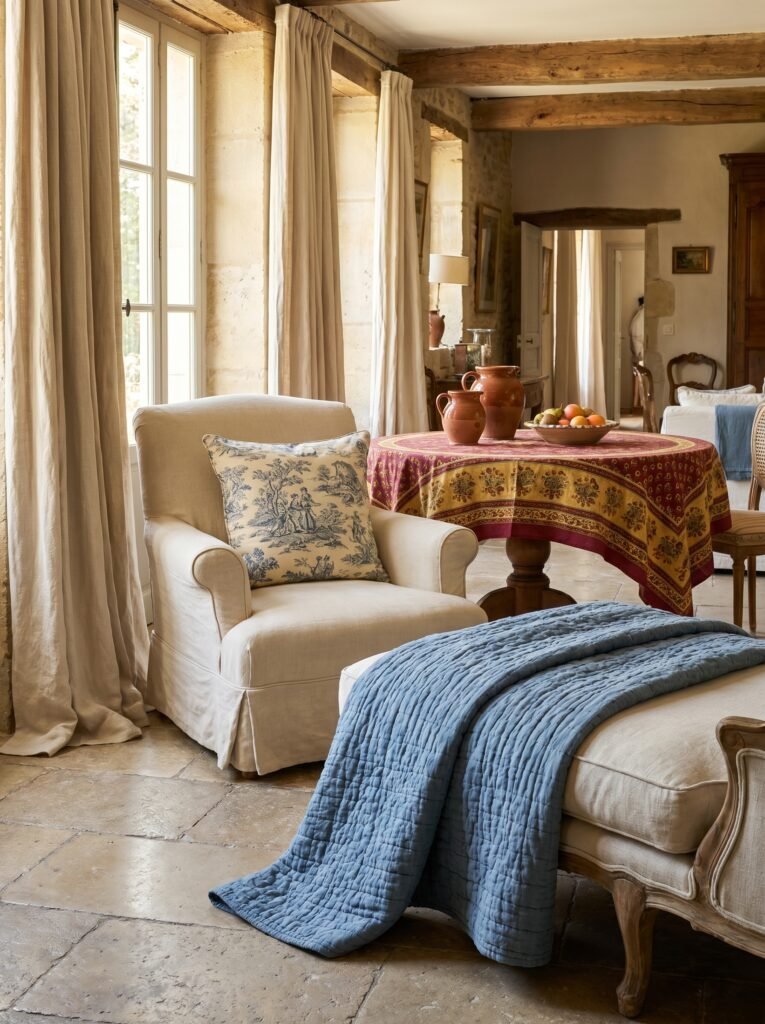
If color is the soul of French country design, textiles are its voice. And the French have an extraordinary gift for choosing fabrics that feel simultaneously humble and luxurious.
Linen is the undisputed queen of this aesthetic. Unbleached, natural linen — the kind that softens with every wash and takes on a beautiful rumpled quality that no synthetic fabric can imitate — appears everywhere in a French country home. Curtains that pool slightly on the stone floor. Slipcovers on a generous armchair. Table linens at dinner that look effortlessly beautiful precisely because they’re not trying.
Toile de Jouy deserves its own paragraph. This iconic French fabric — pastoral scenes printed in one color on a cream ground — has been woven into the identity of French country design for over two hundred years, and it remains as beautiful and relevant today as it was in the 18th century. Used on a single accent chair, or printed on wallpaper in a bedroom alcove, it adds instant depth and storytelling to a space.
Provençal prints — those cheerful geometric and floral patterns in madder red, golden yellow, and deep blue — bring summer color and energy. Thick cotton quilts called boutis add texture and warmth to beds and daybeds alike.
The art of layering these textiles is what separates a French country interior from a mere collection of pretty things. A toile pillow against a linen sofa. A Provençal tablecloth under simple pottery. A rough-woven throw draped over the arm of an antique chaise. Each layer adds warmth, depth, and humanity.
—
6. Antiques, Imperfection, and the Beauty of Things That Have Lived
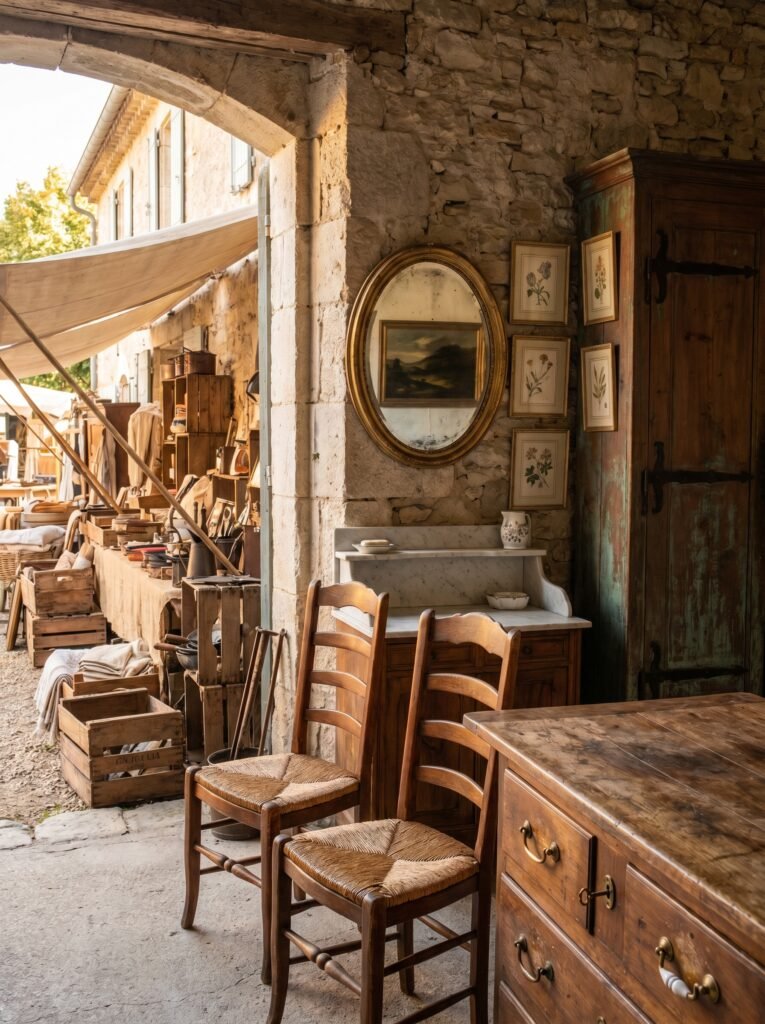
One of the most liberating truths about French country style is that it prizes imperfection. A table with a scratch tells a story. A mirror with a slightly foxed glass has character. A dresser with mismatched handles was clearly loved by someone before it came to you.
The French have a deeply rooted culture of brocante — the flea market tradition that sees beautiful old objects given new life in new homes. This is not shopping; it’s archaeology. And it produces interiors that no amount of money can manufacture, because they’re built from real stories.
When incorporating antiques into a French country interior, look for pieces with honest age: farmhouse armoires with hand-forged iron hinges, rush-seated ladder-back chairs, marble-topped washstands, painted wooden beds with gentle curves. None of it needs to match. All of it needs to feel right together.
“In a French country home, the most beautiful things in the room are almost always the ones with the most history.”
This philosophy extends to art and decoration as well. Framed botanical prints, oil paintings of fruit or countryside landscapes found at a village market, a collection of antique keys hung on a wooden board — these are the details that make a room breathe.
—
7. The Salon — Creating a Gathering Room That Pulls People Together
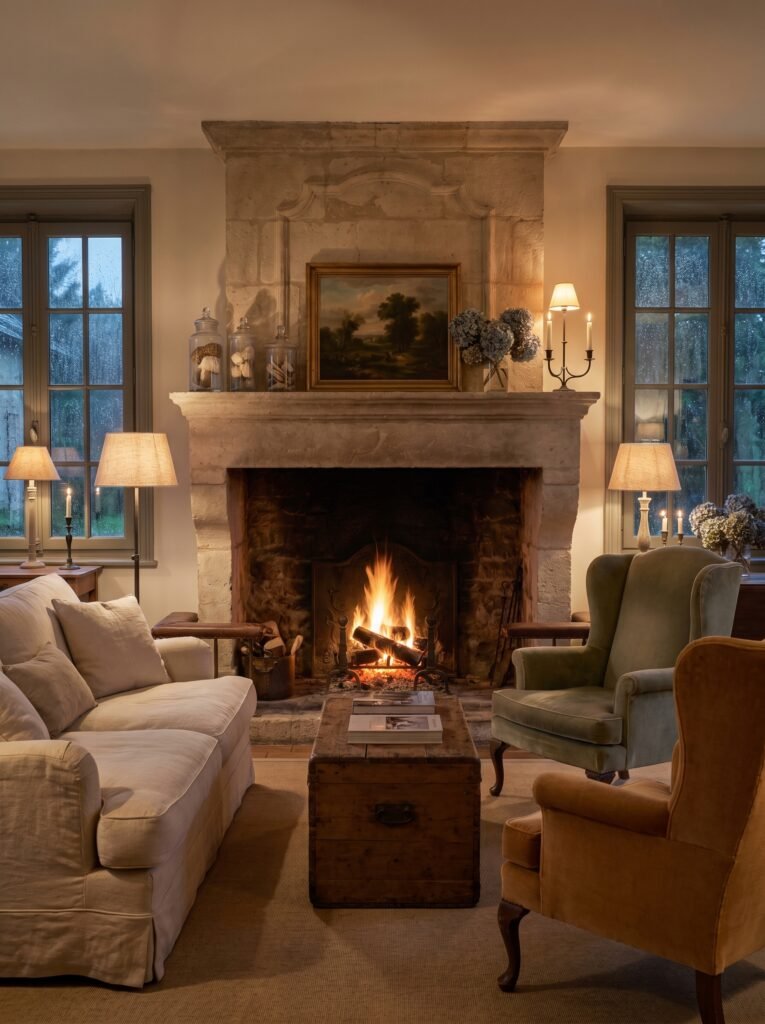
In a French country house, the salon — the main living room — is designed for one purpose above all others: conversation. Chairs and sofas are arranged to face each other, not the television. There’s always somewhere comfortable to sit, always a surface nearby for a glass or a book.
The furniture tends toward generous scale — an overstuffed sofa in natural linen, a pair of wingback chairs covered in faded velvet, a coffee table that started life as a butcher’s block or a wooden trunk. Everything invites you to sit longer, stay later, talk more.
Fireplaces are central — literally and emotionally. A French country salon almost always anchors itself to a fireplace, and everything in the room orbits it. The mantel becomes a stage for changing arrangements of objects: a pair of apothecary jars, a framed oil painting, a bunch of dried hydrangeas still holding their dusty blue color from summer.
Lighting in this room should be warm and layered — never a single overhead source. Table lamps with linen shades, candelabras, the warm glow of candlelight in iron holders. The goal is a room that looks beautiful at 7pm on a winter evening, with rain against the window and good conversation in the air.
—
8. The French Country Bedroom — Rest as an Art Form
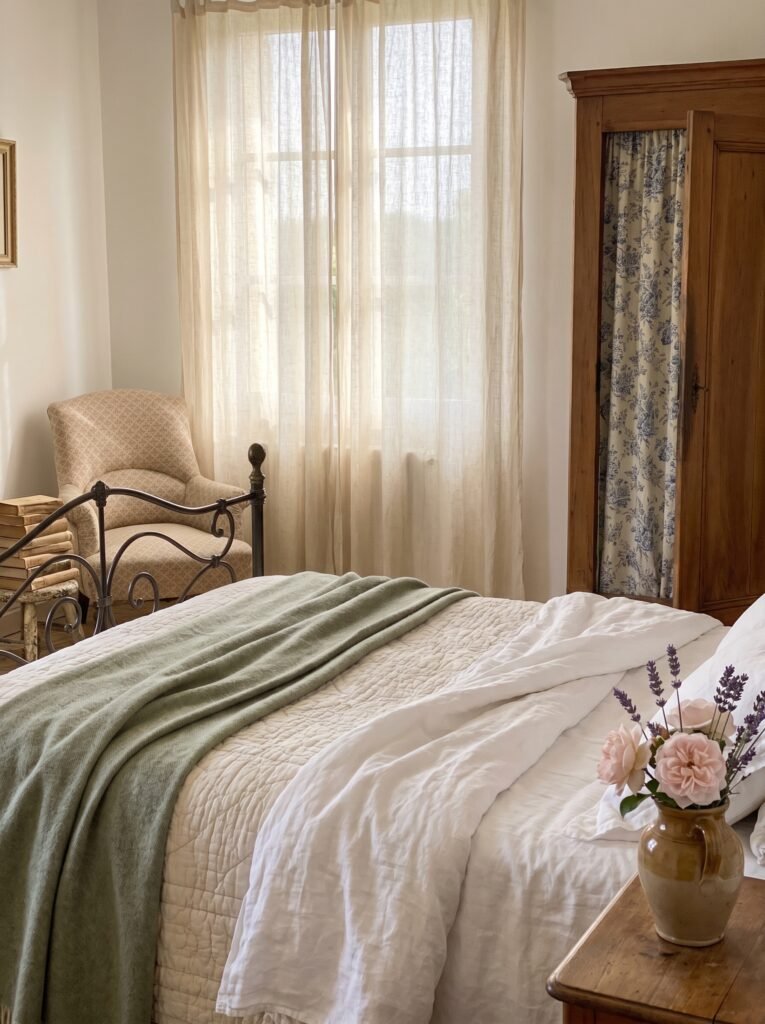
Sleep, in a French country home, is not an afterthought. The bedroom is treated as a sanctuary — a place of genuine rest, soft light, and sensory calm.
The bed is always the focal point, and it’s always generous. A wrought iron or carved wooden bed frame, dressed in layers of linen — a flat sheet, a quilted boutis, a soft wool throw at the foot. The linens are never over-pressed; slight wrinkles are part of their charm.
Curtains in sheer linen or cotton filter the morning light without blocking it entirely. A bergère armchair in the corner provides a reading spot. An antique armoire replaces a built-in closet, its interior perhaps lined with a Provençal print. A small vase of garden roses or lavender on the bedside table — always something living, something that carries scent.
The bedroom in a French country home asks you to slow down. It says: there is nowhere you need to be. Rest here. The light will be beautiful in an hour.
—
9. Bringing the Outdoors In — Gardens, Botanicals, and Living Things
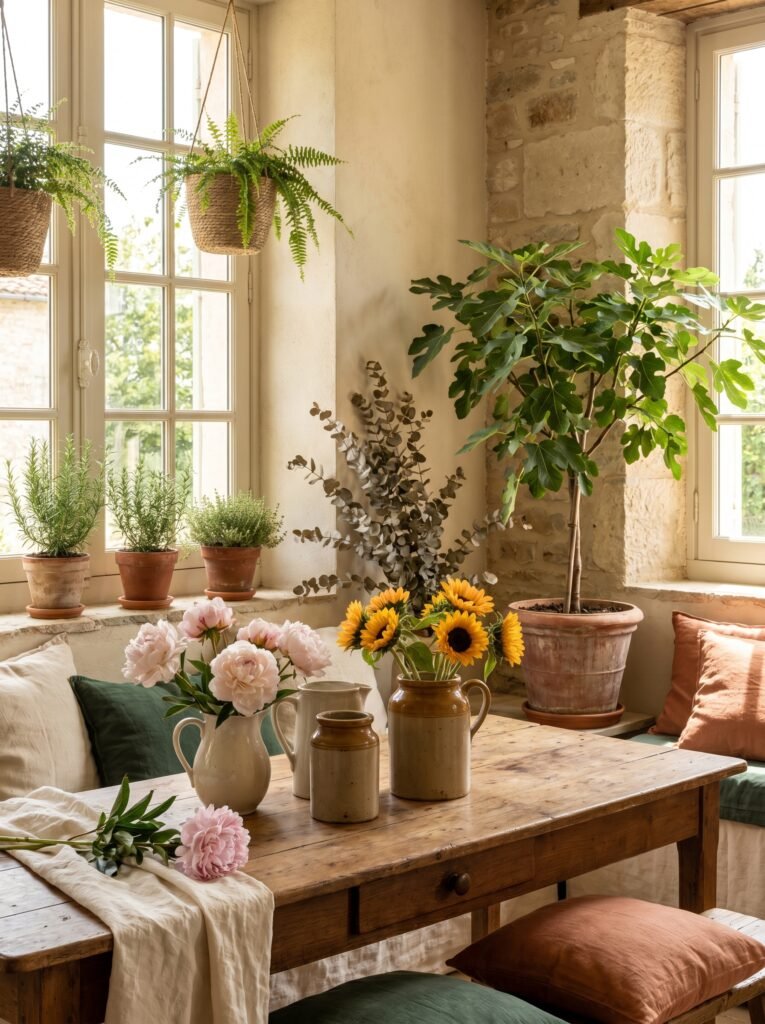
French country interiors are in constant, loving conversation with the natural world outside. This is not a style that seals itself away from nature — it draws nature in at every opportunity.
Fresh flowers are non-negotiable. Not elaborate arrangements from a florist, but loose bunches of whatever is blooming in the garden: peonies in June, sunflowers in August, dahlias in September, dried hydrangeas and rosemary all through winter. They live in simple ceramic pitchers, in old earthenware crocks, in the kind of vessels that look like they were found rather than purchased.
Potted herbs on the kitchen windowsill bring both beauty and function — rosemary, thyme, basil, mint. A large fig tree in a terracotta pot stands in a corner. Ferns hang in woven baskets near a window. Branches of dried eucalyptus lean against a wall.
“A French country home is never quite finished — there’s always something growing, something blooming, something that reminds you what season you’re living in.”
This connection to the seasons is, perhaps, the deepest philosophy of French country design. It refuses to be timeless in the sense of being sealed and static. Instead, it changes with the year — and that constant, gentle change is exactly what keeps it feeling alive.
—
10. The Dining Room — A Table Worth Gathering Around
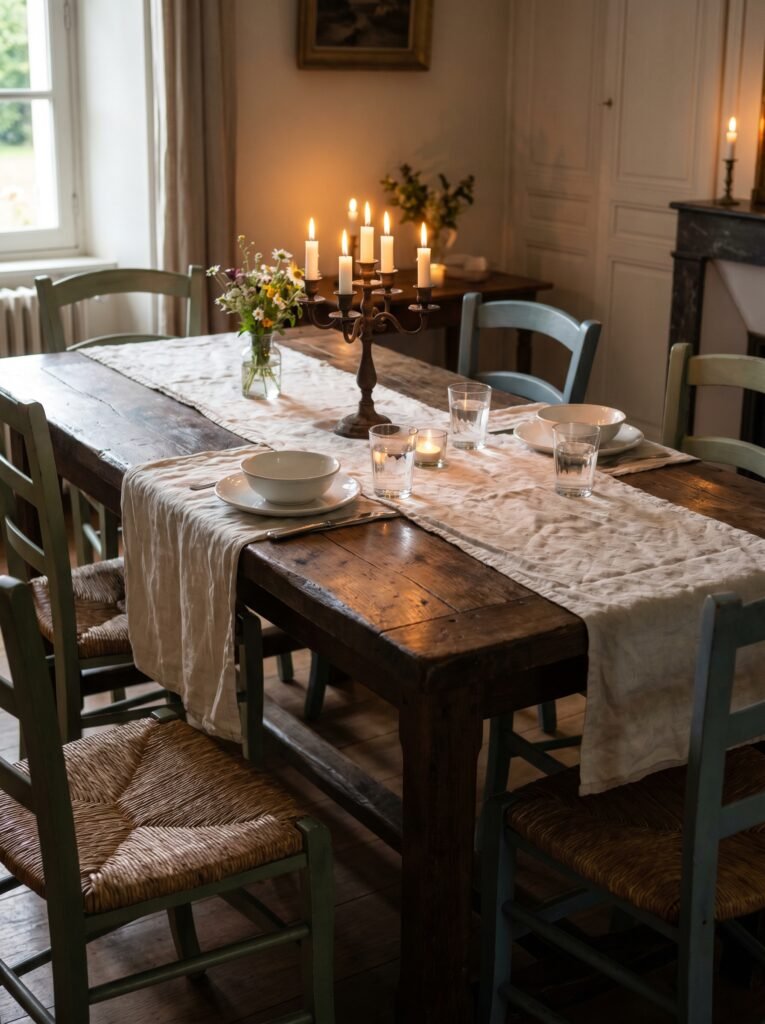
No room in a French country home carries more emotional weight than the dining room. This is a culture where meals are sacred, where the table is set with intention, where dinner lasts three hours and no one apologizes for it.
The dining table itself is usually large and made of old wood — oak or chestnut, often with the uneven surface that comes from centuries of use. Chairs don’t match. There might be a rush-seated farmhouse chair, a painted wooden chair, an upholstered side chair — and together, somehow, they look exactly right.
The table is always dressed, even when no guests are expected. A linen runner. Simple white pottery. Water glasses that catch the light. A small vase of wildflowers or a bundle of fresh herbs. A candelabra for evening meals. The message is clear: this table matters, and the people who sit around it matter more.
—
11. Color on the Walls — Why French Country Homes Aren’t Afraid of Color

While much of contemporary interior design has retreated to safe neutrals, French country interiors embrace color — gently, thoughtfully, beautifully.
A kitchen might be painted in a warm sage green that looks like it absorbed sunlight and never quite let it go. A bedroom ceiling in the softest lavender, almost imperceptible until the light changes. A salon wall in aged ochre that glows like warm bread in candlelight. An entryway in a faded, dusty blue that makes you stop and take a breath the moment you walk in.
These colors succeed because they’re chosen with reference to nature rather than fashion — and because they’re applied with the understanding that paint in an older home, or in a home that aspires to the atmosphere of an older home, should never look too fresh, too bright, too new. Lime wash, chalk paint, and aged color techniques all contribute to that quality of settled-in beauty that is the hallmark of this style.
—
12. The Small Details That Make a French Country Home Feel Genuinely French
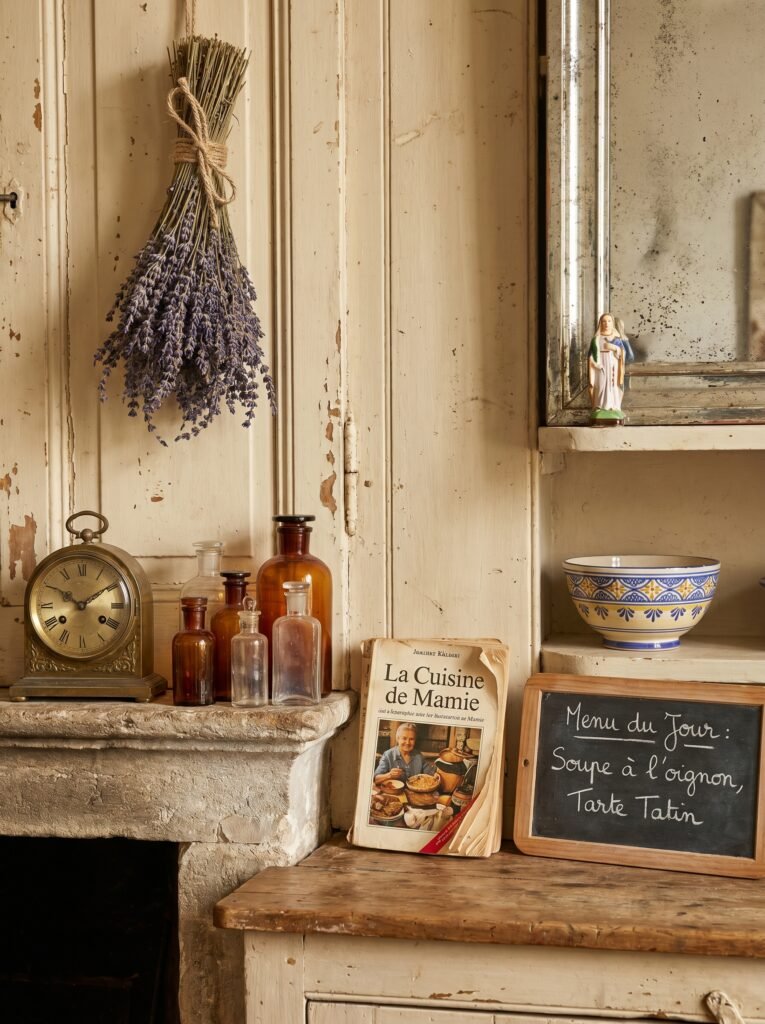
It’s almost always the smallest things that tip a room from “inspired by France” to “unmistakably French.” These details are easy to overlook in the planning stages but impossible to replicate without them.
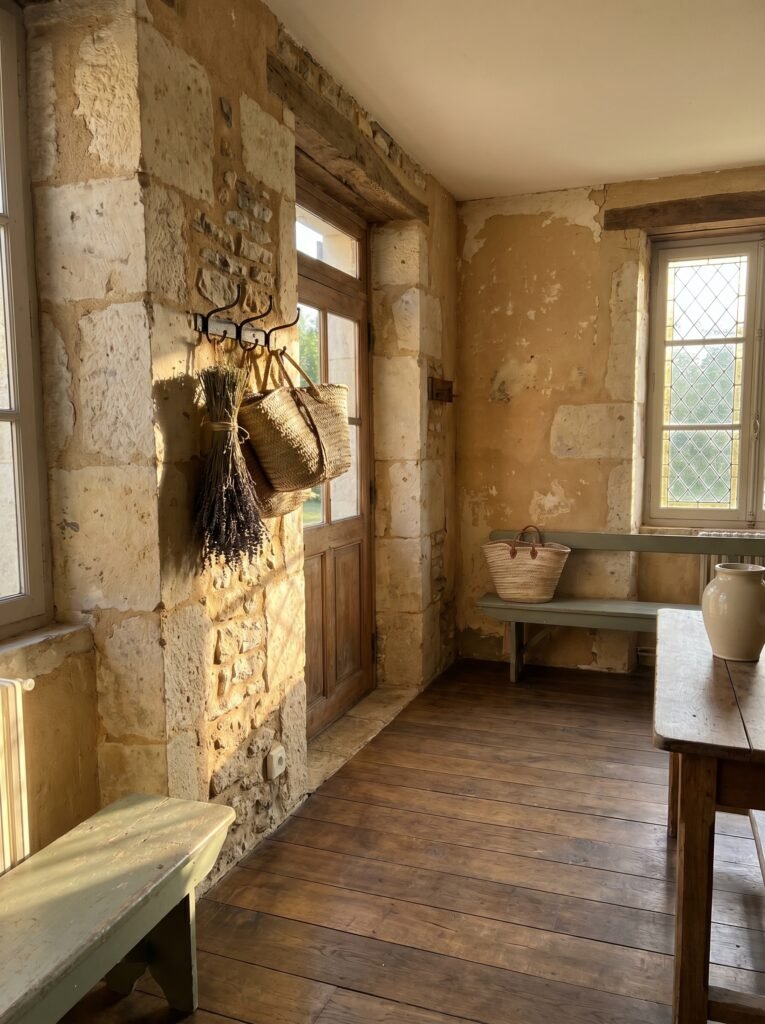
A bouquet of lavender tied with rough twine and hung by the kitchen door. An antique French clock on the mantel, its tick audible in a quiet room. A collection of vintage French apothecary bottles on a bathroom shelf. Market baskets hanging from iron hooks in the entryway. A dog-eared copy of Elizabeth David on the kitchen counter. A handwritten menu chalked on a small blackboard near the dining table.
A prayer card or a small painted saint tucked into the corner of a mirror. A stack of worn hardcover books on a wooden stool. A single beautiful piece of Quimper pottery on a shelf. These are not decorations in the commercial sense — they’re evidence of a life richly lived, of taste developed slowly over time, of a home that belongs to someone who loves beauty but isn’t performing it.
That is, ultimately, the secret of French country design. It cannot be achieved in an afternoon of shopping. It must be gathered — piece by piece, season by season, story by story — until the room finally looks like exactly who you are.
—
🌿 How to Bring French Country Style Into Your Own Home
Starting a French country interior doesn’t require a stone farmhouse in Provence or an unlimited budget. It requires patience, a good eye, and a willingness to let beauty develop over time.
Begin with the palette. Repaint one room in a warm, muted tone — aged cream, soft sage, dusty terracotta — and notice how the atmosphere of the space shifts immediately. Color is the fastest and most affordable way to set the French country tone.
Visit flea markets and antique fairs rather than furniture showrooms. Look for pieces with genuine age and honest imperfection — a worn wooden table, a set of mismatched chairs, an old armoire with its original hardware. These pieces will do more for the character of your home than any new purchase.
Invest in quality linen textiles. Replace synthetic curtains, polyester cushion covers, and fast-fashion throws with natural linen and cotton. The difference in atmosphere is immediate and profound — the room becomes softer, warmer, more human.
Bring in living things consistently. Fresh flowers, herbs on the windowsill, potted plants in terracotta — make a habit of keeping something living in every room, and let the choices follow the seasons.
Resist the urge to finish. A French country home is never quite complete — and that incompleteness is part of its beauty. Leave space for the next beautiful object you haven’t found yet.
—
❓ FAQ
Q: Is French country style the same as shabby chic or farmhouse style? A: They share some elements — the love of natural materials, vintage pieces, and a relaxed atmosphere — but French country is distinctly its own aesthetic. It’s warmer, more richly layered, and more rooted in a specific cultural and geographic tradition than farmhouse style, and more structured and colorful than shabby chic. Think of it as the elegant older sister of both.
Q: Can French country style work in a small apartment or modern home? A: Absolutely. The principles of French country design — warm color, natural materials, meaningful objects, layered textiles, living plants — translate beautifully into any space regardless of size or architecture. A small apartment can carry tremendous French country atmosphere with just the right palette, a few antique pieces, quality linen textiles, and consistently fresh flowers.
Q: What’s the best starting point if I want to redesign my home in French country style? A: Start with color and textiles — they’ll give you the biggest immediate impact for the least investment. Repaint one room in a warm, muted tone, replace synthetic textiles with natural linen and cotton, add a vintage or antique piece that carries real character, and bring in fresh flowers. From there, let the room develop naturally over time as you find pieces that speak to you.
—
💭 Final Thought
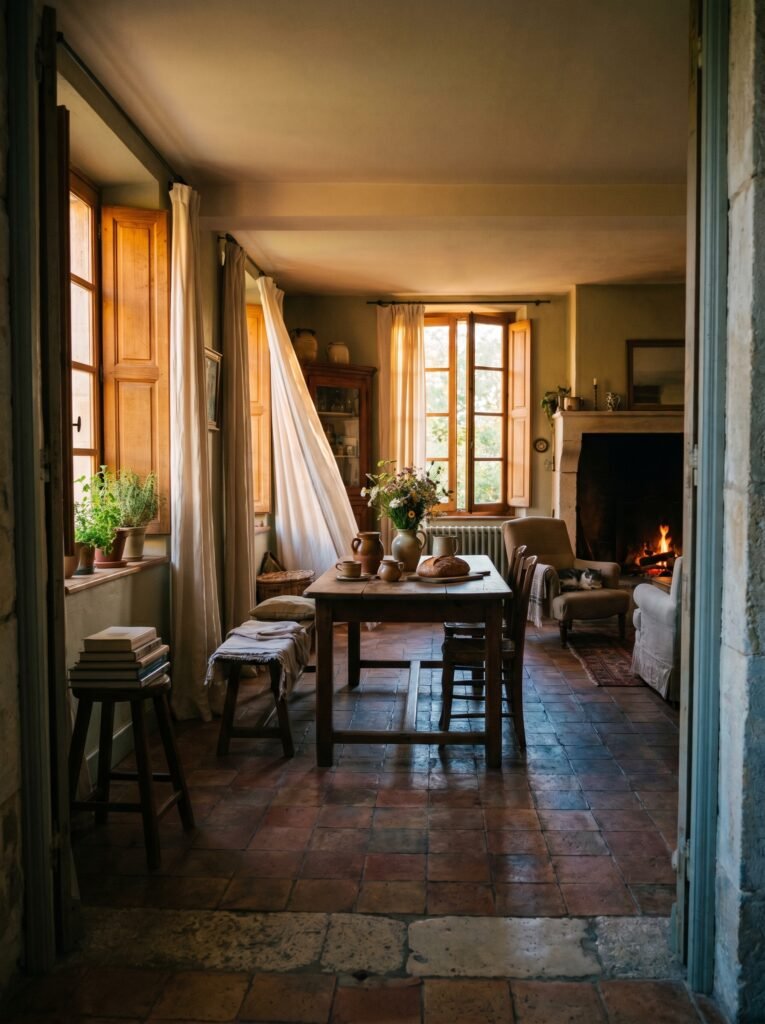
There is something quietly radical about choosing to live in a home that prioritizes warmth over trendiness, history over newness, and gathered beauty over curated perfection. French country interiors remind us that the most beautiful spaces are the ones that feel deeply, unapologetically inhabited — full of the evidence of meals cooked, conversations had, seasons observed, and a life genuinely lived within their walls.
What would it feel like to walk into your home tonight and find it a little warmer, a little softer, a little more like the place you’ve always wanted to come home to?