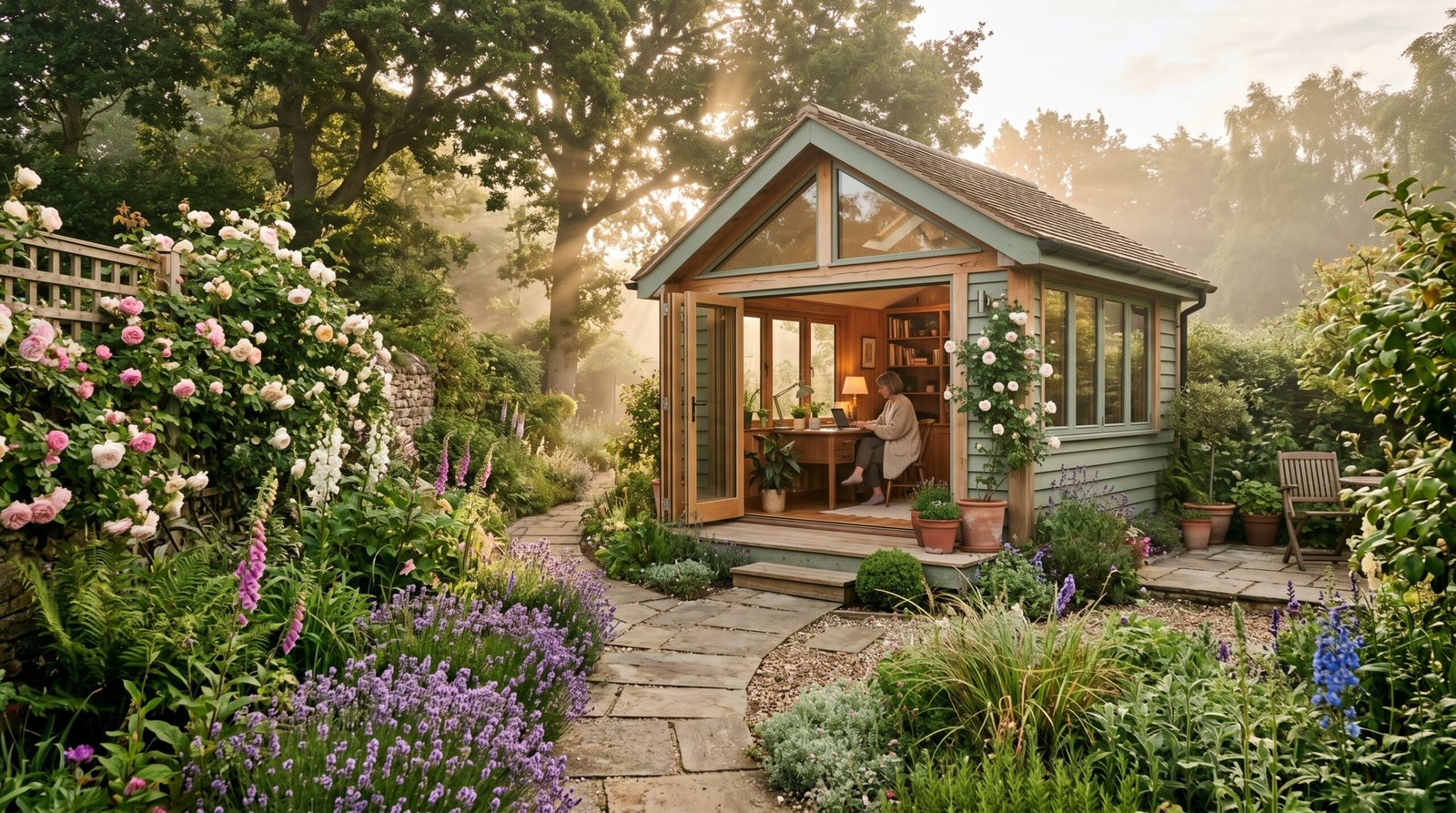
The Garden Office Interior That Changed How I Work, Think, and Breathe
There’s something quietly revolutionary about stepping outside your house to work — not to a coffee shop, not to a co-working space, but to a small, beautiful room at the end of your own garden. A garden office isn’t just a practical solution for remote workers. It’s a deliberate act of designing a life you actually want to live.
—
Table Of Content
1. Why a Garden Office Feels Different From Any Other Workspace

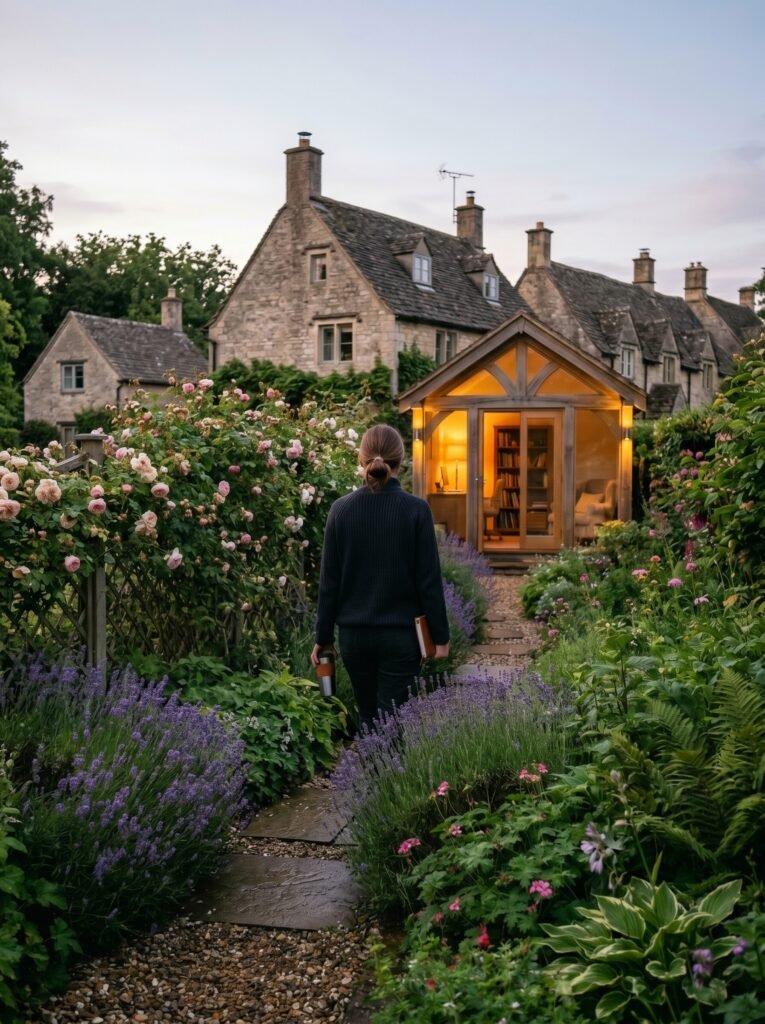
The moment you cross from your home into a garden office, something shifts in your brain. Psychologists call it “environmental cueing” — the way physical transitions signal to your mind that it’s time to change modes. Walking even twenty feet down a garden path, past lavender or wild grass or a climbing rose, is enough to flip that internal switch from home-brain to work-brain.
This is the quiet genius behind garden offices that no open-plan living room desk can replicate. You aren’t just separating your physical space. You’re separating your psychological state. The light is different out there. The sounds are different. The smell of wood and soil and morning air creates a sensory reset that a scented candle inside simply cannot manufacture.
Interior decorating enthusiasts often fall in love with garden offices not because they need more square footage, but because they recognize what thoughtful design can do to the human spirit. A well-designed garden office whispers to you every morning: this is a space that was built for you, on purpose.
“The best workspace isn’t the biggest one — it’s the one that makes you feel like yourself the moment you walk through the door.”
—
2. Getting the Foundation Right: Structure, Light, and Insulation
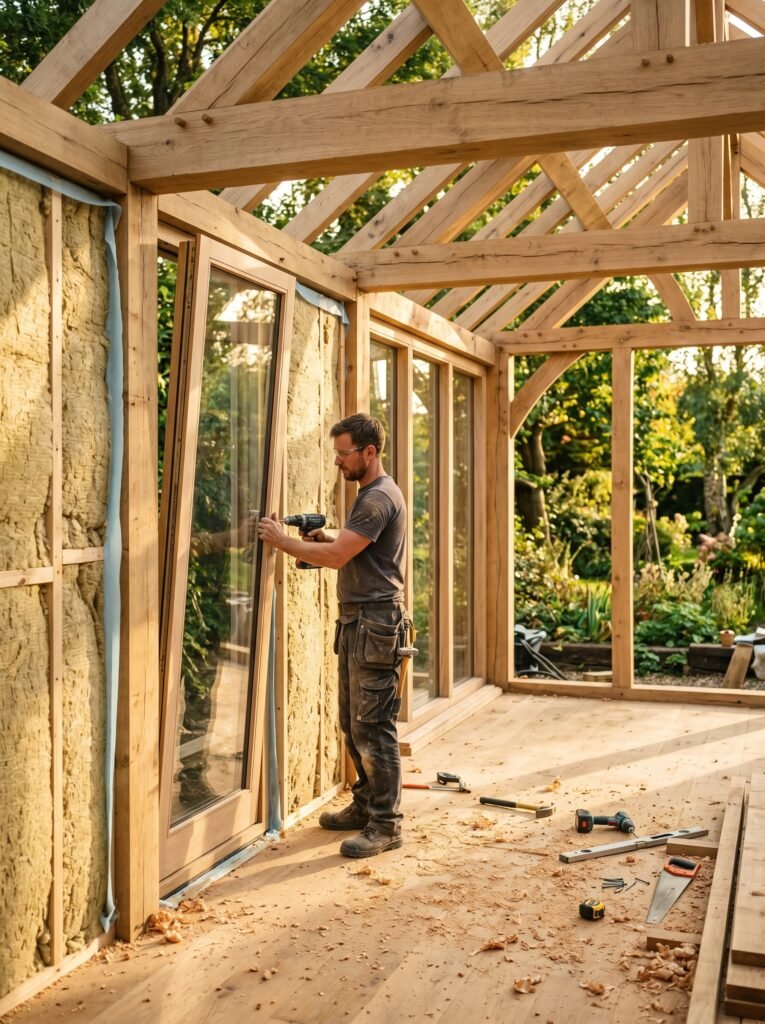
Before any interior magic happens, the bones of a garden office must be taken seriously. This isn’t a section to skim past. Poor insulation, damp walls, or inadequate windows will undermine even the most beautifully curated interior — and you’ll spend half the year either freezing or sweating instead of creating.
Timber frame structures remain the most popular choice for garden offices, and for good reason. Wood breathes beautifully, ages with character, and responds well to interior finishes from painted plasterboard to warm tongue-and-groove paneling. If you’re working with a prefabricated garden room, check that the insulation rating is appropriate for year-round use — look for at least 100mm of wall insulation and a low U-value.
Windows deserve their own paragraph because they are arguably the single most important interior design element in a garden office. Natural light isn’t just a mood booster; research from Cornell University found that employees working in daylit environments reported an 84% drop in eyestrain and headaches. For a garden office, this translates to one simple principle: go bigger with glazing than you think you need. A full-width window facing your garden, or even a set of bifold doors that open the entire front wall to the outside, will transform both your work experience and the visual impact of the space.
—
3. The Color Palette That Makes a Garden Office Come Alive
Color in a garden office works differently than color in a bedroom or living room. You’re not trying to create restful luxury or social warmth. You’re crafting an environment that holds your focus, keeps your energy steady, and reminds you — subtly, constantly — that you’re connected to the natural world just beyond the glass.
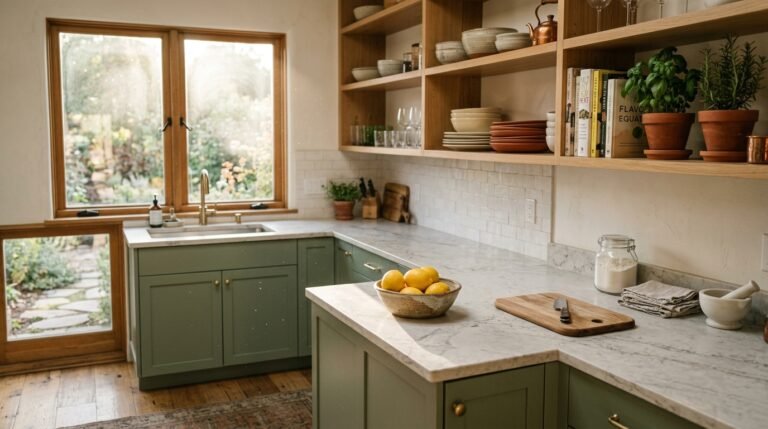
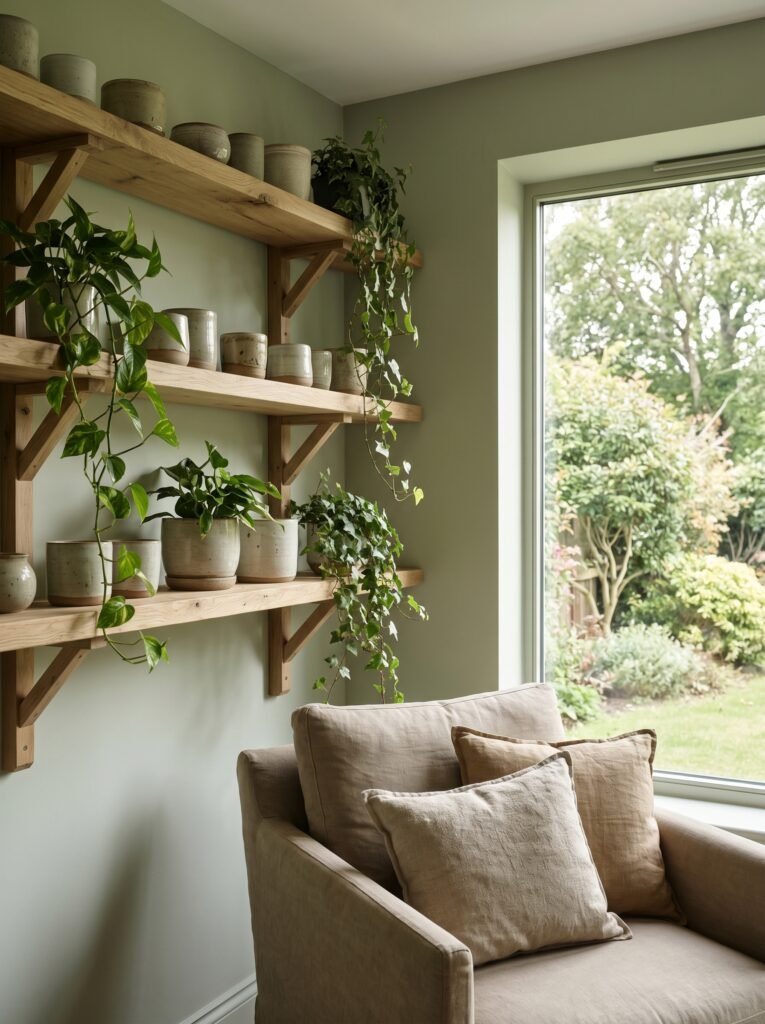
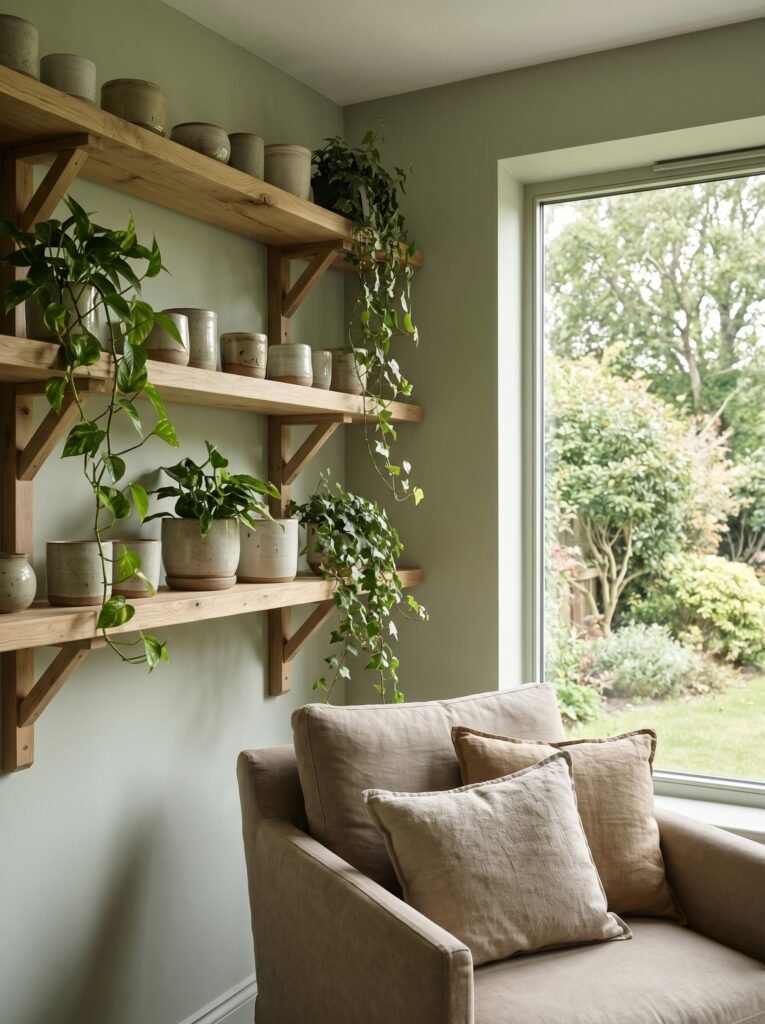
Sage green has become something of a signature shade for garden offices, and it earns that reputation honestly. It’s neither too stimulating nor too sedating. It connects visually to the garden outside and creates a through-line between interior and exterior that feels intentional and deeply calming. Farrow & Ball’s Mizzle or Pigeon, Little Greene’s Normandy Grey-Green, or even a simple soft white with green undertones — these shades work with natural light rather than against it.
If green feels too expected, consider warm putty tones — think raw linen, aged plaster, or dusty terracotta. These earthy neutrals feel grounded and human, especially when paired with raw timber shelving or a rattan pendant light. What to avoid is stark, cool white. In a small garden structure, it reads as clinical rather than clean, and it amplifies the sense of isolation rather than coziness.
—
4. Flooring Choices That Ground the Entire Space
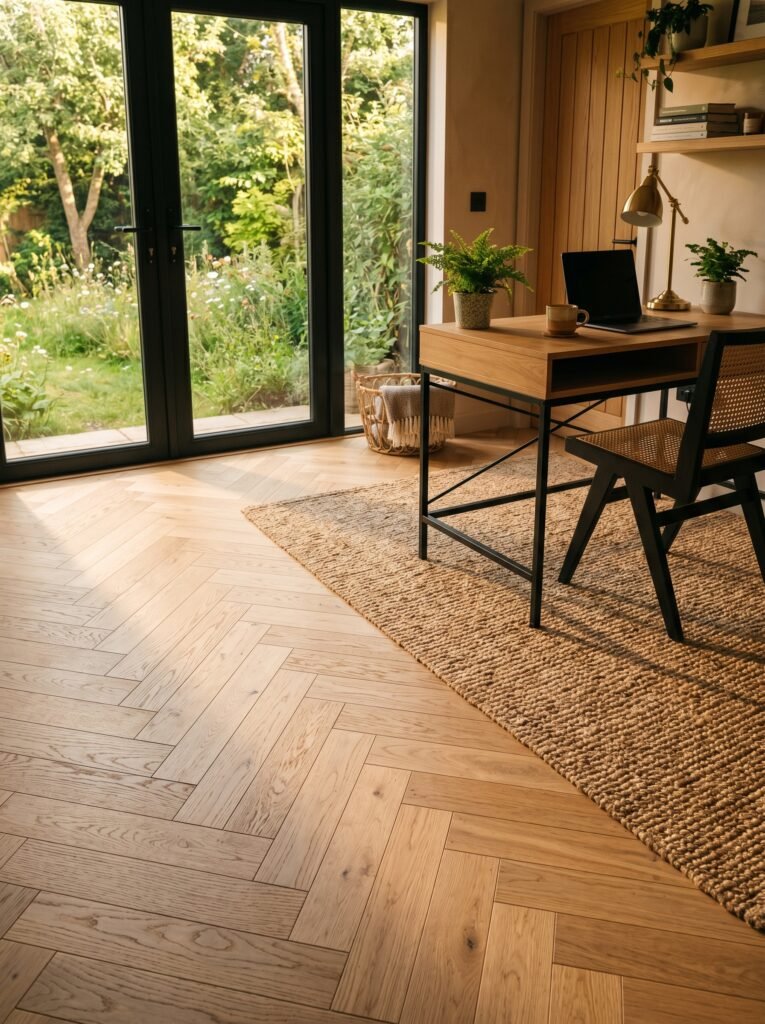
Flooring in a garden office carries enormous visual weight despite covering just a few square meters. Because garden offices tend to be compact — most range between 10 and 25 square meters — every design decision is amplified. The wrong floor can make the space feel cold and temporary; the right one makes it feel like a proper, permanent room.
Engineered hardwood is the gold standard for garden office flooring. It handles fluctuating temperatures and humidity far better than solid wood, installs over underfloor heating beautifully, and gives the space the warmth and authenticity that most people imagine when they picture their dream home studio. Herringbone patterns in pale oak or warm walnut are particularly popular and translate with spectacular effect into Pinterest-worthy interiors.
For a more budget-conscious approach, luxury vinyl tile (LVT) has improved so dramatically in quality that well-chosen options are nearly indistinguishable from real wood in photographs and in person. Pair either option with a generous area rug — a jute weave, a Berber wool, a low-pile cotton flatweave — and you’ve added texture, warmth, and a visual anchor for your desk zone in a single move.
—
5. Designing the Desk Zone: Where Function Meets Intention
Here is where most garden office interior design either soars or quietly fails. The desk zone is the heart of the space — and it deserves to be treated like a piece of intentional interior design, not an afterthought.
Built-in desks are worth every penny in a garden office. Running a desktop surface along the entire width of a windowed wall maximizes both light and the psychological reward of working while looking out at your garden. Deep enough to hold a monitor, keyboard, papers, and still leave clear space for a notebook or a mug — aim for at least 60cm of depth. Pair this with clean, handleless cabinetry below for storage and the effect is seamless, architectural, and calm.
If built-in isn’t possible, a freestanding desk in solid oak, walnut, or even painted MDF with a timber top will carry far more visual weight and dignity than a flat-pack particleboard option. Your desk is where you spend six or eight or ten hours a day. It should feel chosen, not compromised.
Chair selection matters more than most decorating guides admit. An ergonomic chair in a neutral upholstered finish — a warm grey boucle, a cognac leather, a dusty blush — can be both genuinely supportive and genuinely beautiful. The notion that ergonomic chairs must look clinical and utilitarian has long been outdated.
“Design your desk zone as if someone you admire is about to walk in and see exactly who you are.”
—
6. Shelving and Storage: Beautiful Order Instead of Beautiful Chaos
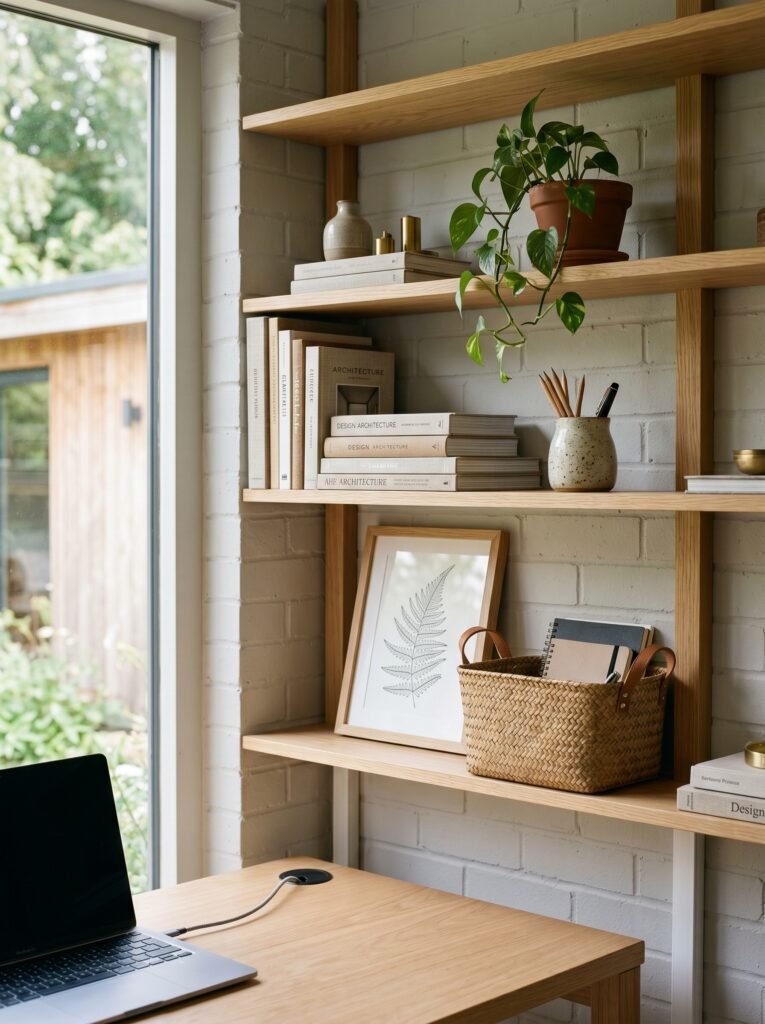
A garden office lives or dies by its storage. Small spaces accumulate visual noise faster than any other environment, and that visual noise — the stacked paper, the tangled cables, the floating pens — creates a low-grade anxiety that quietly drains your concentration.
Open shelving in raw oak or painted pine along one wall gives you both storage and the opportunity for intentional styling. The trick interior designers use consistently is the rule of three: group objects in odd numbers, vary heights, and mix textures. A stack of design books, a ceramic pot of pens, a small trailing plant, a framed print, a woven basket — these grouped with intention read as curated rather than cluttered.
Cable management deserves specific mention because it is the invisible architecture of a functional workspace. Desk grommets, cable boxes, adhesive cable channels along skirting boards — these small, unglamorous interventions make an enormous visual difference. A desk free of trailing cables looks finished. A desk drowning in them, regardless of how beautiful everything else is, always looks like work-in-progress.
—
7. Bringing the Outside In: Biophilic Design Principles
The garden office is perhaps the most natural environment in which to practice biophilic design — the intentional incorporation of natural elements into interior spaces to support human wellbeing. And the research behind it is substantial: studies consistently show that exposure to natural elements reduces cortisol levels, improves concentration, and increases feelings of creative flow.
In a garden office, biophilic design doesn’t mean aggressively filling every corner with plants. It means creating a deliberate visual and sensory connection to the natural world. This can mean placing your desk to face the garden. It can mean choosing materials — timber, stone, cork, wool, linen — that have a natural origin and a natural texture. It can mean a single, well-lit monstera in a beautiful ceramic pot rather than sixteen struggling succulents on a shelf.
Living walls have become increasingly popular in garden office interiors, and done well, they’re genuinely transformative. Even a modest panel of preserved moss, a trio of wall-mounted planters with trailing pothos, or a simple window shelf of herbs creates the kind of biophilic connection that changes how a space feels at a cellular level.
—
8. Lighting Layers That Work Through All Four Seasons
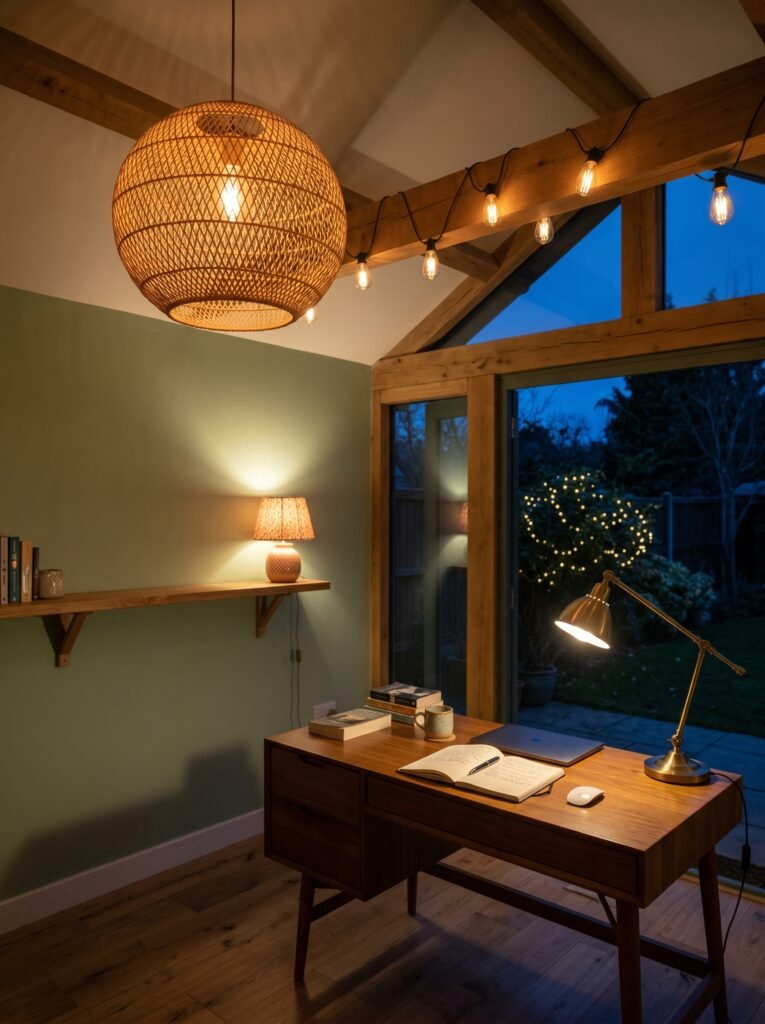
A garden office must work beautifully in July at noon and in November at 3pm when the light has already gone grey and low. This demands layered lighting — a term that interior designers use to describe the combination of ambient, task, and accent light sources that give a room its range and flexibility.
Ambient light — the general background illumination — should come from ceiling sources that feel warm rather than harsh. Recessed downlights on a dimmer switch give you control without sacrificing ceiling height. A statement pendant light, whether a rattan sphere, a linen drum shade, or a sculptural paper globe, adds personality and warmth in a single hanging moment.
Task lighting is non-negotiable at the desk. An adjustable arm lamp — the kind that can direct focused light exactly where you need it for detailed work — prevents eyestrain and keeps your workspace visually defined. Accent lighting, such as a small table lamp on a shelf, a picture light over artwork, or even a string of warm Edison bulbs along a beam, creates the kind of atmospheric warmth that makes a garden office feel genuinely inhabitable after dark.
—
9. Personal Touches That Make a Garden Office Truly Yours
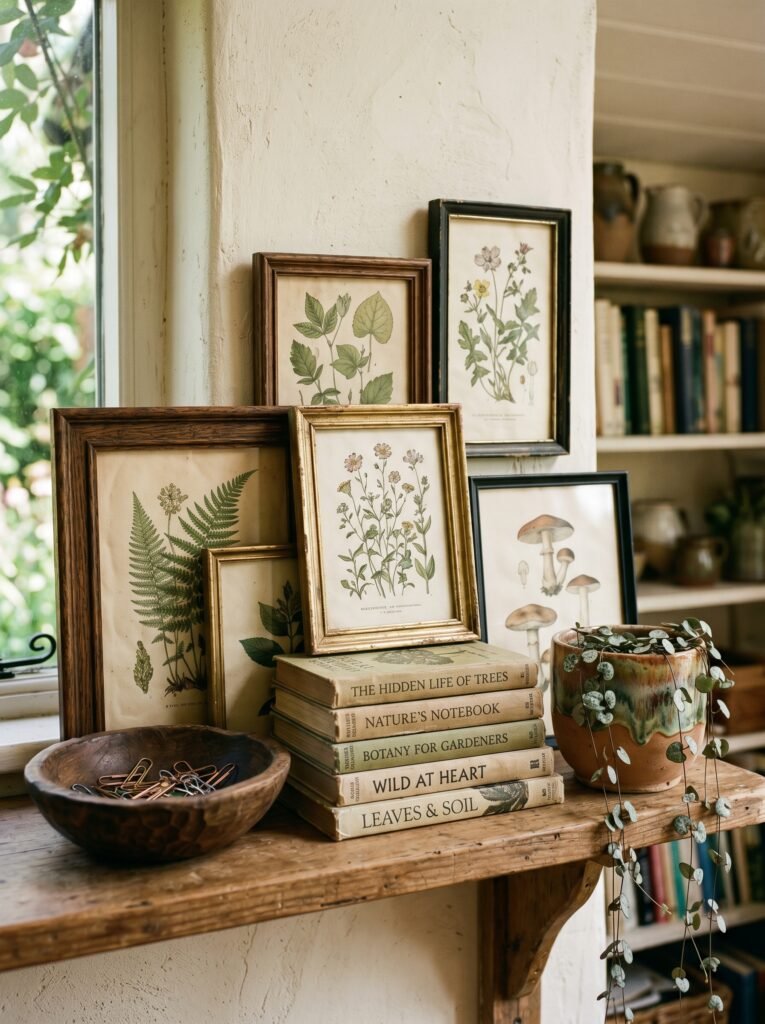
This is the section that separates a beautiful garden office from a magazine garden office — and the distinction matters. A styled space without personal meaning is a stage set. A space with both thoughtful design and genuine personal resonance is where real work, real thinking, and real creativity happen.
What does “personal” mean in an interior design context? It means the framed collection of botanical prints you bought at a flea market six years ago. It means the wooden bowl your mother gave you that now holds paper clips and somehow that feels exactly right. It means a paint color you chose because it reminded you of a holiday, or a shelf of books arranged not by aesthetic but by the actual sequence in which they changed your mind.
“The spaces that stay with us are never the perfect ones. They’re the honest ones.”
The mistake many people make when decorating a garden office is over-designing for an imagined audience. The best garden offices feel like portraits of their owners — imperfect, surprising, and unmistakably specific.
—
10. Sound and Acoustics in a Small Garden Room
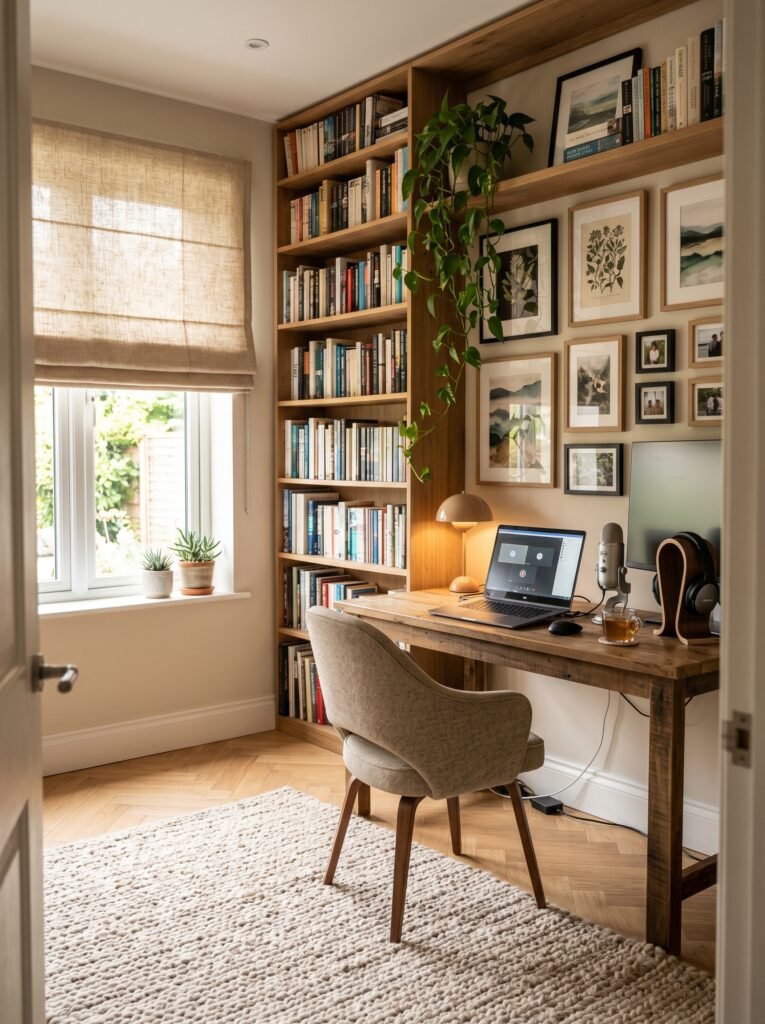
This is the most frequently overlooked element of garden office interior design, and it’s the one that most directly affects your day-to-day experience. A space with poor acoustics — where your own voice bounces back at you on calls, where every external sound intrudes without filtration — is exhausting to inhabit regardless of how beautiful it looks.
In a timber-framed garden room, sound absorption is achieved through soft surfaces. A thick area rug absorbs floor-level reflections. Upholstered seating, curtains or Roman blinds at the windows, bookshelves filled with books — all of these add acoustic mass and reduce echo. A few strategically placed cushions and a fabric wall hanging do more acoustic work than most people realize.
If you use your garden office for video calls, consider positioning your desk against a wall with visual texture and interest — a gallery wall, a bookshelf, a trailing plant — rather than against a blank white surface. This not only sounds better acoustically but also presents a considered, human background to colleagues and clients.
—
11. Heating, Ventilation, and Year-Round Comfort
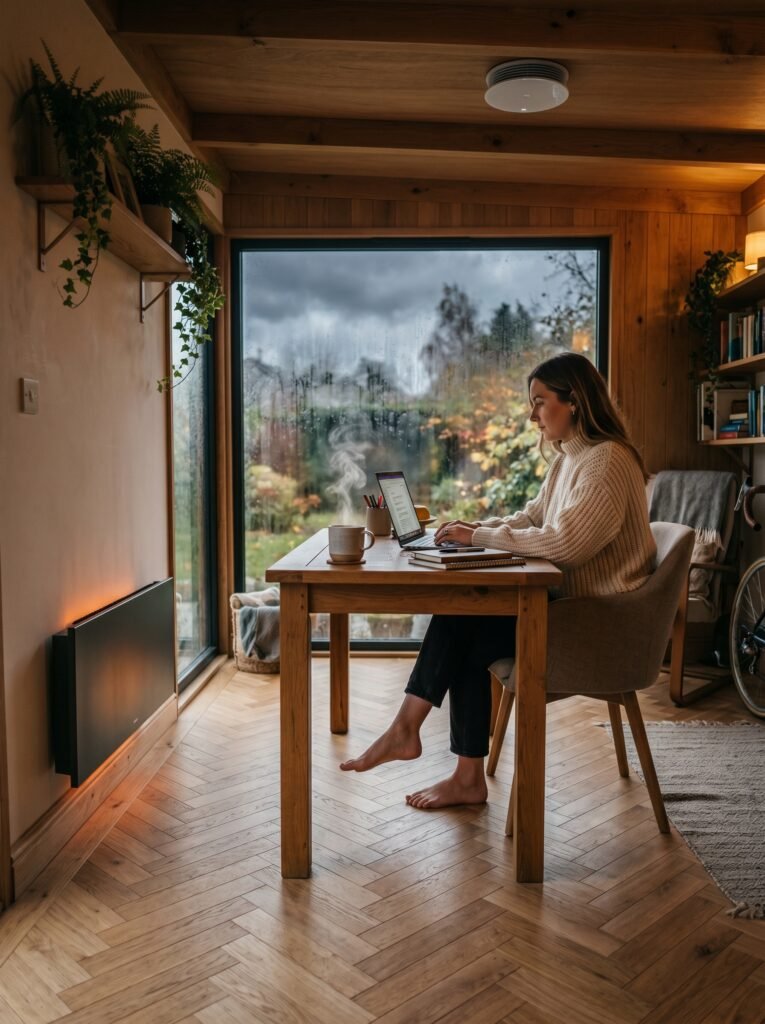
A garden office you can only use for eight months of the year is a garden office that isn’t working for you. Getting climate control right is an investment in your own productivity and wellbeing that pays back immediately and continuously.
Electric panel heaters have improved significantly in design and efficiency — slim, wall-mounted options in white or anthracite fit seamlessly into a considered interior without dominating. Underfloor heating, while a higher upfront investment, is the gold standard for comfort and visual cleanliness. It keeps the floor warm, the room evenly heated from the ground up, and eliminates the need for any visible heat source.
Ventilation is equally important and even more often neglected. A garden office without adequate airflow becomes stuffy by mid-morning, and that stuffiness — that slight heaviness in the air — affects cognitive performance more directly than most people realize. A small, discreet heat recovery ventilation unit or even a well-positioned openable window on the opposite side of the room from your main glazing creates the cross-ventilation that keeps a small space feeling fresh and oxygenated all day.
—
12. The Garden Connection: Framing Your View as Living Artwork
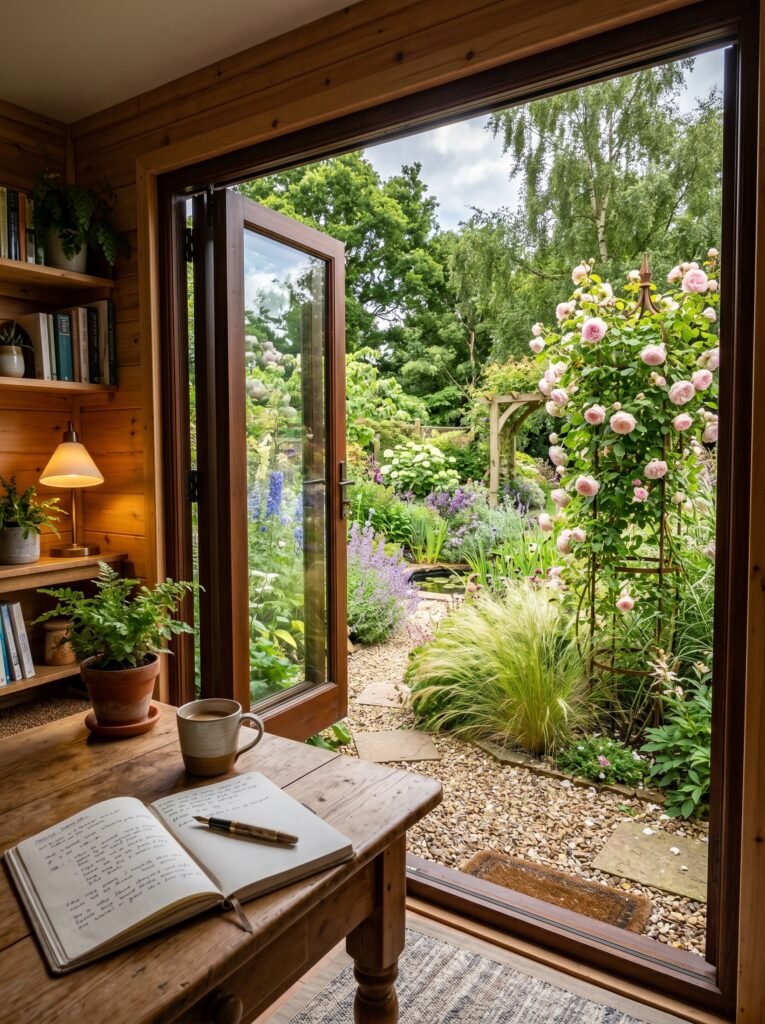
The final and perhaps most poetic principle of garden office interior design is this: the garden itself is part of the interior. The view through your window or bifold doors is not incidental — it is a living, changing, season-by-season artwork that costs nothing and gives everything.
Plant deliberately outside the windows you work near. A climbing rose trained along a simple wire frame, a cloud-pruned evergreen, a row of ornamental grasses that catch the wind — these create the kind of visual theatre that makes you want to look up from your screen. And looking up, even briefly, is one of the most effective cognitive resets available to anyone who works long hours in front of a computer.
Seasonal planting means your view is never static. Spring bulbs push through in February when the light is still thin. Summer perennials fill the frame in July with color and movement. Autumn turns everything amber and rust. Even a bare winter garden, seen through warm glass from a lit, cozy room, has a particular beauty — one that reminds you that rest and dormancy are part of every healthy creative cycle.
—
🌿 How to Take Care of Your Garden Office Interior
A garden office is a living space and, like any living space, it needs a little consistent attention to stay at its best. The good news is that none of this is complicated — it’s the same kind of thoughtful maintenance that makes any beloved space last.
Protect timber finishes annually. Whether your desk, shelving, or flooring is oiled, waxed, or lacquered, an annual refresh keeps the wood nourished and prevents drying or discoloration. It takes an afternoon and the difference is immediately visible. Check insulation and seals each autumn before the cold arrives — even a small gap around a door frame or window edge can make a dramatic difference to both temperature and dampness. Keep your plants genuinely healthy rather than decoratively aspirational — one thriving, well-watered plant does more for the atmosphere of a space than six struggling ones. Finally, edit regularly. Small spaces accumulate clutter faster than large ones, and a monthly fifteen-minute edit — removing what no longer serves the space, re-ordering what does — keeps the interior feeling intentional rather than overwhelming.
—
❓ FAQ
Q: How much does it cost to design a garden office interior? A: The range is genuinely wide, and that’s encouraging rather than daunting. A modest but beautifully considered garden office interior — good flooring, thoughtful paint, a quality desk, layered lighting, and a few considered accessories — can be achieved for between £2,000 and £5,000. A more fully fitted, bespoke interior with built-in joinery and underfloor heating will sit between £8,000 and £20,000. The key is prioritizing the elements that affect daily experience most directly: light, seating, and acoustics.
Q: What interior style works best for a garden office? A: The styles that consistently perform best in garden offices are those rooted in natural materials and calm color palettes — Japandi, Scandi-natural, modern rustic, and biophilic design all translate beautifully into small timber-framed structures. The common thread is restraint: fewer objects chosen with more intention, natural textures over synthetic ones, and a color palette that connects to the garden rather than competing with it.
Q: Can a garden office interior work in a very small space? A: Absolutely — and in some ways, a smaller garden office forces better design decisions. When you have 10 or 12 square meters, you cannot afford wasted corners or meaningless furniture. Built-in storage, a wall-mounted fold-down desk, vertical shelving, and a carefully chosen single statement piece — a beautiful rug, a standout light fixture, one framed gallery wall — create a space that feels considered rather than cramped. Small is not a limitation; it’s an invitation to be precise.
—
💭 Final Thought
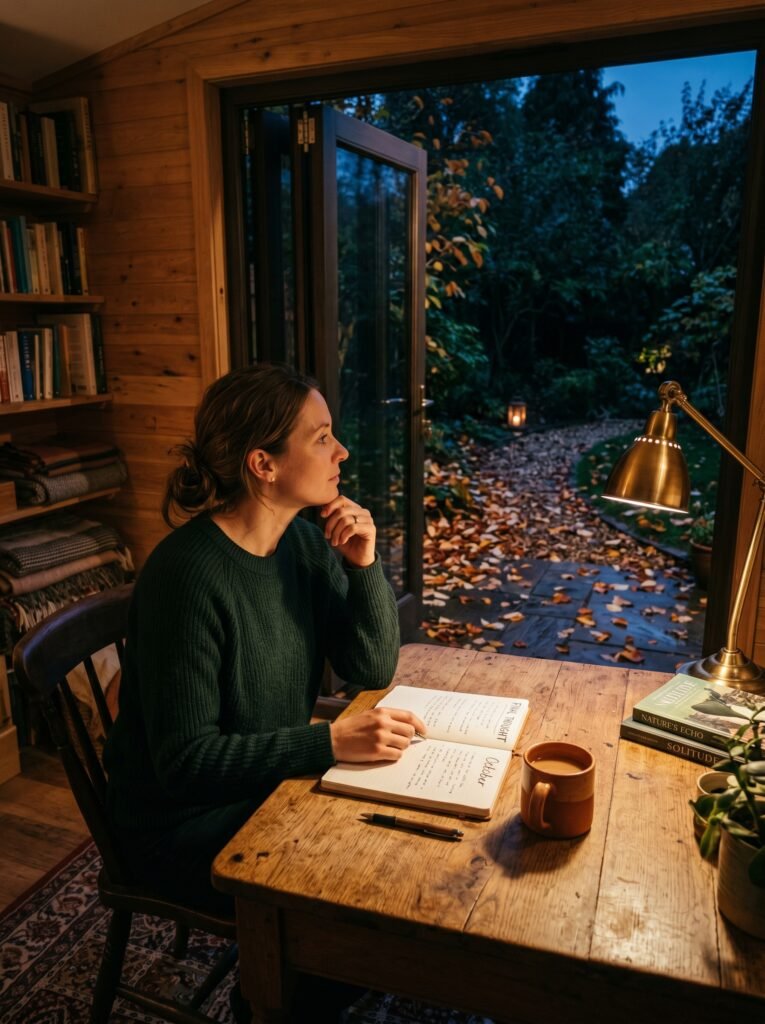
A garden office interior, done with intention and care, becomes one of the most quietly transformative spaces you will ever inhabit. It is where the ordinary morning commute — those twenty steps down a garden path — becomes a daily ritual of transition, presence, and possibility. It’s not about the square footage or the budget or even the style. It’s about creating a room that holds you well while you do your best work.
So here’s the question worth sitting with: if you could design a space that was entirely, honestly yours — not for an Instagram grid or a show home tour, but for the actual texture of your actual working life — what would it feel, look, and smell like?