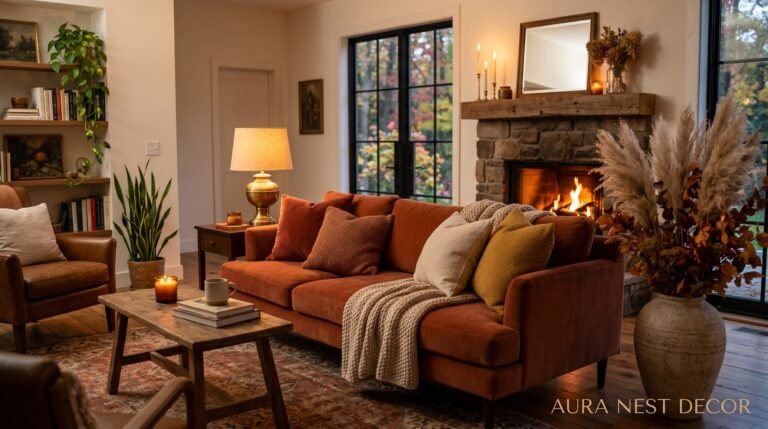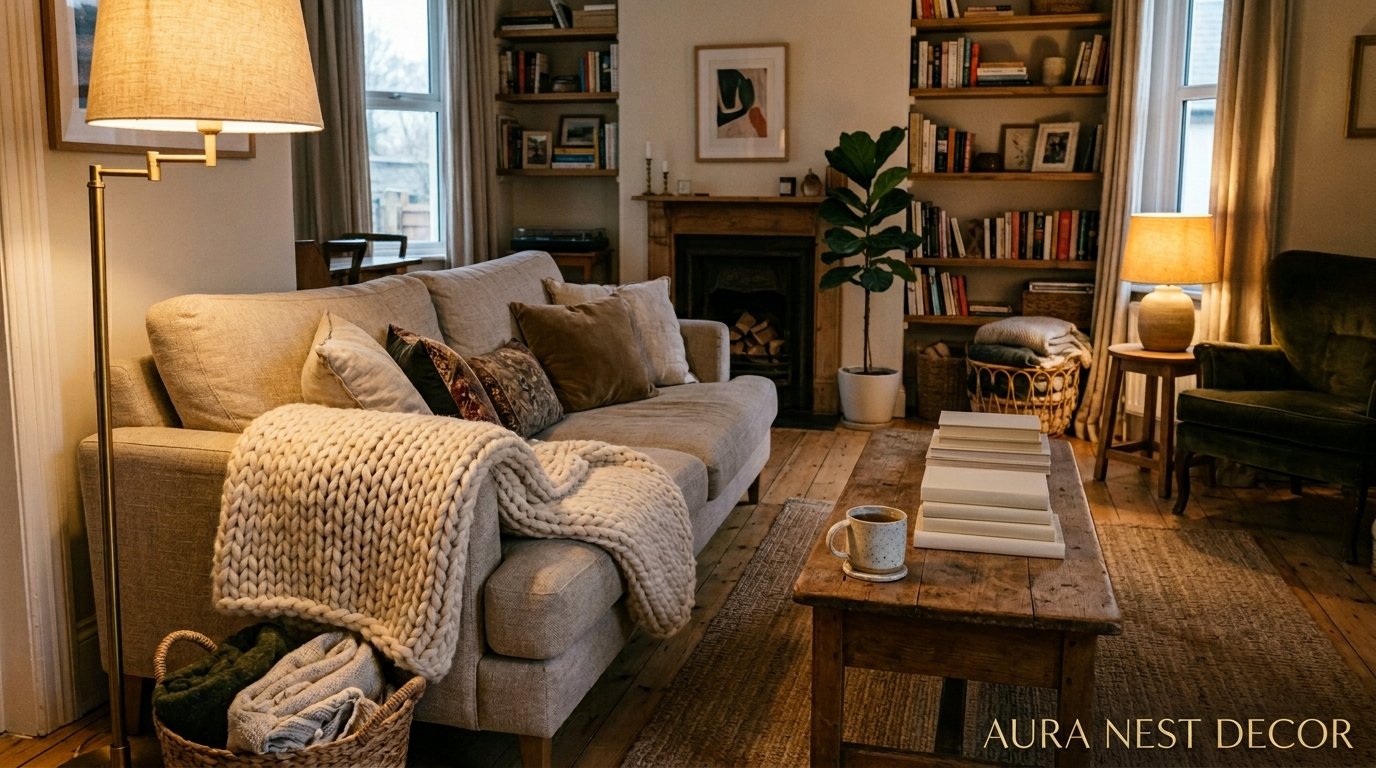
The Living Room That Actually Feels Like Coming Home (Not a Hotel Lobby)
You know the feeling when you walk into someone’s living room and just… exhale? Not because it’s perfect. Because it’s right. That’s what we’re chasing here — not a staged room, not a showroom, but a space that holds you.
—
1. Why Most “Cozy” Living Rooms Feel Like a Lie
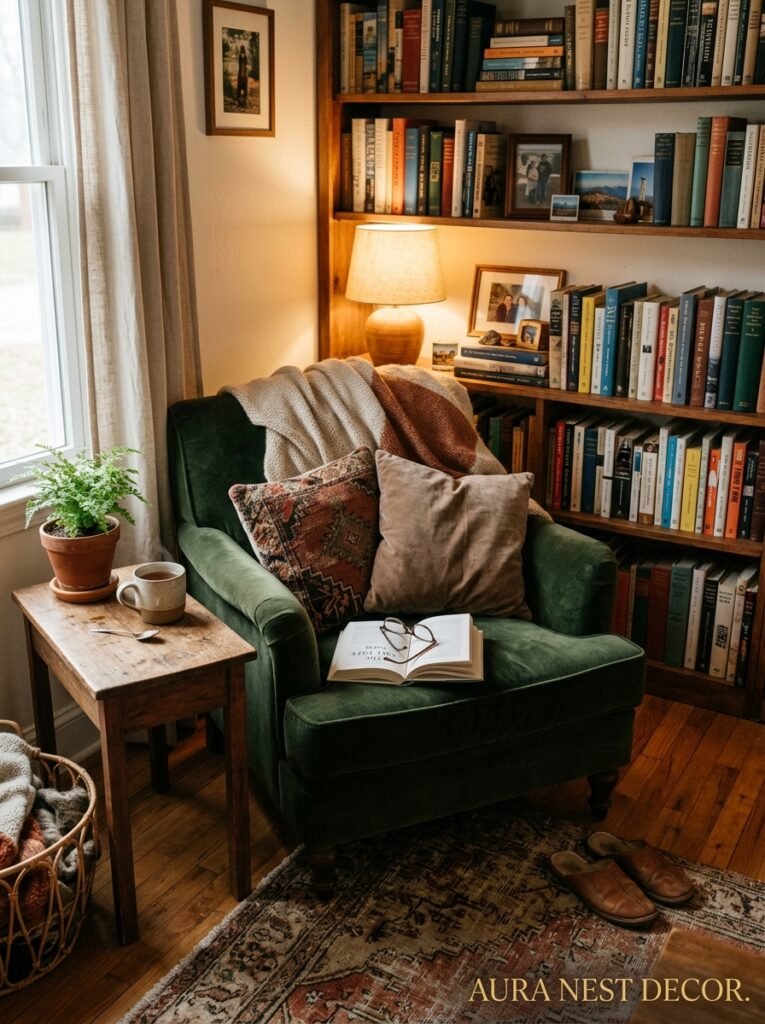
Here’s the thing nobody says out loud: a lot of so-called cozy rooms are just beige and expensive. A chunky knit throw on an Instagram-perfect sofa does not a cozy room make. What actually makes a room feel warm is so much harder to bottle — and honestly, it took me years of getting it wrong before I understood what was missing.
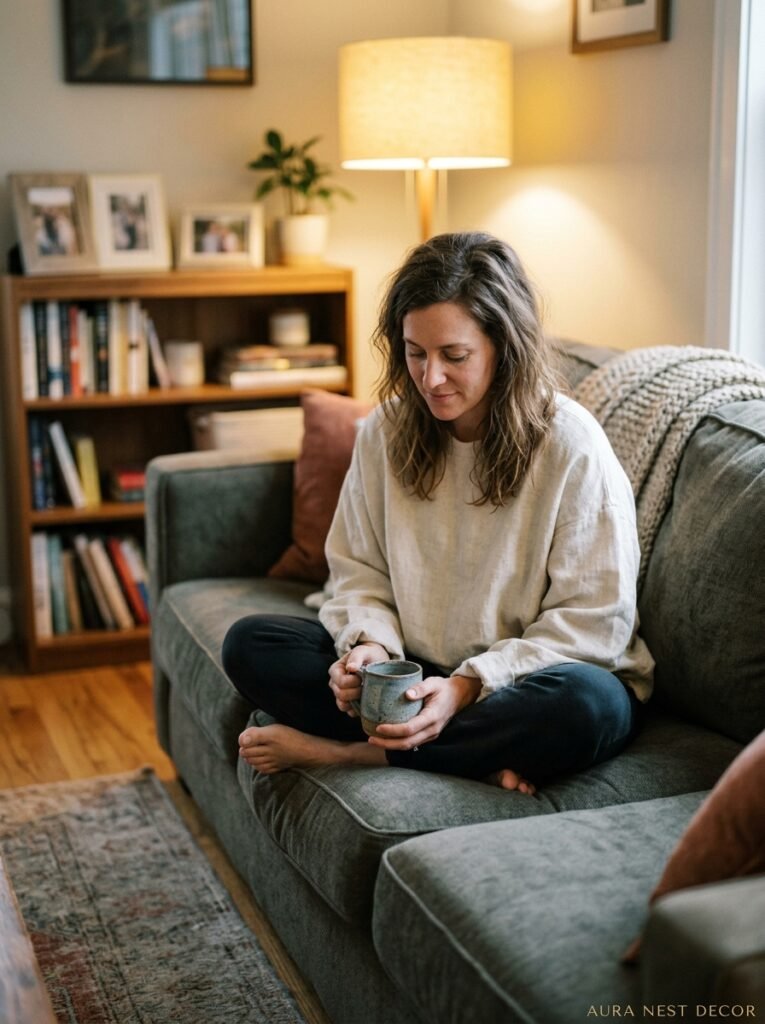
The rooms that feel genuinely cozy share one quality that has nothing to do with aesthetics: they feel lived in. There’s a book spine that’s been cracked open. A candle that’s been burned halfway down. A rug that’s slightly off-center because someone dragged a chair across it once. None of that is Pinterest-worthy on its own. But together? It reads as a room that belongs to someone real.
So before you buy a single thing, ask yourself what your living room is actually missing. Because I’d bet money it’s not another throw pillow.
“The rooms that stop you mid-scroll aren’t perfect. They’re specific. They feel like someone real lives there.”
—
2. The Lighting Secret Every Gorgeous Cozy Room Is Hiding
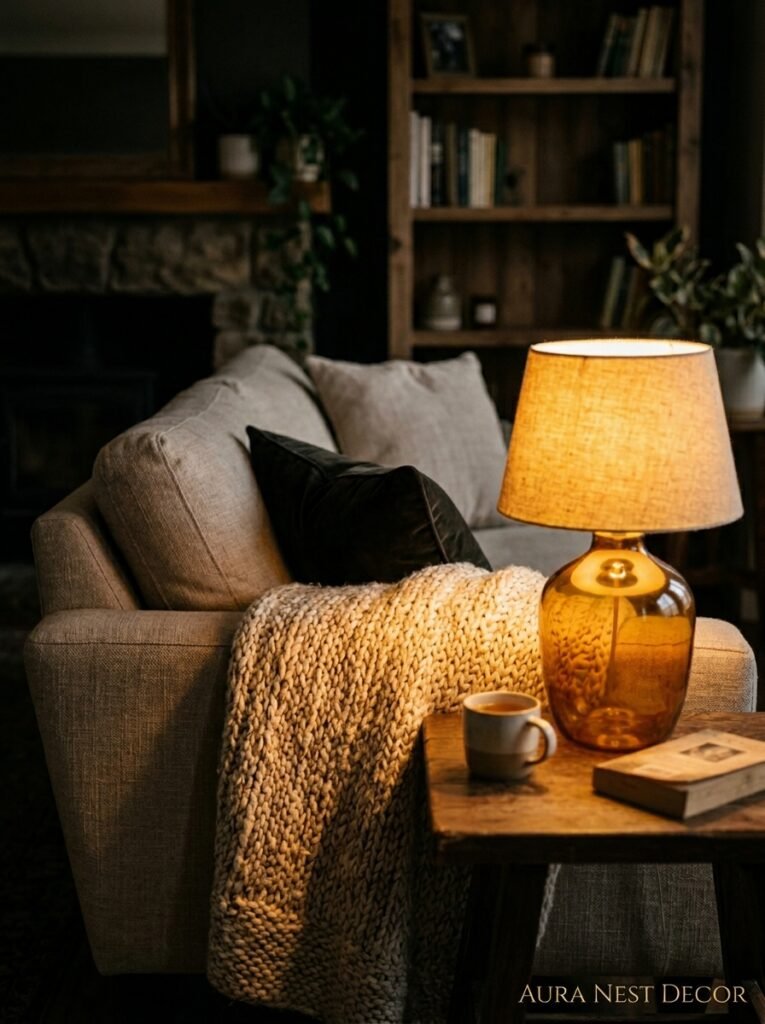
Overhead lighting is the enemy of cozy. I’ll die on this hill.
There is nothing — NOTHING — a single ceiling light does for a living room except make it look like a dentist’s waiting room at 9pm. If your main source of light is directly above your head, the whole room feels flat and weirdly exposed. Like you’re being interrogated.
What you want instead is layered light at different heights. A floor lamp tucked behind an armchair. A table lamp on a low sideboard. A string of warm Edison bulbs on a bookshelf, maybe. The difference when you switch from overhead to layered isn’t subtle. It’s like the room exhales too.
The bulb temperature matters more than most people realize. Anything above 3000K starts reading as clinical. You want 2200K to 2700K — that amber, almost honey-toned glow that makes everyone in the room look like they’re in a good film. And dimmer switches. Please. If you do ONE thing after reading this, add a dimmer switch. The cheapest, most underrated cozy upgrade that exists.
—
3. The Color That Keeps Showing Up in Every Beautiful Cozy Living Room Right Now
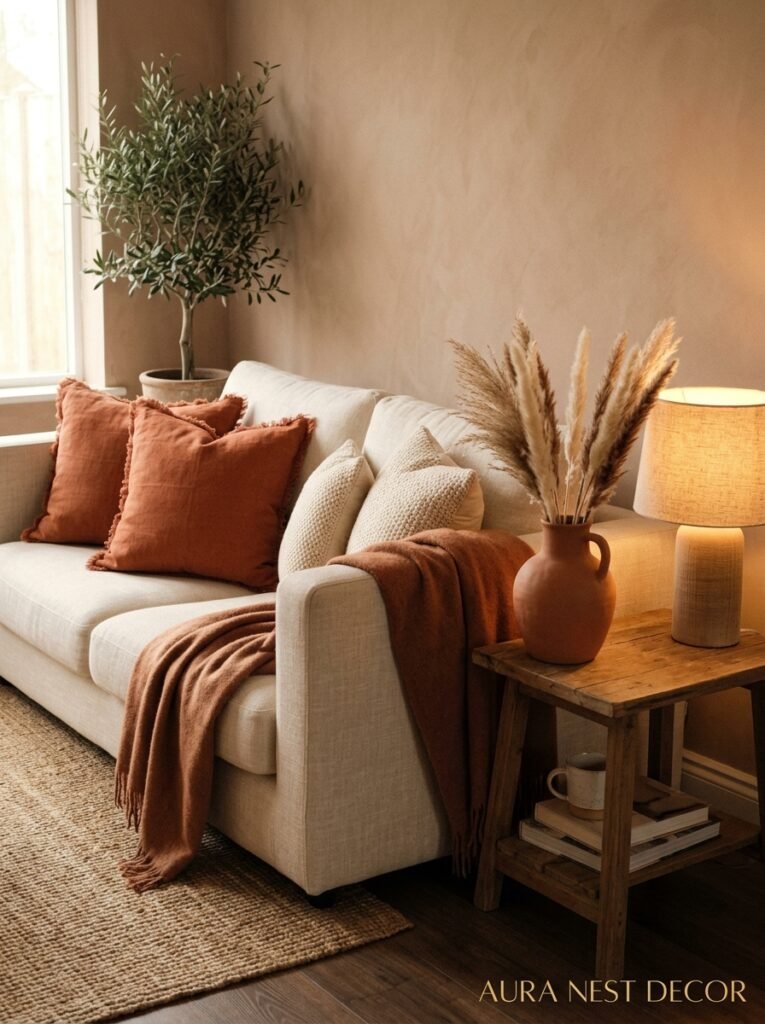
It’s not greige. It’s not Farrow & Ball Elephant’s Breath (though, no shade, that’s still gorgeous). The color I keep seeing — the one that hits different in a real room versus a mood board — is this sort of warm, dusty terracotta-adjacent clay. Not orange, not pink, kind of both. Like the inside of a very good piece of pottery.
In British homes, I’m seeing it on walls, sometimes just one, with cream linen sofas that have seen better days in the best possible way. In American homes, it tends to show up in textiles — a lumbar pillow here, a ceramic lamp base there. Both approaches work. Honestly, the textile version is the lower-commitment entry point if you’re nervous about paint.
But here’s what makes it feel cozy rather than trendy: the other colors in the room. Clay tones only really sing when they’re paired with deep forest green, or warm ivory, or that particular shade of brown that’s almost chocolate but not quite. Put clay next to cold grey and it looks lost. Context is everything.
—
4. Furniture Placement Nobody Talks About (But Changes Everything)
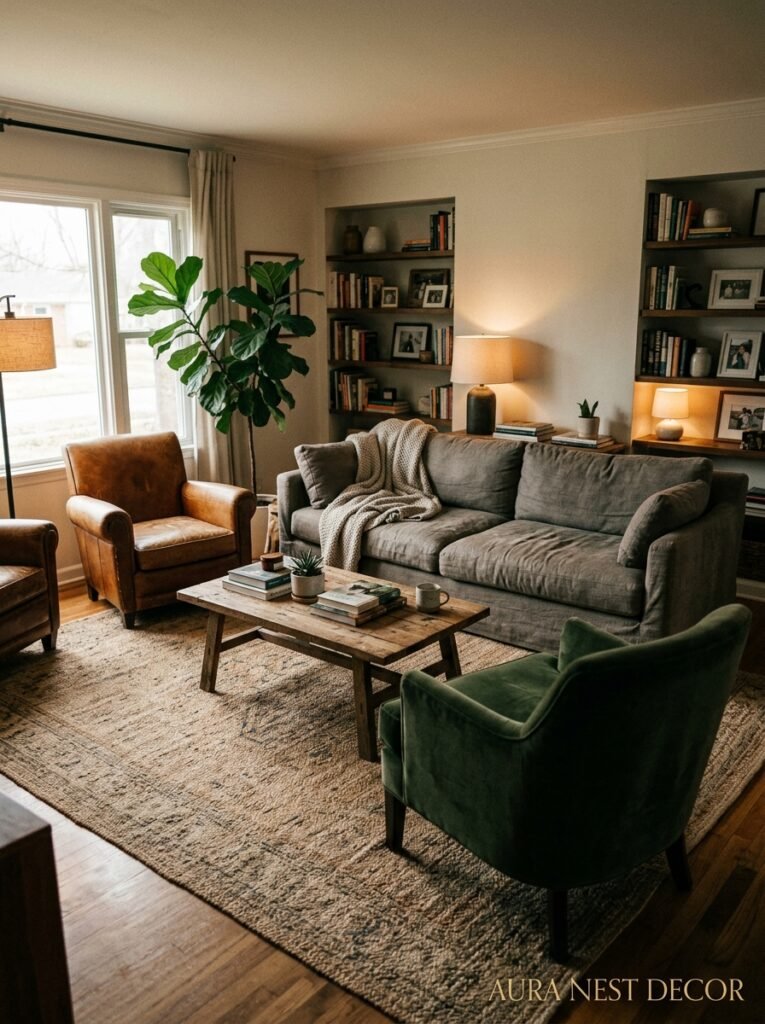
Pull your sofa away from the wall.
I know. I know it feels counterintuitive, especially in smaller rooms. But sofas pushed flat against walls make a room feel like a waiting area. It creates dead space in the middle of the room that doesn’t know what to do with itself, and then cramped chaos around the perimeter. Even pulling it out six inches makes the whole arrangement feel more intentional, more like a conversation, less like a queue.
The goal is to create a zone — a contained little world within the room. Sofa, chairs, coffee table, rug all working together as a cluster rather than furniture arranged around the edges of a box. The rug especially. That rug needs to anchor the whole thing. Front legs of every piece of furniture on the rug, if you can manage it. Or go big enough that everything sits fully on top. What you cannot do — what drives designers quietly mad — is a rug so small it just floats in the middle of the grouping doing absolutely nothing for anyone.
“Your furniture isn’t decoration. It’s an arrangement. And arrangements have to make sense from the inside out.”
—
5. The Case for Owning One Genuinely Ugly Lamp You Love
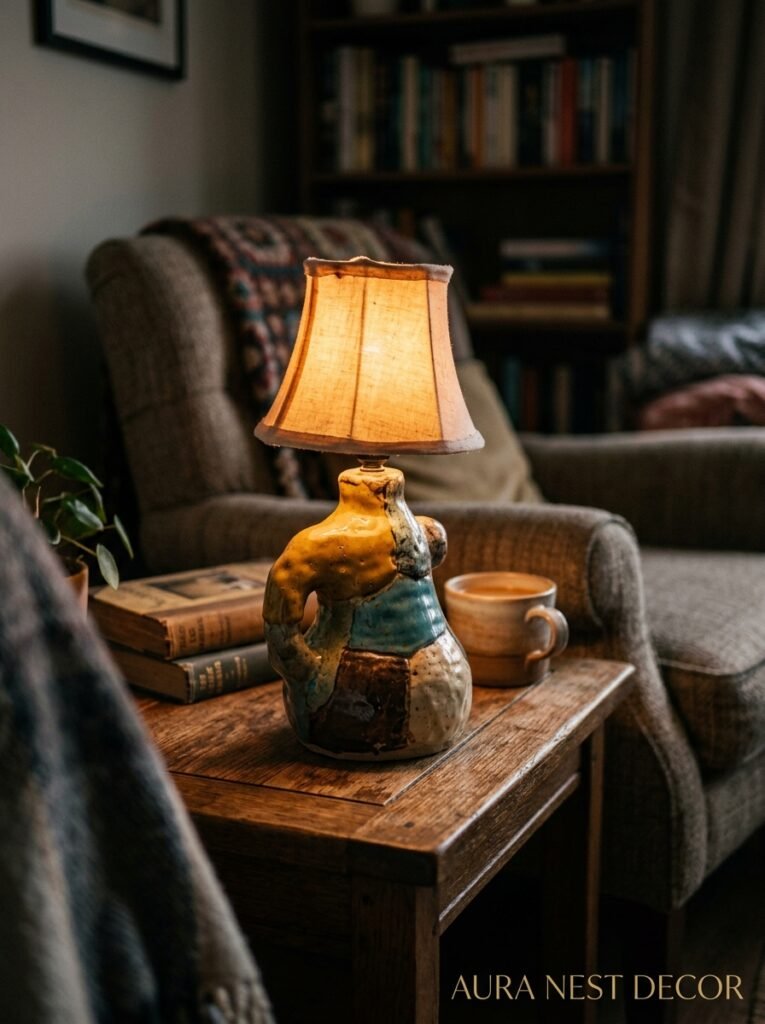
Not everything in a cozy room should be beautiful. That sounds wrong but stay with me.
The rooms that feel most alive have at least one thing in them that wouldn’t survive a style audit — an inherited lamp with a slightly dated base, a bookshelf crammed with actual books not organized by color, a side table that’s too small but was a car boot sale find and you love it anyway. These things are the personality of a room. Strip them out in favor of perfect cohesion and the room becomes a render, not a home.
I have a floor lamp in my living room that is genuinely not attractive. The shade is a warm ivory, slightly off-round from years of being bumped. The base is a dark turned wood that doesn’t go with anything I own. But the light it throws is THE coziest in the whole room — this warm, directional glow that hits exactly the right spot on the wall behind my sofa. And because I love the light, I kept the lamp. And now it’s just part of the room. Part of the story of it.
The instinct to curate everything to death is understandable. But cozy doesn’t curate. It accumulates, slowly, with intention.
—
6. Why Texture Is Doing More Work Than Your Color Scheme
Color gets all the attention. Texture is doing the actual heavy lifting.
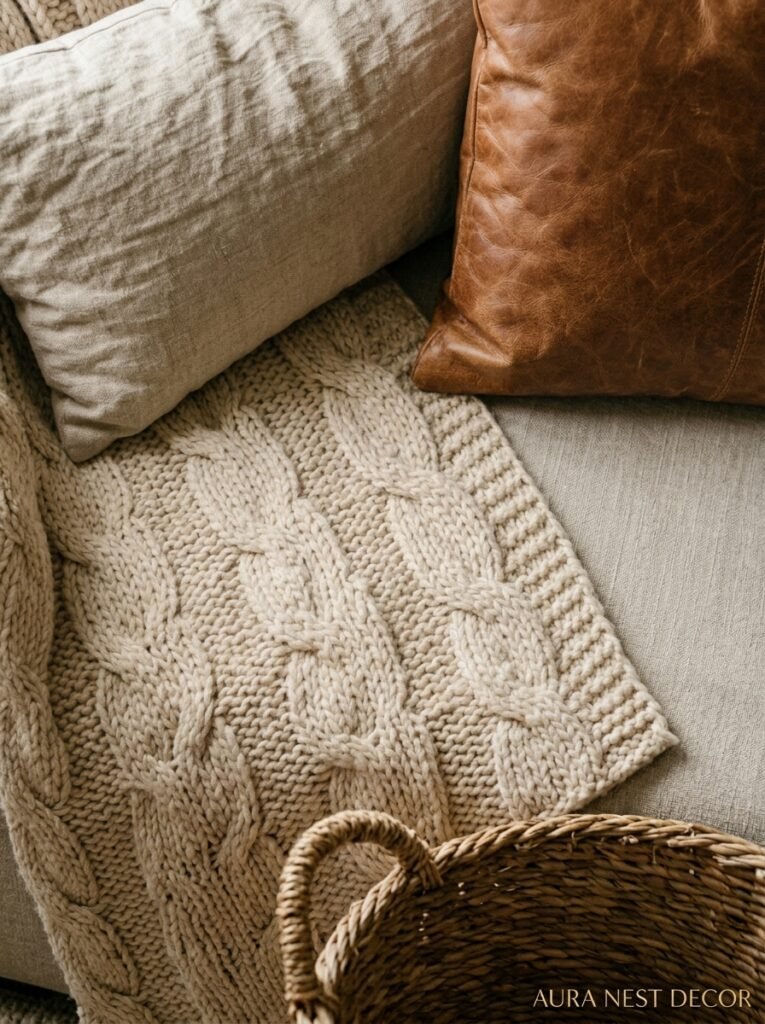
Think about it: a room done entirely in cream but with smooth walls, leather sofa, glass coffee table, and polished floors is cold. A room done in the same cream but with a linen sofa, a shaggy rug, a chunky woven throw, rough-plaster walls, and a wooden coffee table with a little grain in it? Warm. The colors are almost identical. The texture is completely different.
Cozy rooms have rough things and smooth things existing right next to each other. That contrast is what makes your hand want to reach out and touch something — and tactile appeal IS comfort. Velvet cushions against a matte clay pot. A glossy stack of coffee table books beside a basket of rough wool. Worn leather and crisp linen. It shouldn’t match so much as it should layer, each surface doing its own thing.
Side note — don’t underestimate what a woven basket does for a corner. Sounds basic, I know, but there’s something about the way light catches the texture of wicker or seagrass that adds warmth to a space in a way that costs almost nothing.
—
7. The “This Room Doesn’t Quite Make Sense” Effect (and Why It Works)
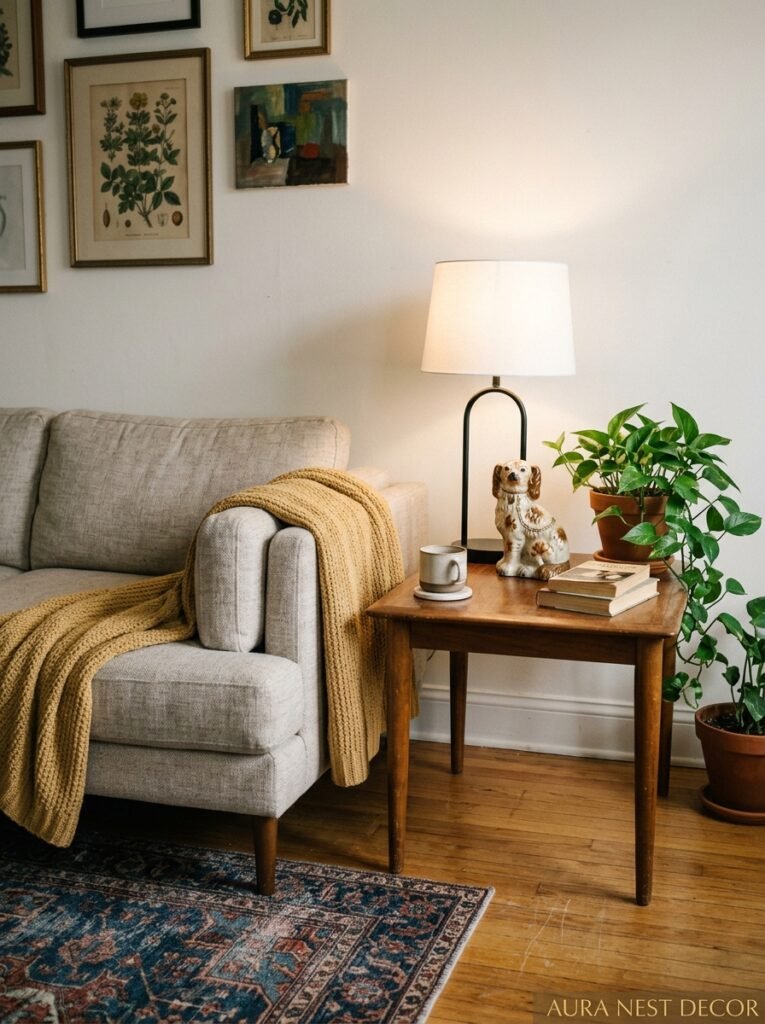
The most interesting cozy rooms have a slight contradiction in them. A very modern sofa in an old Victorian terrace. A traditional Persian rug under a mid-century chair. A really beat-up vintage coffee table in an otherwise quite polished space. Something that shouldn’t work but does.
I think what’s happening is that contradiction signals authenticity. It says: this room wasn’t purchased as a set. It grew. And growing takes time, and time is exactly what cozy feels like — it feels like a room that has accumulated evenings and conversations and seasons.
Designers call it “mixing old and new.” I just call it not being afraid to put something in a room because it came from somewhere, not just because it photographs well.
“A room that grew over time will always feel more real than a room that was assembled at once.”
—
8. What British and American Cozy Rooms Actually Do Differently
This is interesting, and it doesn’t get talked about enough.
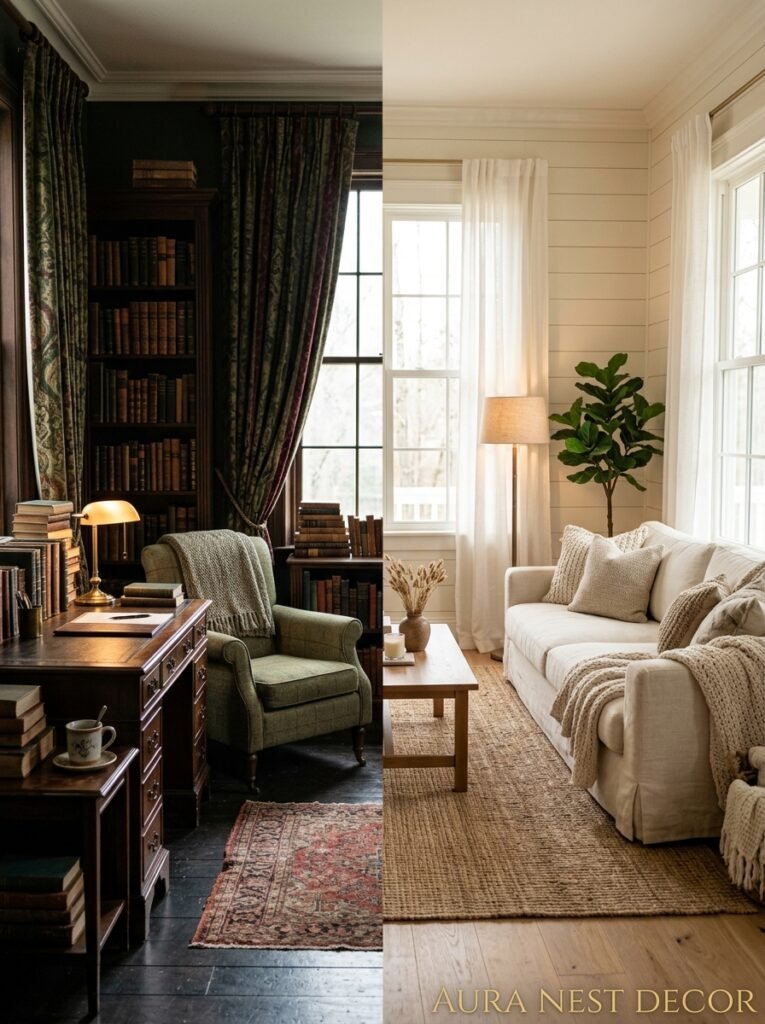
British cozy tends to go darker and more layered. Deep walls — navy, forest green, dark terracotta. Lower furniture. Books EVERYWHERE, often doubling as decor whether intended or not. Older pieces mixed in naturally because the houses are often older. There’s a lived-in quality that happens almost by default because UK houses accumulate history. British cozy is less about adding softness and more about warmth — fire, dark colours, weight.
American cozy skews lighter and airier but with more textile. Bigger sofas. More throw pillows. Warmer woods. Open plan spaces that are styled to feel contained and purposeful. The challenge in American homes is often scale — large open plan living rooms can feel airy but untethered, and achieving cozy means working HARDER at creating that contained zone feeling. More rugs. More defined groupings. More “room within a room” thinking.
Both are valid. Both are gorgeous. But knowing which visual language you’re working in helps you make better decisions faster.
—
9. The One Rule That Makes Any Small Living Room Feel Intentional
Edit ruthlessly, then add one thing you love.
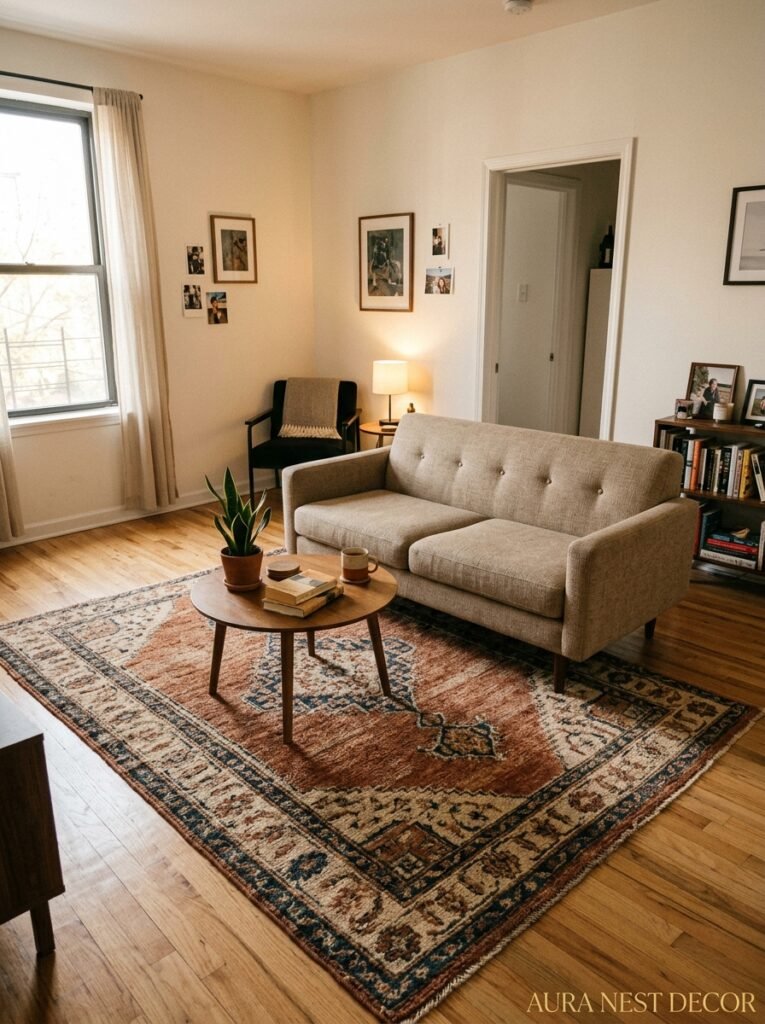
Small rooms fail when they try to do everything. They fail when every inch is filled, every surface decorated, every corner occupied. The temptation in a small room is to stuff it — to prove that small doesn’t mean bare. But bare and edited are NOT the same thing.
Edit down to what you actually use and love. Then — and this is the part people miss — add back one thing that’s purely about beauty. A plant that’s too big for the space. A painting that takes up too much wall. A lamp that’s over-scale for the table. One deliberate act of “too much” in a tightly edited room reads as confidence, not clutter. It says: I chose this. The room feels intentional because you broke the rules exactly once, on purpose.
In a small British living room, this might be a large pendant light hung low over a bistro-style coffee table. In a smaller American apartment living room, maybe it’s a floor-to-ceiling gallery wall when everything else is spare. One statement. One rule broken. That’s it.
—
10. Scent Is a Cozy Layer and You’re Probably Not Using It Right
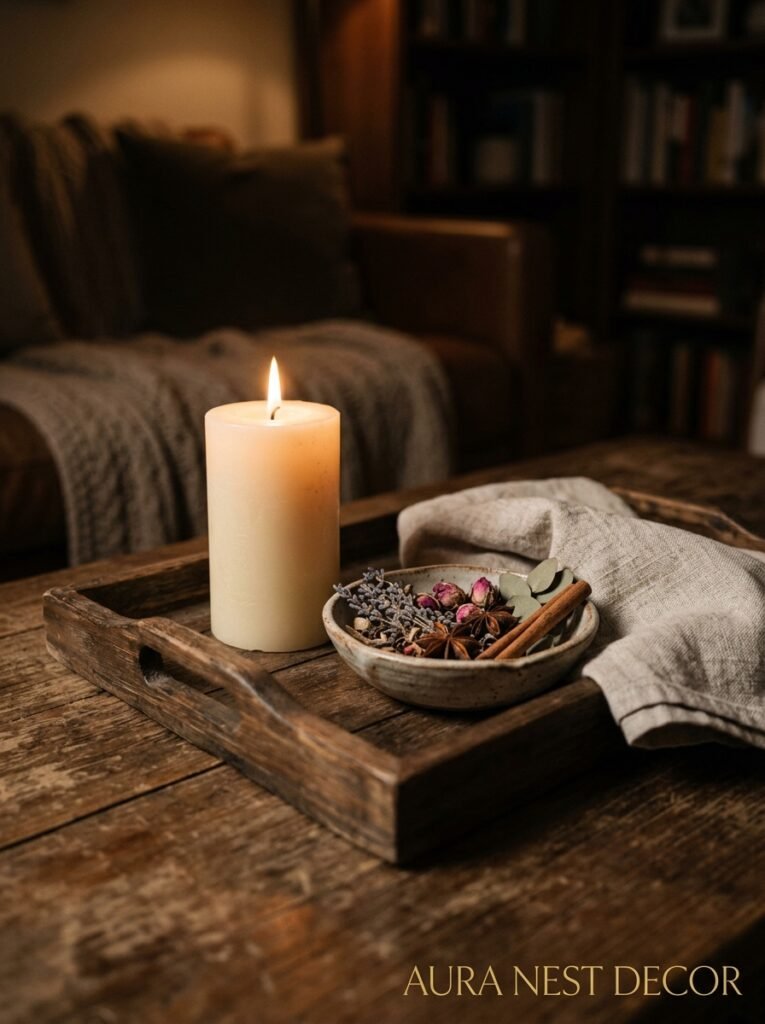
Before you roll your eyes — hear me out.
Scent is the only sense that bypasses conscious thought and goes directly to memory and emotion. Which means the smell of your living room is doing work on your nervous system before you’ve even sat down. That’s not nothing.
Most people either have no scent strategy (fine) or they rotate whatever candle smells nice right now (also fine but missing something). The cozy approach is to find one or two scents that become synonymous with being home. Not seasonal, not trendy — just yours. Something slightly warm, slightly woody, slightly familiar.
For me it’s a combination of a cedar and sandalwood candle and real wood from a fire when we use it. Nothing synthetic trying to smell like a forest — actual wood. There’s no substitute. But if you don’t have a fireplace, look at candles with real beeswax bases rather than paraffin, and scents that lean warm: amber, leather, clove, sandalwood, smoke. They tend to smell lived-in rather than freshly cleaned, which is exactly the vibe you want.
—
11. Coffee Table Styling That Doesn’t Look Like a Showroom
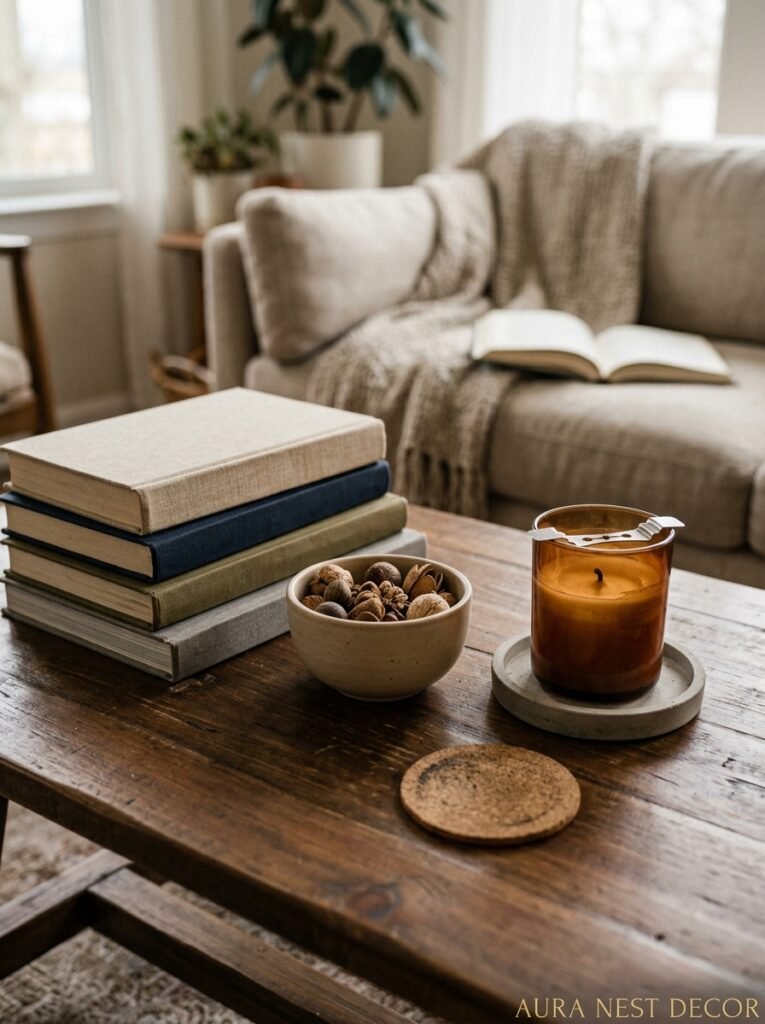
Three things on a coffee table max. Done.
Okay, a bit more nuance. But honestly, not much more. The coffee table is the most over-styled surface in any living room — stacked books, a tray, a candle, a small plant, a coaster set, some decorative spheres — and by the time you’ve added all of it, it’s just noise. It stops reading as intentional and starts reading as a display in a homeware shop.
What actually works: one taller thing (a candle, a small vase with a single stem, a lamp if it’s large enough), one lower thing (a tray, a stack of two or three actual books you’ve actually read), and space. Actual visible table surface. The space isn’t emptiness — it’s breathing room. It gives the eye somewhere to land that isn’t competing with everything else.
And for the love of all that is good and cozy: leave your remote control out. A living room that looks like nobody actually watches TV in it doesn’t feel like home. It feels like a furniture showroom that forgot to add a till.
—
12. The 20-Minute Reset That Keeps a Cozy Room Feeling Cozy
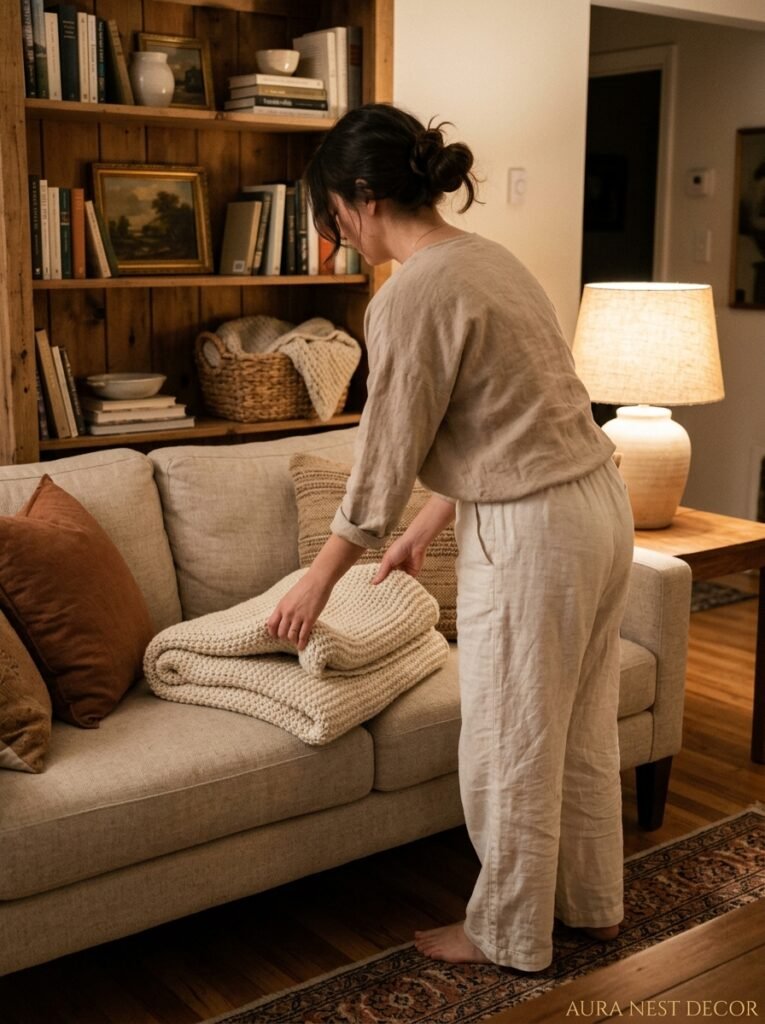
Cozy isn’t a decorating project. It’s a practice.
The best cozy rooms I’ve ever been in — the ones that made me want to sit down and not leave — weren’t that way because they’d been professionally decorated. They were that way because someone maintained them with small, regular attention. Cushions plumped. Throws folded loosely, not perfectly. Surfaces cleared of the random accumulation of daily life. Candles lit, not just sitting there.
Twenty minutes, maybe once or twice a week, makes a disproportionate difference. Not deep-cleaning — just resetting. Returning things to the right place, refreshing the surfaces, changing out a dead flower, lighting something. It’s maintenance but it’s also a kind of care, and rooms that are cared for feel it. They hold a different quality of attention. You can’t always say exactly why a room feels warm and right, but care is usually a big part of the answer.
—
❓ FAQ
Q: How do I make a large open-plan living room feel cozy without it feeling closed off? A: Rugs are your best tool here — define separate zones with different rugs to create “rooms within a room.” Layer in warm lighting at multiple heights, and don’t be afraid to put furniture in the middle of the space rather than hugging the walls. The goal is to create intimacy within the openness, not fight against it.
Q: What’s the coziest sofa fabric that’s also practical with kids or pets? A: Honestly? Performance velvet or a tightly woven linen blend. Performance velvet sounds counterintuitive but it’s come a long way — it’s soft, warm, and genuinely wipeable. Avoid loosely woven textures if you have pets, as claws catch. And go darker rather than lighter — a dusty blush velvet sofa hides far more than that cream linen looks like it will.
Q: I rent and can’t paint — how do I get a cozy feel without permanent changes? A: Textiles and lighting are your entire toolkit here, and they’re surprisingly powerful. A large dark-toned rug can anchor a cold floor. Floor lamps at varying heights replace the need for overhead ambiance. And a large piece of textile art or tapestry on a wall — hung with removable hooks — can shift the tone of a room almost as much as paint. It’s slower and more expensive than a tin of paint, but it’s entirely reversible.
—
💭 Final Thoughts

Cozy isn’t a style. It’s a feeling, and it comes from a room that knows what it’s for — rest, connection, the particular pleasure of being somewhere that wants you there. You don’t build that in a weekend shopping trip. You build it in a hundred small decisions, over time, without being too precious about any of them.
Start with the light. Pull the sofa out from the wall. Leave the remote on the coffee table.
What’s the one thing in your living room right now that makes it feel most like you — not like a design concept, but like you specifically?