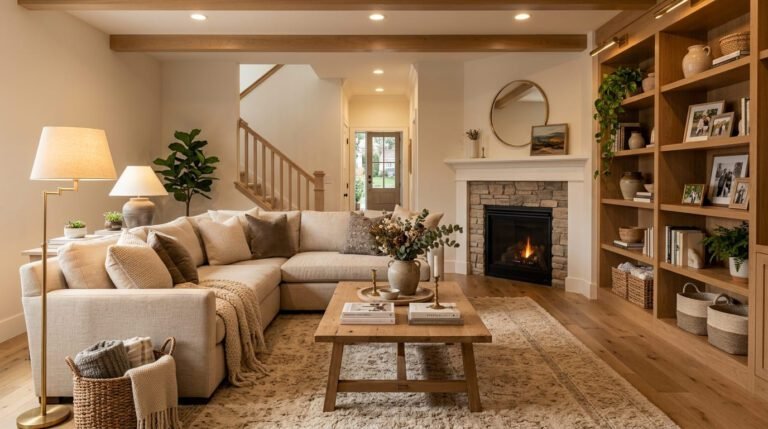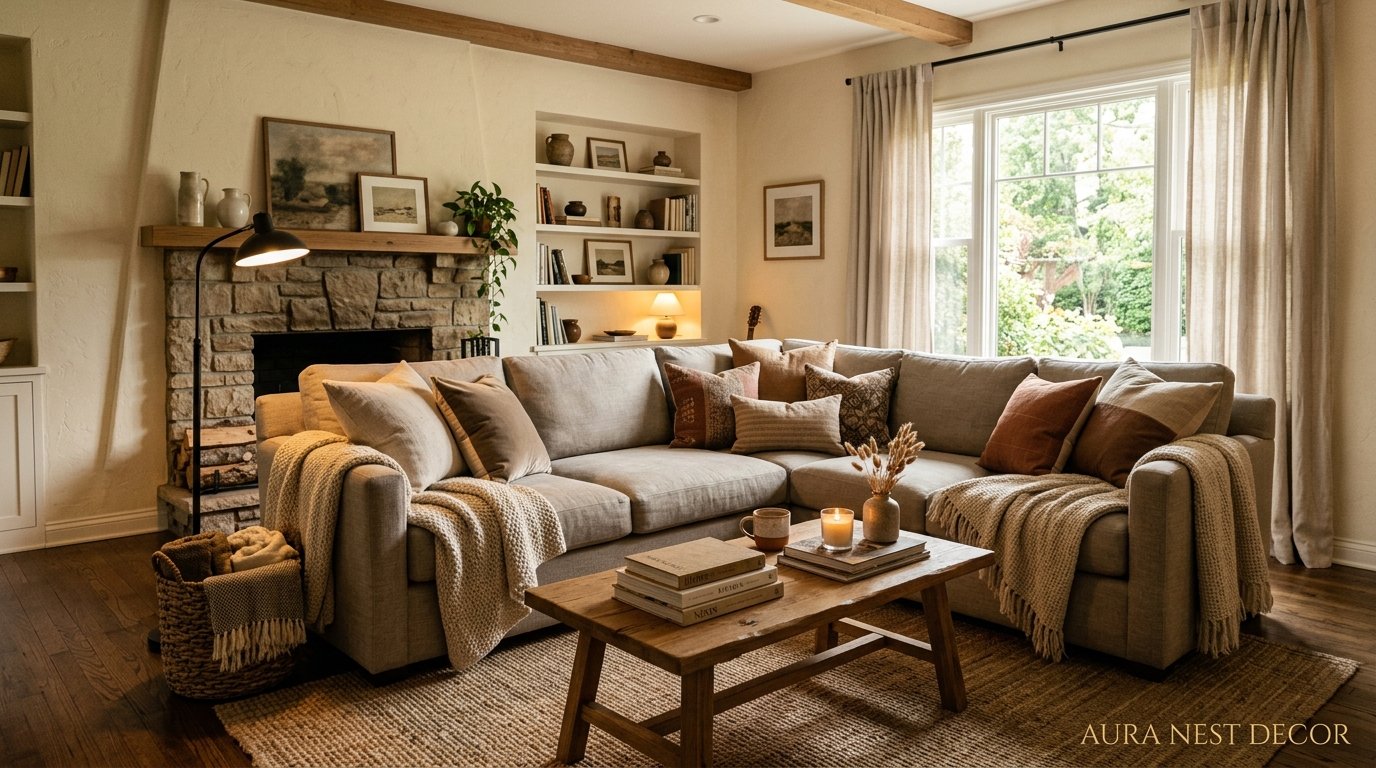
The Living Room That Feels Like a Hug: How to Nail Warm Transitional Style Without It Looking Like a Showroom
You know that feeling when you walk into someone’s home and something just settles inside you? Not because it’s perfect. Because it feels lived in and considered at the same time. That’s warm transitional style — and it’s genuinely one of the hardest things to pull off, which is probably why so many people end up with something that looks like a hotel lobby instead.
—
1. Why “Transitional” Doesn’t Mean What Most People Think It Does
Here’s what I used to think: transitional meant mixing modern and traditional in equal measure. Like some kind of decorating math problem. A sleek sofa here, an ornate mirror there, balance everything out. Done.
It’s not that.
Warm transitional is really about mood, not formula. It’s the feeling of a space that doesn’t announce its era. You can’t quite tell if it was decorated in 2010 or 2023, and that’s genuinely the point. The furniture isn’t trendy. The color palette doesn’t scream any particular decade. And there’s warmth — real, amber-toned, tactile warmth — running through everything like a thread you don’t consciously notice but would definitely miss if it wasn’t there.
The word “warm” is doing SO much work here, by the way. It’s not just color temperature (though it is that too). It’s the weight of the textiles, the softness of the edges, the way the room doesn’t fight you when you sit down. A truly cold transitional room is kind of miserable — all that careful balance with zero comfort. We don’t want that. We want the kind of room you genuinely don’t want to leave on a Sunday afternoon.
Also — and I feel strongly about this — warm transitional isn’t beige. Or it doesn’t have to be. I’ll get into colors properly in a minute but I wanted to flag that early because I think the fear of doing warm transitional is that it’ll end up looking like oatmeal. It won’t. Promise.
“The best transitional rooms feel like they were collected slowly, not decorated all at once.”
2. The Color That Keeps Showing Up in Every Beautiful Warm Living Room Right Now
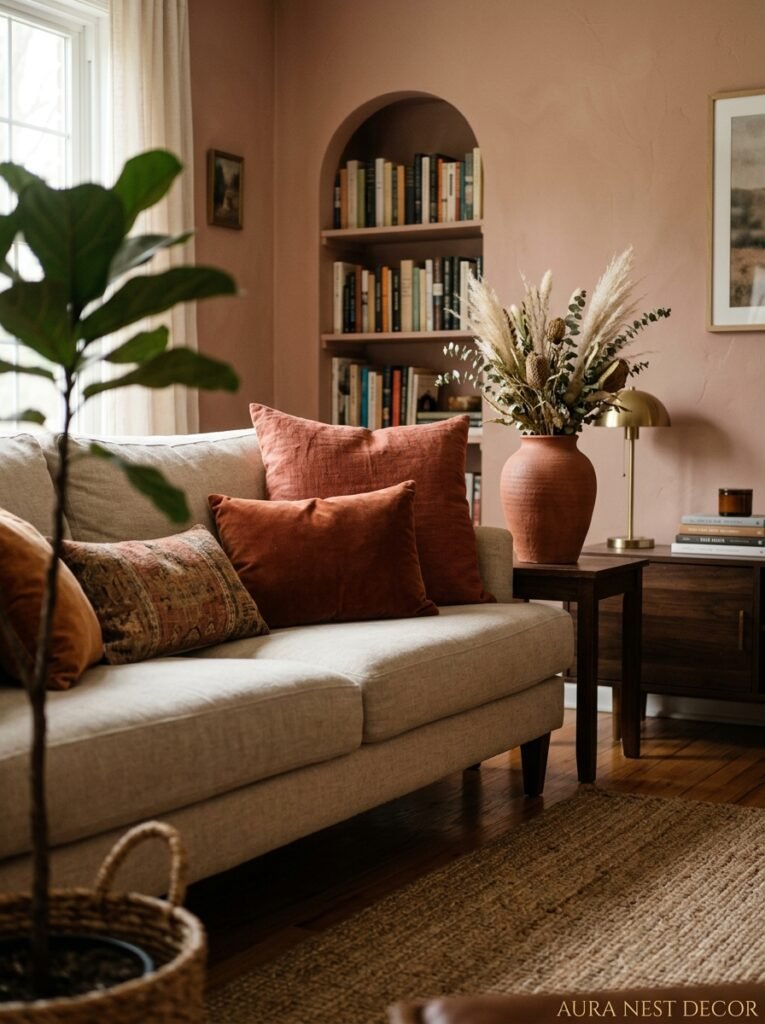
It’s not greige. It’s not the warm whites everyone was obsessed with in 2019. Right now, the color that keeps appearing in every warm transitional living room that stops me mid-scroll is a kind of muted, earthy terracotta — but not the burnt orange version that felt very 2021. Something softer. More clay. More like the color of a well-worn terracotta pot that’s been sitting on someone’s back porch for three years.
And here’s the thing: it doesn’t have to be the wall color. Most of the time it isn’t. It shows up as a velvet pillow, a ceramic lamp base, a piece of abstract art with one peachy-warm section. It anchors the whole room without dominating it.
For walls, the colors I’m seeing work best are those slightly dusky, slightly complex neutrals — think Farrow & Ball’s Elephant’s Breath or Dead Salmon (yes, that’s a real name, yes it’s gorgeous), or Benjamin Moore’s Pale Oak if you’re in the States and want something with just enough warmth to feel cozy but enough grey to stay sophisticated. These aren’t stark whites and they’re not warm beiges either. They’re somewhere in the middle with a little personality.
The thing about warm transitional color is that it rewards layering. One of those dusty wall colors plus warm wood tones plus a rug in muted rust and cream — suddenly you’ve got something that looks like it was styled by someone who really knows what they’re doing, even if you just sort of stumbled into it.
3. The Sofa Rule Nobody Tells You (But Everyone Who Has a Good Room Follows)
Don’t buy the sofa last. I know everyone says figure out the sofa first, and I know that sounds like the same thing, but stay with me.
What I mean is: don’t treat the sofa as the thing you have to “work around.” Most people pick the sofa, then spend the next six months trying to find things that go with it and wondering why the room feels off. The sofa becomes a constraint instead of an anchor.
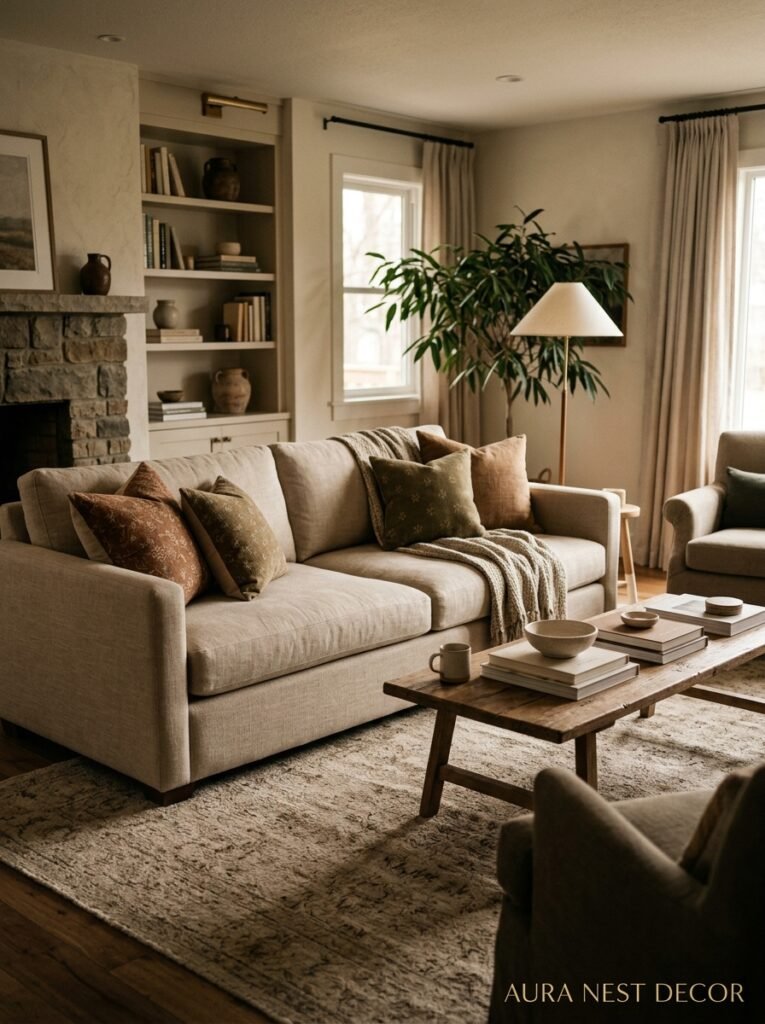
In a warm transitional room, the sofa should feel like it belongs to the room, not like the room belongs to it. That means the sofa should be the QUIETEST thing in the space, tonally. A soft, low-profile sofa in warm linen or a muted boucle — something that doesn’t assert itself too aggressively — lets everything else in the room actually breathe.
What I love is a sofa in a warm greige or oatmeal linen (okay, fine, sometimes it IS a little oatmeal-adjacent) with clean but not harsh lines. No ornate carved legs, but not that stark Danish modern look either. Something in between. A gentle curve on the arm helps enormously. It sounds subtle but it changes the whole energy of the piece.
And then — this is the fun part — you pile it with texture. A chunky knit throw in caramel. Velvet pillows in terracotta and olive. A linen pillow that’s ever so slightly rumpled. The sofa becomes a base layer, not the main event.
4. What Every Warm Transitional Room Has That You Probably Haven’t Thought About
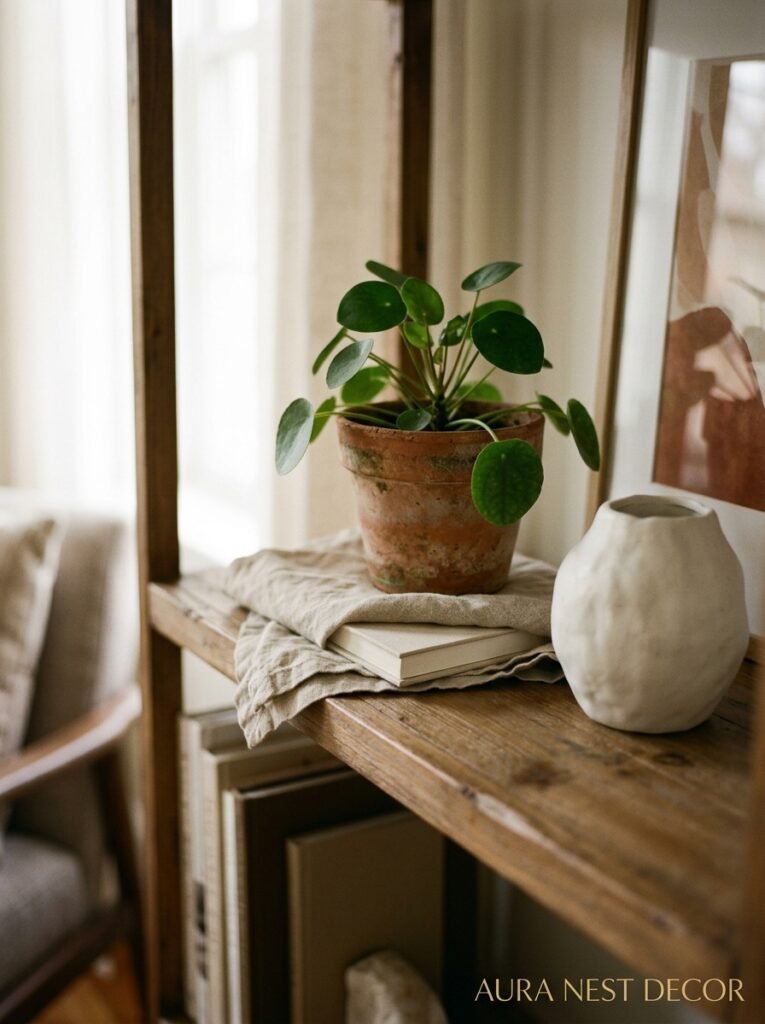
Wood. The right kind of wood.
Not the orange-toned pine or honey oak that’s having its comeback moment (I’m watching that trend with slight suspicion, honestly). The wood that works in warm transitional rooms is more burnished. Darker in parts. Walnut, or something that looks like walnut. Wood with grain and depth and a little bit of age to it, or furniture that’s convincingly aged even if it’s new.
A walnut coffee table with a simple silhouette against a linen sofa is one of my favorite combinations in decorating. Full stop. The wood grounds the softness of the textile, and the textile softens the darkness of the wood. They do something for each other.
Side note — if you can’t afford solid walnut right now (same), a good walnut veneer from somewhere like West Elm or John Lewis does the job. Don’t let anyone make you feel bad about that.
The other thing? Wood should show up more than once in the room. Not matching, not a set, but related. Maybe the coffee table in walnut, a side table in a slightly lighter warm wood, and one picture frame in a honey tone. The variation makes it feel organic. A matching “suite” of furniture is the fastest way to age a room by twenty years and not in the good way.
“Warmth in a room comes from the wood as much as the light — don’t skip it.”
5. The Lighting Setup That Makes Every Transitional Room Look Like Someone Who Actually Knows What They’re Doing Lives There

Overhead lighting is not your friend. I’m sorry. The main ceiling light in most rooms is just… a problem. It’s flat, it casts shadows in the wrong places, and it makes a beautiful room look like a dentist’s waiting area.
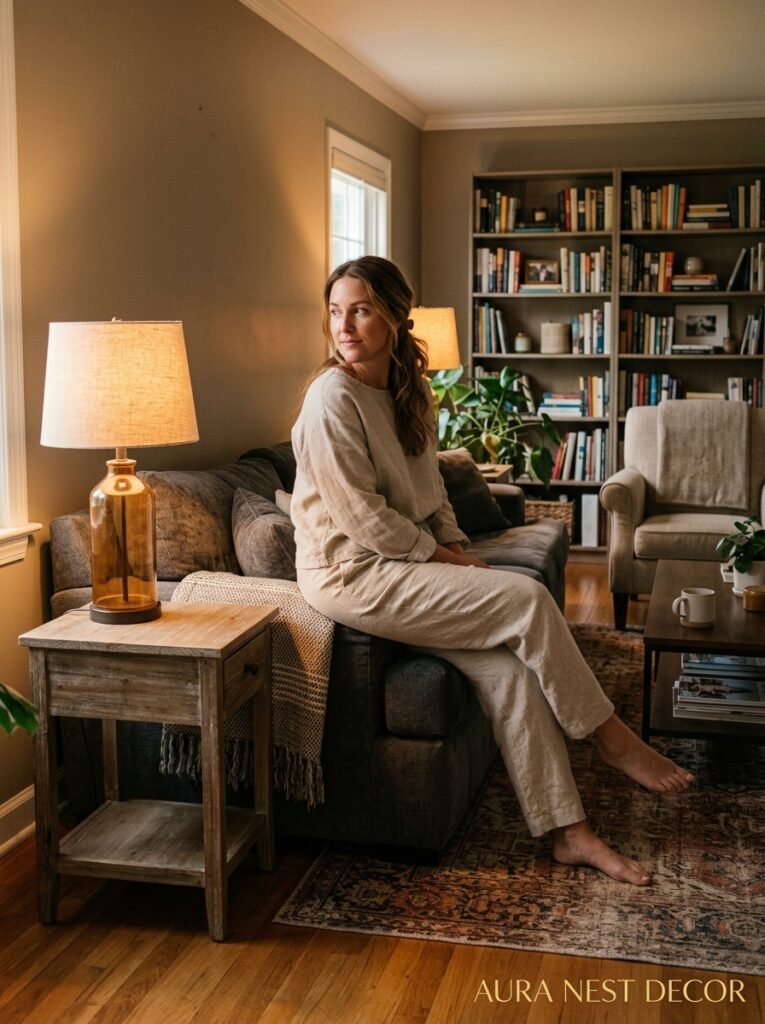
The secret to that golden, inviting warmth in transitional rooms is layers of light at different heights. Floor lamp in the corner throwing a wide, low wash of amber. Table lamp on the side table — something with a fabric shade, not a drum shade, something that diffuses the light and casts it warm. Candles, actual candles, when you’re home in the evening. Not as decor props but as actual light sources.
The amber glow of an Edison bulb at 7pm in a corner lamp changes EVERYTHING. This isn’t an exaggeration. The same room at 2pm under overhead light and at 7pm under lamp light feels like two different rooms. One feels like a functional space. One feels like a retreat.
Bulb temperature is something most people ignore until they’ve gotten it wrong a few times. You want 2700K or lower for living rooms. Anything cooler starts to feel clinical. Warm white, not daylight, not cool white. Get a few extra bulbs in the right temperature and swap them across your existing fixtures before you buy anything new — you might be surprised what that alone does for a room.
6. Rugs Are Not an Afterthought and I Will Die on This Hill
The number of people I’ve talked to who picked their rug last, treated it like a footnote, chose it based on what was left in the budget — it makes me want to sit down.
The rug is the room. Or at least it’s the thing that makes the room feel unified or not. Get this wrong and nothing else fully works. Get it right and even mediocre furniture looks intentional.
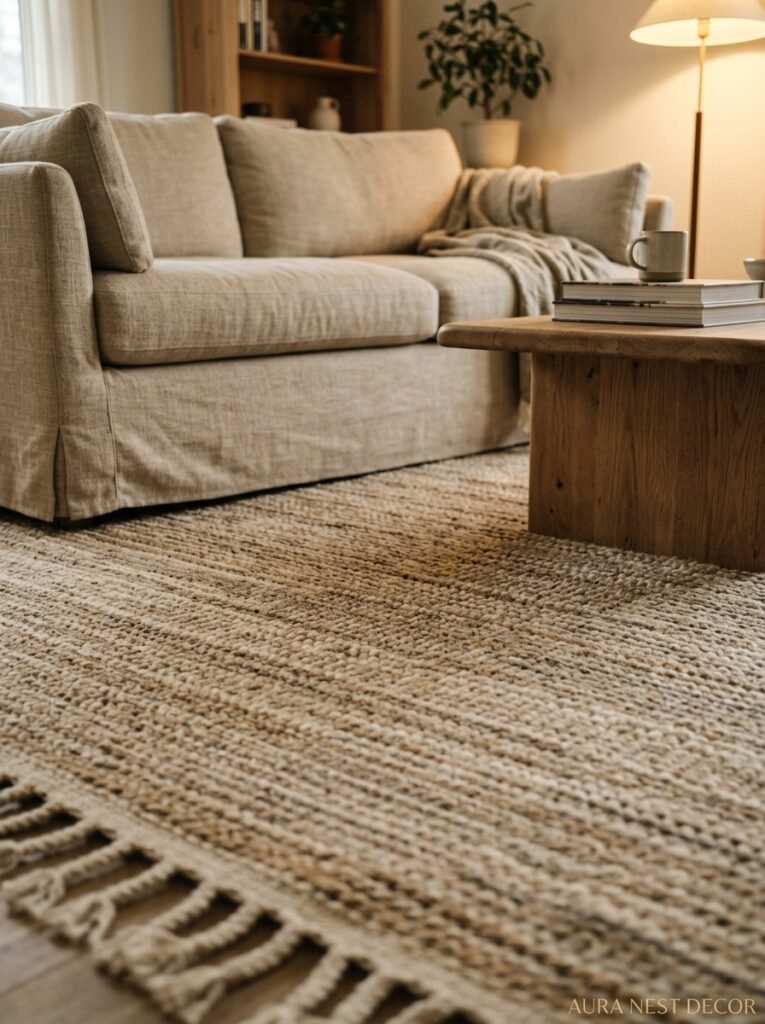
For warm transitional, you want a rug that has some visual texture — not a plain solid, not a graphic modern pattern, but something with movement. A faded Persian-style rug in muted terracotta, cream, and dusty blue (the blue is key, it keeps it from going too warm and muddy). A natural jute layered under a smaller vintage-look piece. A subtle abstract rug in earthy tones.
Size matters enormously. Too small is the most common mistake and it looks sad, like the furniture is floating and nothing is tethered. In a US living room, you almost certainly need at least an 8×10. In a UK sitting room where everything is slightly smaller, a 160x230cm at minimum. The front legs of every main seating piece should sit ON the rug. That’s the rule.
7. The One Piece of Old Furniture That Makes a Transitional Room Actually Work
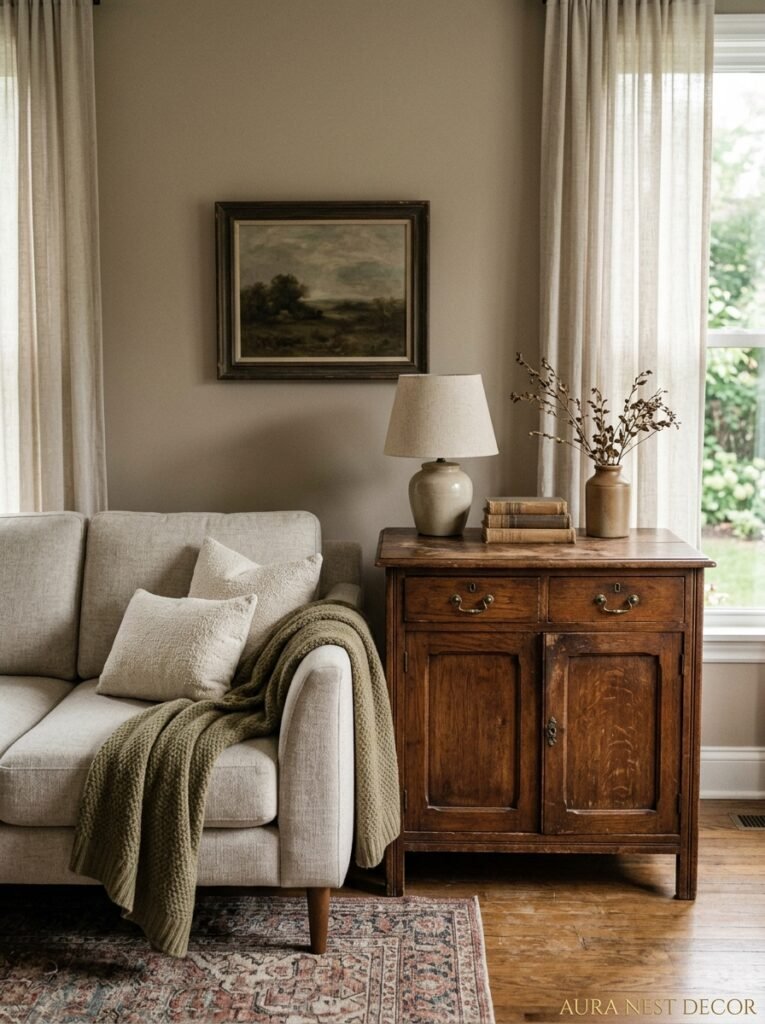
Something inherited, thrifted, or genuinely old.
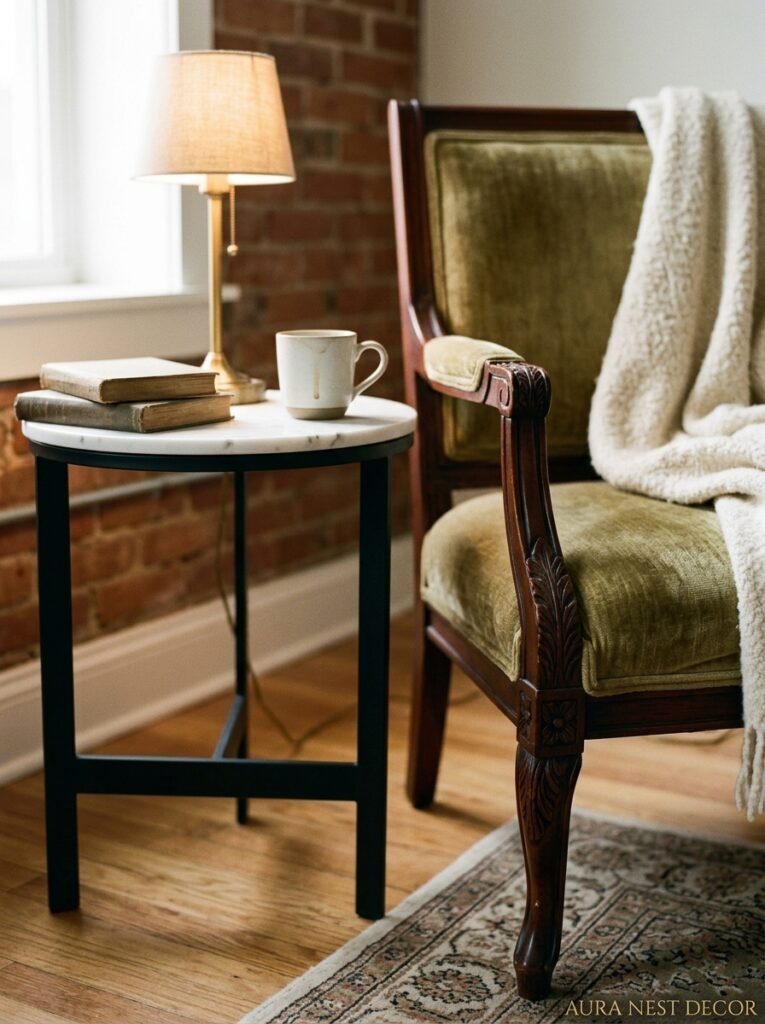
I don’t mean faux-antique. I don’t mean distressed-on-purpose. I mean something that has actual history — a chippy wooden stool, a brass lamp from a charity shop, a coffee table that was someone’s grandmother’s, a side chair that’s been reupholstered once and shows its age in the most charming way.
The reason this matters is that new furniture, no matter how well chosen, has a tendency to look like a set. Everything has the same sheen, the same factory-made precision. One genuinely old piece breaks that up. It’s the thing that makes the room feel like it wasn’t decorated all in one weekend.
It doesn’t have to be expensive. It almost shouldn’t be. The best room I’ve ever seen in person had a very ratty but somehow perfect old wooden ladder propped in the corner holding blankets, and the rest of the room was quite new and quite nice. That ladder did more for the warmth of the space than anything else in it.
“One old thing in a new room is worth ten carefully chosen new things.”
8. Texture Is the Actual Secret Ingredient and Nobody Talks About It Enough
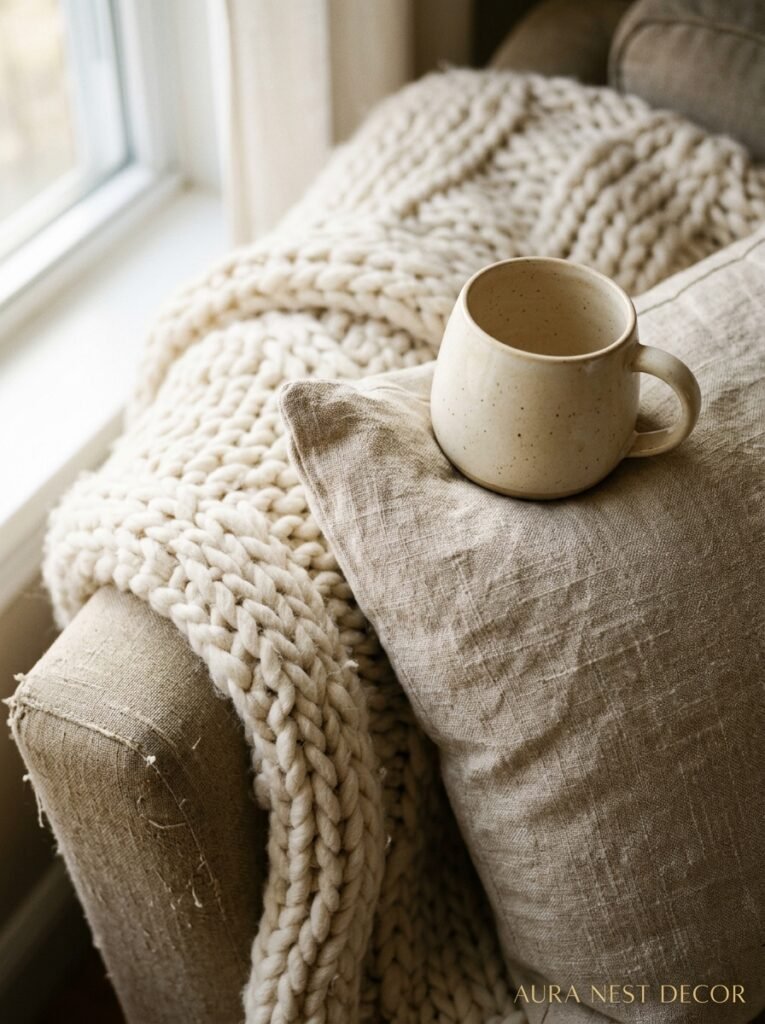
Color gets all the attention. Furniture arrangement gets some attention. Texture gets… not enough attention. And in a warm transitional room especially, texture is what separates something that looks curated from something that looks clinical.
What does texture do? It catches light differently at different times of day. It invites touch. It adds visual complexity without adding visual noise. A linen pillow next to a velvet pillow next to a chunky knit throw isn’t complicated — but it has so much more going on than three matching fabric pillows, and your eye just… enjoys sitting there.
In a warm transitional room, think about texture in these kinds of terms: rough next to smooth, matte next to sheen, woven next to knit. A ceramic vase with a matte, slightly rough finish next to a polished brass candlestick. A jute rug under a velvet side chair. Linen curtains pooling slightly on a dark wood floor.
None of these combos are complicated or expensive. But they create a room that feels, as my friend once put it, “expensive without looking like you tried.”
9. How to Handle the Gallery Wall Without Making It Look Like an Etsy Explosion
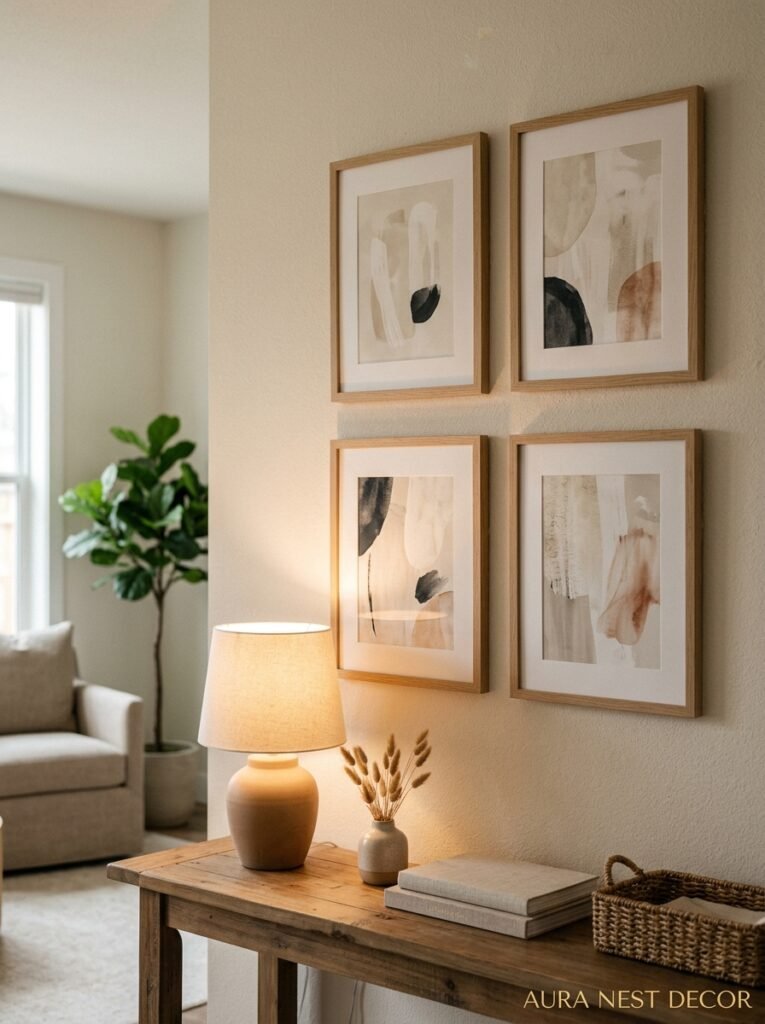
Gallery walls. I have complicated feelings.
Done wrong, they look like someone printed thirty inspirational quotes and panicked. Done right, they’re one of the most effective tools in a transitional room because they give you something personal, something layered, something that’s YOURS.
For warm transitional specifically: keep the frame situation relatively cohesive but not matching. Thin brass frames, simple natural wood frames, and the occasional slightly chunkier black frame (used sparingly) work well together. Avoid that trend of all-white frames with all-white mats — it’s too cold for this aesthetic.
The art itself should mix mediums. An abstract print, a botanical, maybe a black and white photo, a small original painting if you’ve got one. Not all prints, not all photography, not a theme. The lack of a strict theme is actually what makes it feel like a real person’s collection.
And not everything has to be framed. A small shelf within the gallery wall holding one ceramics piece or a small plant breaks the flatness.
10. The Window Treatment Choice That Changes a Room More Than You’d Expect
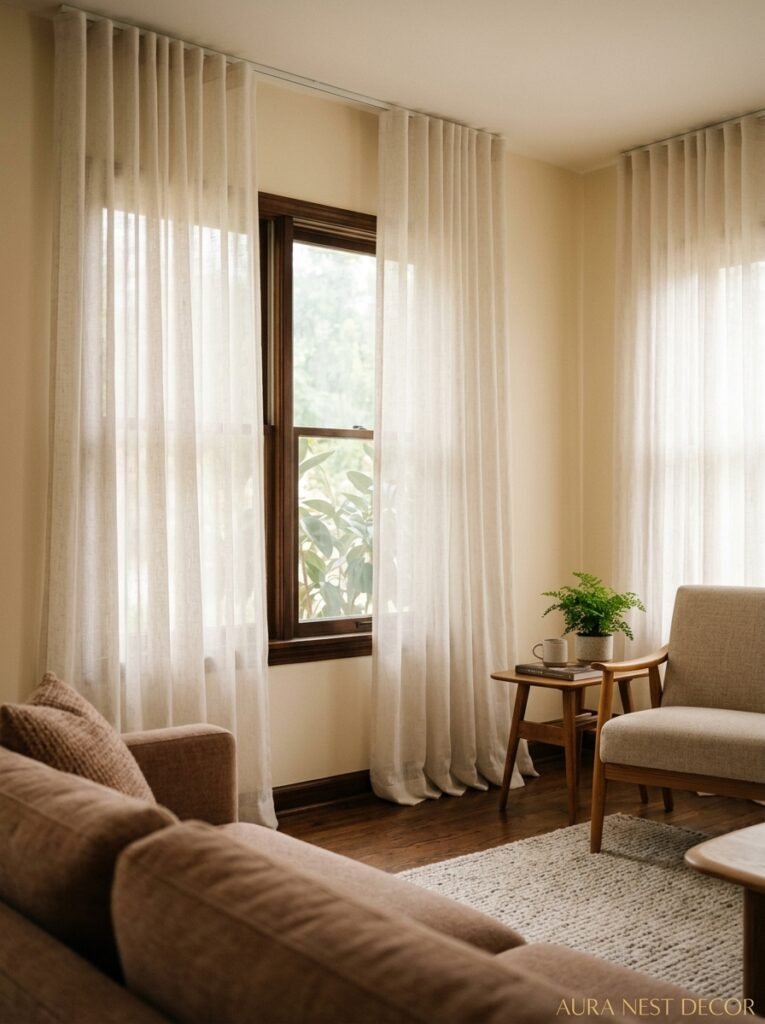
Blinds are fine but they’re not doing anything for you.
In a warm transitional room, curtains are transformative in a literal, physical way — they add height (always hang them high, close to the ceiling, never at the window frame), they add softness, and if you choose the right fabric they glow in a really satisfying way when the afternoon light hits them.
Linen curtains. Unlined or lightly lined. In a warm natural tone, a soft cream, or even a very muted sage. The slightly imperfect drape of natural linen is exactly right for this aesthetic — it has a casual elegance that heavier drapes don’t.
In the UK especially, where light is already at a premium, unlined linen curtains let in that lovely diffused natural light while still giving you the softness and warmth of fabric at the windows. It’s a small thing but it’s genuinely lovely.
11. The “Third Place” in Your Room That Most People Completely Neglect

You’ve got your sofa. You’ve got your coffee table. And then there’s usually a blank corner or an awkward wall that just kind of… sits there.
That third place is the opportunity most people miss. A reading chair that’s not quite part of the main seating arrangement — slightly angled away, with its own small side table and lamp — creates a kind of secondary world in the room. A little corner that says you could come here for a different reason than the sofa.
It doesn’t have to be a massive statement chair. A smaller slipper chair in a slightly different texture or color from the sofa works beautifully. Something in an olive boucle or a dusty blue velvet — a quiet nod to a different color that ties back to something in the rug.
That small act of giving different parts of the room different personalities is genuinely what separates a warm, interesting transitional room from a functional but forgettable one.
12. The Finishing Layer That Pulls It All Together (And That Most People Add Too Soon)
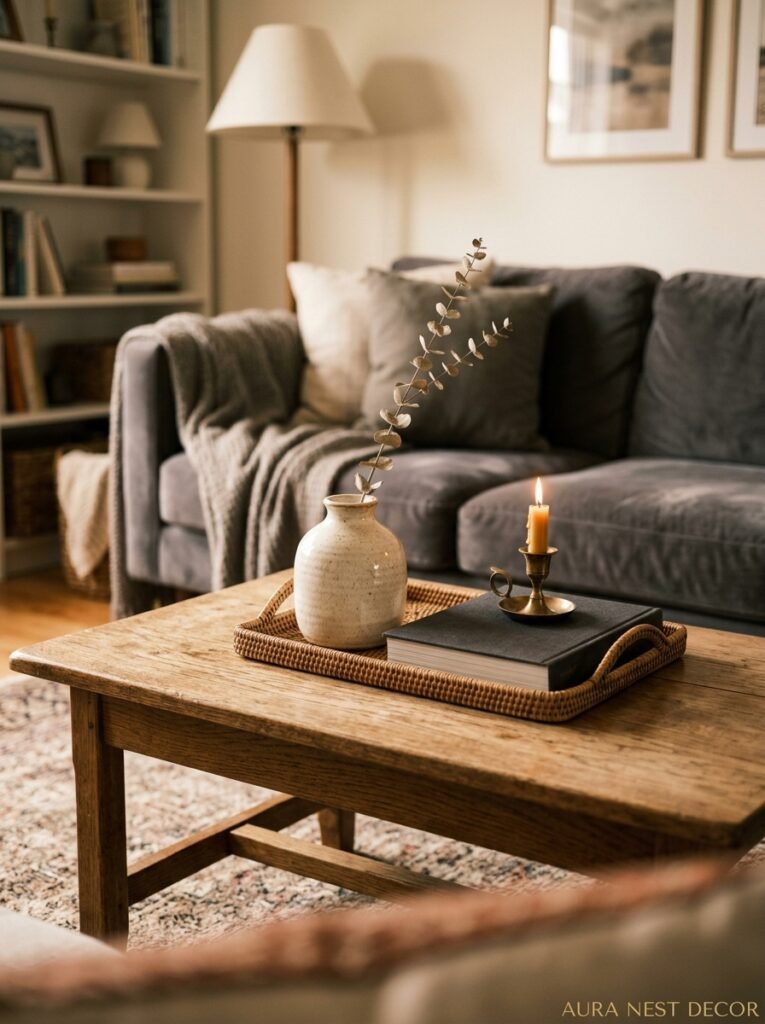
Accessories. Last. I cannot stress this enough.
So many people go to HomeGoods or TK Maxx or Dunelm and buy all the pretty things first and then try to build a room around them. That’s backwards. Accessories are meant to fill in gaps, not drive decisions.
Once everything else is in place — the sofa, the rug, the curtains, the lighting, the wood, the old thing — then you walk around the room and notice what it’s missing. Maybe the coffee table feels bare and needs a stack of books and one low vase. Maybe the bookshelf needs something to break up the books. Maybe there’s a corner that just needs one plant (a big fiddle leaf fig or a trailing pothos, not fifteen little pots — edit yourself here).
The best accessories in a warm transitional room have a kind of organic, slightly imperfect quality. Handmade-looking ceramics, woven baskets, natural materials. Not too shiny, not too precious, not too many.
Less, genuinely. Less is more here. I know that’s a cliché but in this case it’s just true.
—
❓ FAQ
Q: What’s the difference between warm transitional and modern farmhouse? A: Modern farmhouse leans into rustic elements — shiplap, galvanized metal, that very specific Pinterest-era aesthetic. Warm transitional is more refined and timeless. It doesn’t belong to a trend or a region. You’d see it equally at home in a Brooklyn brownstone or a Cotswolds cottage, which is sort of the whole point.
Q: Can I do warm transitional on a budget? A: Honestly, yes — and sometimes a budget actually forces you into better decisions. You can’t buy a whole new room at once, so you layer slowly, and that slow layering is exactly what the style calls for. Invest in the rug and the sofa if you can; thrift everything else and fill in gradually.
Q: My room gets very little natural light. Can warm transitional still work? A: It might actually work better. Warm, low lighting is baked into this aesthetic — you’re not fighting against it. Lean into darker wall colors, more candlelight, warmer bulbs, and heavier textures. A low-light warm transitional room can feel genuinely cosy in a way a bright room can’t quite replicate.
—
💭 Final Thoughts
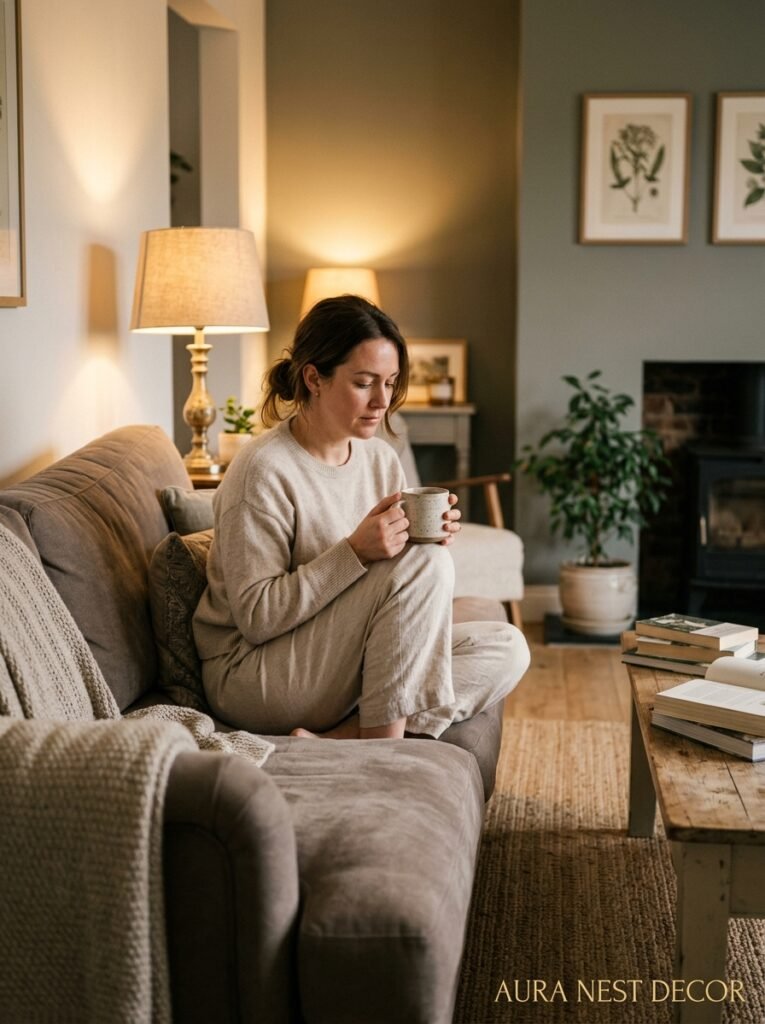
The thing about warm transitional style is that it has this quality of not being done. You’re always adding a blanket, swapping a cushion, picking up a ceramic from a market and finding it a home somewhere. It’s a living aesthetic, which is maybe why it feels so… livable.
That’s the goal, isn’t it? Not a room to impress visitors, but a room you genuinely want to be in at 9pm on a Tuesday with nowhere to be.
So — what’s the one thing your living room is missing right now?